
Key Takeaways
- Modified bitumen (mod-bit) is a multi-ply flat roof system with two layers of reinforced asphalt membrane bonded to the deck and sealed together.
- Three application methods exist: torch-applied, self-adhered, and cold-applied. Each fits a specific building condition, not every job.
- Torch-applied work requires a written fire safety plan, certified applicators, and a post-work fire watch. It is not appropriate on every occupied building.
- Modified bitumen roofing is a solid mid-range system between 4-ply BUR and single-ply TPO or EPDM, with a 20-to-25 year lifespan when properly installed and maintained.
Modified bitumen is common flat roof systems installed on Ontario commercial buildings, and it is also one of the most misunderstood. Property owners get quotes that say “mod-bit” without specifying which of the three application methods the crew will actually use, and the difference between torch-applied, self-adhered, and cold-applied is critial.
Each modified bitumen roofing method affects fire safety, install time, odour during the job, and long-term performance. This post breaks down what a modified bitumen roof is, how the three methods compare, where mod-bit fits against BUR and single-ply systems, and what to ask before you sign a quote.
What is a Modified Bitumen Roof?
Modified bitumen is asphalt roofing with polymer modifiers added to the bitumen to improve flexibility, temperature tolerance, and long-term durability. The membrane comes in rolls, each roll is a factory-made sheet with a reinforcement mat saturated in modified asphalt, and the system is built up in two plies on the roof.
A standard 2-ply mod-bit assembly from the deck up looks like this:
- Roof deck. Steel, concrete, or wood.
- Vapour barrier. Applied to the deck to stop interior moisture from migrating up.
- Insulation. Typically polyiso, sized to the R-value the building requires. Tapered polyiso is specified where the deck does not have built-in slope.
- Cover board. A rigid substrate that stabilizes the surface the membrane bonds to.
- Base sheet. The first ply, mechanically fastened or adhered to the cover board.
- Cap sheet. The second ply, bonded to the base sheet, with a factory-applied granulated surface that handles UV and impact.

The polymer modifiers are what make the material behave differently from old-school asphalt roofing. There are two main formulations:
- SBS (Styrene-Butadiene-Styrene). A rubber-like modifier that stays flexible at low temperatures, which is why SBS mod-bit performs well through Ontario freeze-thaw cycles. This is the formulation we specify on most jobs.
- APP (Atactic Polypropylene). A plastic-like modifier that is more heat-tolerant and UV-resistant, but less flexible in cold weather. Better suited to warmer climates than Ontario’s.
For the materials side, we specify mod-bit primarily from IKO’s commercial line and BP Canada, both of whom produce SBS-modified systems engineered for Canadian freeze-thaw conditions.
The Three Mod-Bit Application Methods
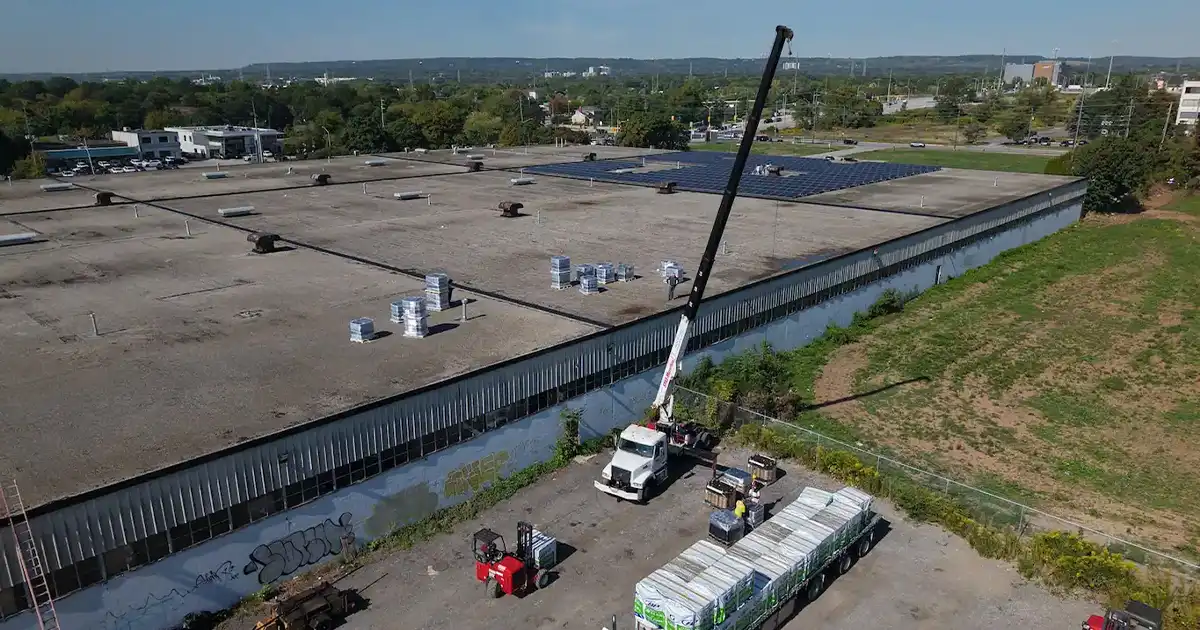
The quote you get from a contractor will specify (or should specify) one of three application methods. Each bonds the membrane to the roof differently, and each has a real-world fit and a real-world drawback.
1. Torch-Applied Mod-Bit
A propane torch is used to heat the back of the rolled membrane. The bitumen on the underside melts, and the applicator rolls the sheet onto the substrate, bonding it as they go. The base sheet and the cap sheet are both typically torch-applied in this method.
Where it fits:
- New construction and unoccupied buildings where fire safety is easier to manage.
- Industrial and warehouse buildings with open deck access and no interior combustibles directly below the work area.
- Roofs where a fully bonded, homogeneous membrane-to-substrate seal is the priority.
The real-world drawback: Fire safety. Torch-applied work is the most common cause of roofing-related structure fires, and insurance carriers have tightened requirements significantly over the last decade. Any torch job on an occupied building in Ontario should include:
- A written hot work permit and fire safety plan.
- Certified applicators trained in torch-safe practices.
- Fire extinguishers staged within arm’s reach of the work zone.
- A post-work fire watch of at least one hour after the last torch is shut down, often two hours depending on insurer requirements.
Legitimate contractors price this into the quote. If your quote is noticeably cheaper than the others and the contractor is vague on the fire watch protocol, that is not a bargain, that is a liability.
2. Self-Adhered Mod-Bit
The membrane ships with a factory-applied adhesive backing protected by a release film. The applicator peels the release film and rolls the membrane onto the substrate, where the adhesive bonds on contact. No torch, no flame, no heat source on the roof.
Where it fits:
- Occupied buildings where torch work is not practical or not permitted by the insurer.
- Food processing facilities, schools, healthcare, and tenant-sensitive environments where fire risk during installation is an operational concern.
- Re-roofs over existing assemblies where heat from a torch could damage substrates below.
- Shoulder-season work when ambient temperatures are too cool for reliable torch adhesion.
The real-world drawback: Self-adhered mod-bit requires clean, dry substrate conditions and is more temperature-sensitive than torch-applied. The adhesive does not bond well below roughly 5°C, and any dust, debris, or moisture on the substrate will compromise the bond. Substrate prep is not optional on these jobs.
3. Cold-Applied Mod-Bit
The membrane is bonded using cold adhesive applied between plies with a squeegee, roller, or spray equipment. No heat source is involved, and the adhesive cures chemically over several hours.
Where it fits:
- Occupied buildings where both torch and odour-sensitive environments rule out other methods.
- Complex roof geometries with many penetrations, curbs, and transitions where a liquid adhesive is easier to work into details than a rolled self-adhered sheet.
- Insurance-restricted sites where the carrier has prohibited open-flame work.
The real-world drawback: Cold-applied systems have the longest cure time of the three methods, which extends the window during which weather can affect the install. Some cold adhesives are also solvent-based and produce strong odours during application, which can be an issue for adjacent occupied tenant spaces with rooftop HVAC intake.
How to Choose Between the Three Methods
The application method is not a preference. It is a decision driven by the building condition, the occupancy below the roof, the season, and the insurer’s fire safety requirements.
Choose torch-applied when:
- The building is unoccupied or the tenant space below can be isolated from the work zone.
- The insurer permits hot work with a standard fire safety plan.
- The weather window is warm enough for reliable adhesion and long enough to complete the job without partial installs.
- The roof assembly needs the fully bonded, heat-fused seal that torch work provides.
Choose self-adhered when:
- The building is occupied and tenant operations cannot tolerate torch work.
- The insurer restricts open-flame work on the roof.
- Substrate conditions can be kept clean and dry through the install.
- Ambient temperatures are warm enough for the adhesive to bond.
Choose cold-applied when:
- The roof has complex geometry, many penetrations, or transition details that are difficult to seal with rolled membrane.
- Neither torch nor self-adhered is a fit due to site conditions.
- The project timeline accommodates the longer cure window.
- Adjacent tenant spaces can tolerate the odour profile of the chosen adhesive during the application window.
On most of the occupied commercial and industrial work we do across Toronto and the GTA, the realistic choice is between self-adhered and cold-applied. Torch-applied is reserved for jobs where the fire safety protocol can actually be executed properly.
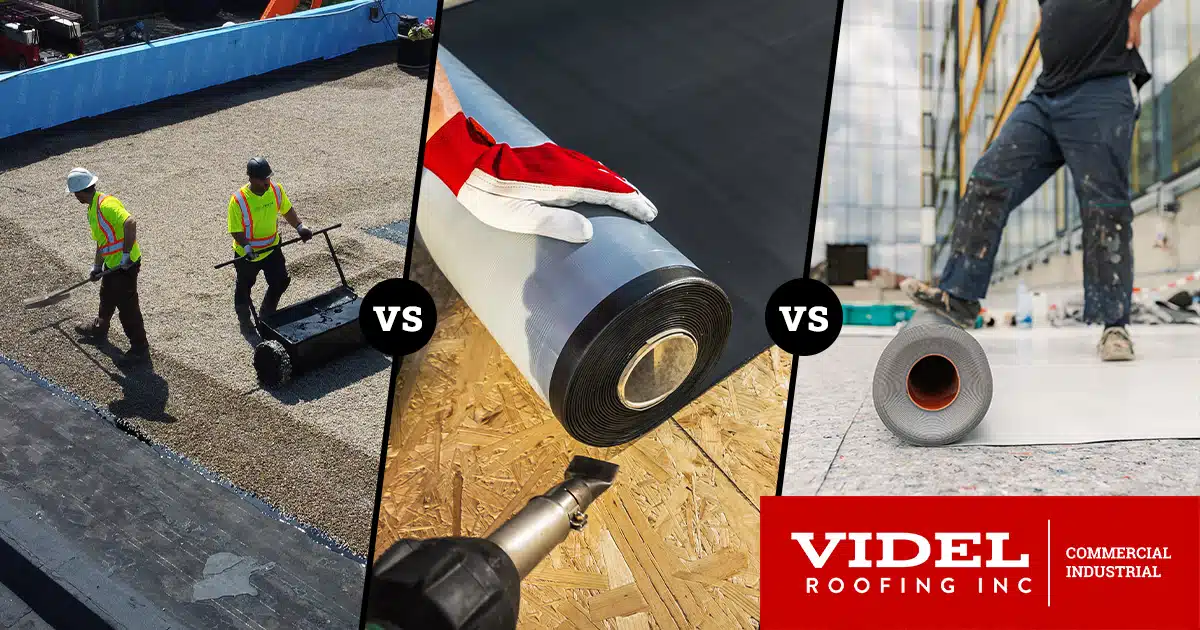
Where Mod-Bit Sits Against BUR and Single-Ply
Mod-bit is a legitimate mid-range specification. It is a step up from single-ply in redundancy and durability, and a step below 4-ply BUR in long-term service life and impact resistance. Here is how it compares.
Mod-bit vs. 4-Ply BUR:
- BUR has four layers of waterproofing to mod-bit’s two. More redundancy, longer lifespan (25-to-30 years vs. 20-to-25), better foot-traffic resistance.
- BUR costs 20 to 30 percent more than mod-bit installed.
- Mod-bit installs faster and lighter. Structural load limitations on older buildings sometimes rule out BUR and make mod-bit the practical choice.
- For the full case on why we specify BUR on heavy-traffic buildings, see our guide to 4-ply built-up roofing systems.
Mod-bit vs. TPO:
- Mod-bit has two plies of waterproofing. TPO has one.
- TPO seams are welded; mod-bit plies are bonded across their full surface. Under Ontario freeze-thaw, the continuous bond holds up better than a welded seam.
- TPO installs faster and usually cheaper. Mod-bit provides more margin against membrane damage and localized failures.
Mod-bit vs. EPDM:
- Same two-vs-one-ply redundancy story as TPO.
- EPDM’s adhered seam is historically the most common EPDM failure point in freeze-thaw. Mod-bit does not have that specific failure mode.
- EPDM is cheaper installed. The lifecycle math varies depending on how aggressively the EPDM is maintained and how many seam failures accumulate over a 20-year hold.
For a wider comparison of all four systems with photo documentation from our field work, our breakdown of the best flat roof types for Ontario covers the failure mechanisms in more detail.
Mod-Bit as a Cap Sheet Over BUR
One place mod-bit earns its spec on almost every job is as the cap sheet over a 4-ply built-up roofing assembly. The BUR provides the redundant waterproofing through three plies of felt bonded with hot asphalt, and a granulated mod-bit cap sheet goes on top as the finished surface.
Why this combination works:
- The BUR gives you four layers of waterproofing below the cap, so the roof is not relying on any single sheet.
- The mod-bit cap provides a factory-finished, UV-resistant, granulated top surface that holds up better to weathering than a traditional flood-coat-and-gravel finish.
- The cap sheet is repairable and replaceable without touching the plies below, which simplifies long-term maintenance.
- On commercial plazas and industrial buildings with rooftop traffic, the cap sheet absorbs impact and foot traffic better than a flood coat, protecting the redundant assembly underneath.
This is a frequent specification on the commercial and industrial buildings we replace. The Vaughan 23,000 sq ft plaza we rebuilt last year used this exact assembly: 4-ply BUR with a granulated cap over new polyiso insulation, with extended perimeter details to solve a long-running brickwork-saturation problem.
What Mod-Bit Costs in Ontario
The following ranges are general Ontario commercial market pricing for a 2-ply SBS modified bitumen full replacement: tear-off to deck, new insulation, base sheet, cap sheet, standard flashings, and perimeter details. They do not include tapered insulation packages, drain replacements, structural repairs, or parapet rebuilds, which are quoted separately.
| Scope | Installed cost (per sq ft) | Expected lifespan | 20,000 sq ft example (cost per year of service life) |
|---|---|---|---|
| 2-Ply Mod-Bit, torch-applied | $7.00 – $9.50 | 20 to 25 years | $5,600 – $9,500 |
| 2-Ply Mod-Bit, self-adhered | $7.50 – $10.00 | 20 to 25 years | $6,000 – $10,000 |
| 2-Ply Mod-Bit, cold-applied | $8.00 – $10.50 | 20 to 25 years | $6,400 – $10,500 |
Self-adhered and cold-applied carry a price premium over torch-applied because the materials cost more and the install windows are more weather-sensitive. On occupied buildings where torch work is not an option, that premium is the cost of installing the roof without putting the tenants at risk.
For a full lifecycle comparison across BUR, mod-bit, TPO, and EPDM with ownership-hold math built in, our Flat Roof ROI Calculator models the real cost of each system over a 20-to-30 year hold.
MAXIMIZE ROOF LIFE WITH A
Preventative Roof Maintenance Plan
Avoid surprise repairs and extend the time between costly replacements with expert maintenance tailored to your roof.
Reduce costly repairs
Prevent leaks & damage
Extend roof life
Questions to Ask Before Accepting a Mod-Bit Quote
A quote that just says “2-ply modified bitumen” is not a specification. Before you sign, get answers to these in writing:
- Which application method (torch, self-adhered, or cold-applied) is specified, and why is it the right fit for this building?
- Who is the membrane manufacturer, and is it an SBS or APP formulation?
- If torch-applied, what is the fire safety plan, who holds the hot work certification, and what is the post-work fire watch duration?
- What is the base sheet attachment method: mechanically fastened or adhered?
- What insulation is specified, and what R-value does it deliver?
- What is the manufacturer warranty, what is the workmanship warranty, and what voids each?
Contractors who install mod-bit correctly answer these questions without hesitation. Contractors who lead with the cheapest quote and deflect on the details are the ones who leave you with a roof that is failing at year 12 instead of year 22.
What does SBS mod-bit mean?
SBS stands for Styrene-Butadiene-Styrene, the rubber-like polymer modifier added to the asphalt. SBS mod-bit stays flexible at low temperatures, which is why it is the formulation we specify for Ontario freeze-thaw conditions. APP mod-bit uses a plastic-like modifier that performs better in hot climates but less well in Canadian winters.
Is torch-applied mod-bit safe on occupied buildings?
Torch work on occupied buildings is possible but requires strict fire safety protocol: a written hot work permit, certified applicators, extinguishers at the work zone, and a post-work fire watch of one to two hours minimum. Many insurers restrict or prohibit torch work on occupied commercial buildings, in which case self-adhered or cold-applied mod-bit is the appropriate alternative.
How long does a 2-ply modified bitumen roof last?
A properly installed 2-ply SBS mod-bit with regular maintenance will typically last 20 to 25 years on an Ontario commercial building. Without maintenance, expect 14 to 18 years. Replacement of flashings and perimeter details on schedule is what carries the system past the 20-year mark.
Can mod-bit be installed over an existing roof, or does the old roof have to come off?
Installing over an existing roof is sometimes possible when the existing membrane is dry, the insulation is not saturated, and the deck is structurally sound. In most cases, the right specification is a full tear-off to the deck so the insulation condition can be verified and the deck inspected. A condition assessment before quoting tells you which path the roof actually supports.
Get a Roofing Quote for Your Building
Picking the right mod-bit method, or deciding whether mod-bit is even the right system for your building, starts with someone walking your roof. Learn more about our flat roof replacement service, then call (905) 397-1198 or contact us online for a free quote.