
Key Takeaways
- Minor flat roof repairs in Toronto typically run between $500 to $2,500 for commercial properties, depending on scope and access.
- Per-square-foot pricing for commercial flat roof repair in Ontario generally runs $3 to $12, depending on repair type and system.
- At a certain threshold, repair costs require a proper replacement conversation.
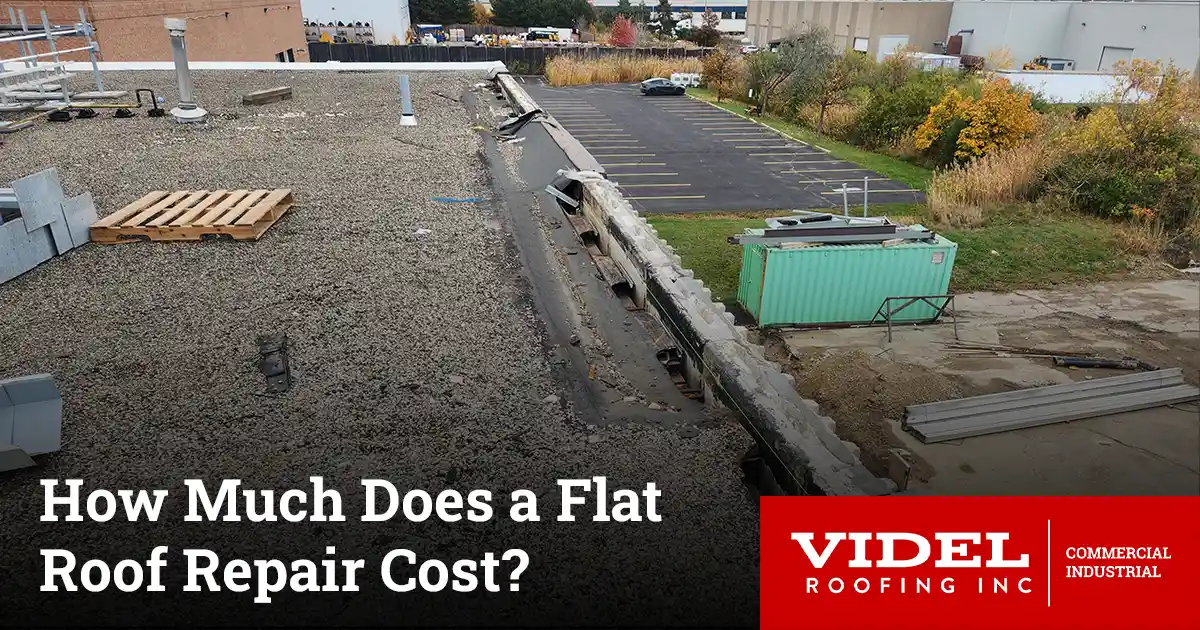
Flat roof repair costs in Toronto vary widely depending on what actually needs to be fixed. A single failed pitch pocket might be a $600 repair on a morning visit. A 5,000 sq ft section of saturated membrane with drainage issues is a different conversation entirely.
This post breaks down what commercial and industrial property owners in Toronto and the GTA should expect to pay for flat roof repairs, the factors that move the number up or down, and the threshold where a repair stops making financial sense and a replacement becomes the smarter call.
All pricing in this post is Ontario-specific, based on our field work on commercial and industrial properties.
What affects the cost of a flat roof repair in Toronto?
Two commercial buildings with the same size and same roof system can produce wildly different repair quotes. The variables that move pricing include:
- Roof system type: BUR, modified bitumen, EPDM, TPO, and PVC each require different repair techniques, materials, and crew skills.
- Repair scope: A localized patch is not the same job as a 2,000 sq ft tear-and-replace section.
- Access: Ground-level access with a clear staging area is cheapest. Restricted access, tight alleys, and downtown sites add time and cost.
- Roof height and safety requirements: Higher roofs require more fall protection setup, which adds labour hours before any repair work starts.
- Existing roof condition. Repairs on a roof that’s otherwise sound are straightforward. Repairs on an aging roof with multiple failing areas often compound scope.
- Emergency vs. scheduled. An urgent leak at 4 PM on a Friday costs more than the same repair scheduled for Tuesday morning.
- Materials. Compatibility with the existing system is non-negotiable. Using the wrong materials creates a bigger problem than the one being fixed.
Commercial flat roof repair cost by scope
The cleanest way to think about repair pricing is by scope tier. Minor, moderate, and major repairs each have different cost ranges, typical turnaround times, and decision points on whether to repair or replace.
Minor repairs: $500 to $2,500
Minor repairs for Toronto flat roofs cover isolated defects that can be diagnosed, scoped, and completed in a single visit. These are the repairs that matter most because they’re the ones that prevent small problems from turning into big ones.
Typical minor repair scenarios:
- Single pitch pocket reseal around a conduit or pipe penetration
- Small membrane puncture patch from a dropped tool or foot traffic damage
- Flashing re-adhesion at a parapet or curb where expansion has pulled it loose
- Drain strainer replacement or minor drain clearing
- Caulking and sealant refresh at specific failure points
Turnaround: same day to 48 hours. Cost drivers: crew mobilization, access setup, and materials. For property owners on a Preventative Roof Maintenance Plan, many of these repairs are handled as part of scheduled inspections rather than as separate billable events.
Moderate repairs: $2,500 to $15,000
Moderate repairs address multi-point defects or larger-scope single defects that require a half-day to multi-day crew engagement.
Typical moderate repair scenarios:
- Drain replacement including cutting the existing drain, installing a new assembly, and tying the flashing back in
- Flashing replacement along a parapet run or around multiple penetrations
- Localized membrane replacement on a section 100 to 500 sq ft in size
- HVAC curb repair where the curb flashing has failed and requires full rebuild
- Seam repair across an EPDM or TPO field where multiple seams have opened
- Skylight repair and reflashing when the unit itself is sound but the surrounding membrane has failed
Turnaround: 1 to 3 days on site. Cost drivers: material volume, scope duration, and any structural or deck work uncovered during the repair.
Major repairs: $15,000 to $75,000+
Major repairs approach the decision threshold where full replacement becomes the more cost-effective option. These are large-scope, multi-crew jobs, often on specific roof sections rather than the whole roof.
Typical major repair scenarios:
- Sectional replacement of 1,000 to 5,000 sq ft where the membrane has failed in a defined area
- Wet insulation removal and replacement in zones where moisture has compromised the assembly
- Full parapet rebuild on aging masonry structures where flashing failure has caused long-term damage
- Tapered insulation retrofit to address chronic ponding on a section of the roof
- Elevator shaft or rooftop enclosure repair where the flashing and waterproofing integration has failed
Turnaround: 3 to 10 days on site, sometimes longer. Cost drivers: tear-off volume, insulation replacement, deck repair if required, and disposal.
Per-square-foot repair pricing
For repairs quoted on a per-square-foot basis, Ontario commercial pricing generally falls in these ranges:
| Repair type | Per sq ft (installed) |
|---|---|
| Membrane patching (minor, localized) | $3 to $6 |
| Sectional membrane replacement | $6 to $10 |
| Membrane + insulation replacement (wet sections) | $8 to $12 |
| Full parapet or perimeter flashing rebuild | $10 to $15 (linear foot basis varies) |
These ranges assume the repair is performed on an otherwise sound roof, with standard access and no structural deck issues. Site-specific factors (height, access, existing damage scope) can push pricing outside these ranges in either direction.
Repair cost examples: real building sizes
Pricing ranges are useful, but dollar figures on real buildings are more useful. Two scenarios, both realistic for the Toronto and GTA commercial market:
Example 1: 20,000 sq ft multi-tenant plaza in Toronto
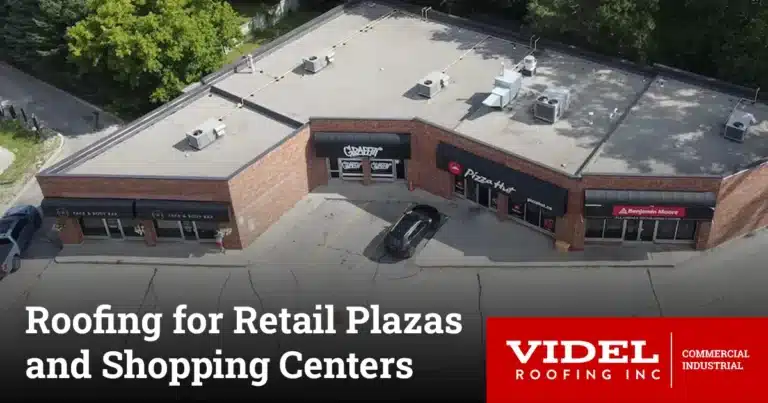
A multi-tenant retail plaza with a mix of tenants (restaurants, retail, service businesses) and a roof that’s about 18 years old. Construction is 4-ply BUR with gravel ballast. The property manager has called about multiple active leaks.
On inspection, the issues are:
- Three failing pitch pockets around HVAC penetrations
- One 150 sq ft section of membrane with blistering and active water intrusion
- Flashing failure along a 40-foot parapet run on the east exposure
- One clogged drain with standing water
Repair scope and approximate cost:
- Pitch pocket resealing (3 pockets): $1,200
- Sectional membrane replacement (150 sq ft): $1,500
- Parapet flashing rebuild (40 linear ft): $3,500
- Drain clearing and strainer replacement: $400
- Total: approximately $6,600
This is a moderate repair scope on a mid-size commercial building, completed over 2 to 3 days on site, addressing all active leaks without triggering a replacement conversation.
Example 2: 80,000 sq ft industrial warehouse in Mississauga
A distribution warehouse with an 18-year-old modified bitumen roof. The building’s owner has noticed multiple leaks over the last 12 months and wants a full assessment.
On inspection, the issues are:
- A 2,000 sq ft zone on the south exposure with saturated insulation, requiring tear-off to the deck
- Five failed pitch pockets across mechanical penetrations
- Two drains requiring full replacement with updated flashing detail
- Chronic ponding in a 1,500 sq ft low spot, requiring tapered insulation retrofit
- General flashing failures at three HVAC curbs
Repair scope and approximate cost:
- Wet insulation tear-off and replacement (2,000 sq ft): $18,000
- Pitch pocket resealing (5 pockets): $2,000
- Drain replacement (2 full assemblies): $6,500
- Tapered insulation retrofit (1,500 sq ft): $9,500
- HVAC curb flashing rebuild (3 curbs): $7,500
- Total: approximately $43,500
This is a major repair scope on an industrial building, completed over 8 to 12 days on site. At this level of spend, the ROI conversation starts shifting: the building’s owner needs to decide whether another round of major repairs is coming in 2 to 3 years, and whether a phased replacement strategy might make more sense than continuing to spend on repairs.
When repair approaches replacement cost
Every roof eventually reaches a point where the cost of the next repair, plus the repairs that will come in the next 2 to 5 years, approaches or exceeds the cost of a full replacement. The decision point isn’t a single number. It’s a pattern:
- Repair invoices have been climbing year over year
- The same areas keep failing despite previous patches
- Insulation has become wet in multiple zones
- The warranty on the original roof is long expired
- The building’s ownership timeline supports a 25+ year replacement investment
At that point, the question becomes whether another $40,000 in repairs makes sense, or whether that capital is better directed at a full replacement that resets the roof’s service life for the next 25 to 30 years. Our Flat Roof ROI Calculator models the tradeoff directly: it compares the cost of maintaining an existing roof against the cost of a premature replacement, and shows the capital you preserve by extending rather than replacing.
For Toronto-area commercial flat roof replacements, current pricing runs roughly $12 to $18 per square foot installed, depending on the system. On a 20,000 sq ft roof, that’s $240,000 to $360,000. At 80,000 sq ft, replacement cost lands between $960,000 and $1.44 million. Against those numbers, a $40,000 repair that buys another 5 years is almost always the right call, provided the roof is genuinely repairable.
Factors that make a repair more expensive in Toronto
Toronto-area commercial roofs have a few cost drivers that don’t apply uniformly across the GTA:
- Downtown and mid-rise access. Restricted ground-level access, limited staging areas, and complex crane or boom requirements add setup time. Repairs in Toronto’s core can run 15 to 25 percent higher than the same repair in Mississauga or Brampton.
- Building height. High-rise commercial roofs require more fall protection setup and often helicopter or crane material delivery, which changes the economics of any repair.
- Traffic and parking. Loading zone access for crew vehicles and materials is harder to coordinate in Toronto than in surrounding municipalities.
- Tenant coordination. Multi-tenant buildings with active businesses during business hours often require after-hours or weekend work, which carries a premium.
Our Toronto commercial roofing service area covers the full range of building types across the city and surrounding GTA municipalities, and our pricing accounts for the site-specific realities of each location.
When to call for a repair quote
Certain repairs can wait for the next scheduled maintenance visit. Others can’t. A few signals that a repair conversation needs to happen now rather than next quarter:
- Active interior leaks showing up during or after rainfall
- Visible ponding on the roof surface that doesn’t drain within 48 hours
- Rising repair invoices from a contractor who is patching the same issues repeatedly
- Tenant complaints about ceiling stains, mold, or building envelope comfort issues
- Recent weather events (hail, wind, ice) that may have caused damage
For any of these, an inspection with a written condition report is the next step. Our flat roof repair service starts with an on-site assessment, documented with photographs, so you know what the scope actually is before a quote lands on your desk.
Book a repair assessment
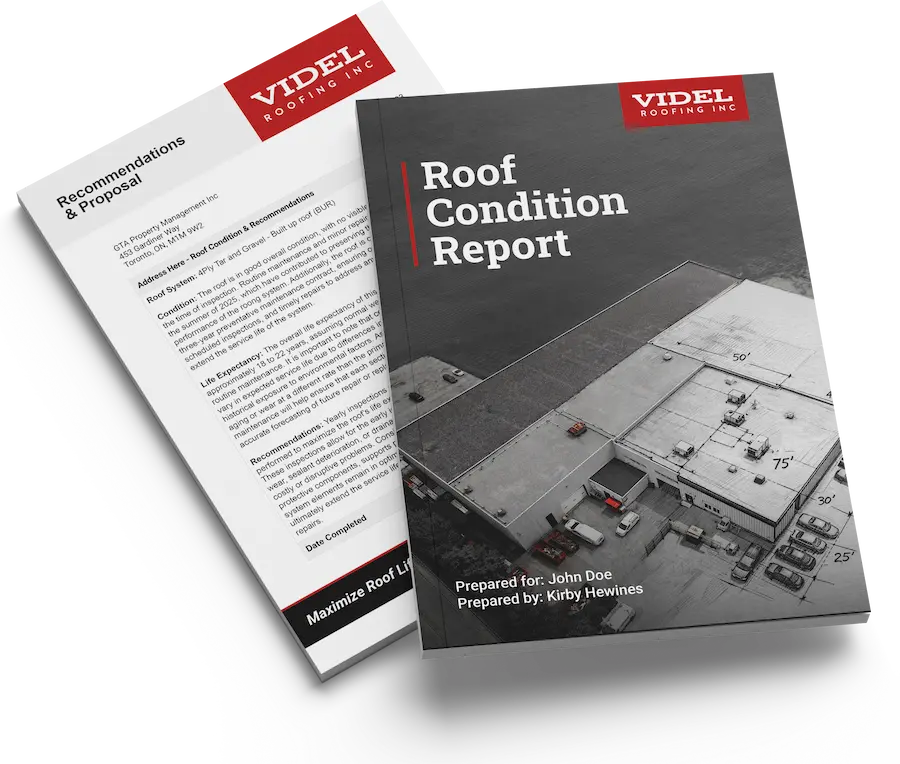
If you’re dealing with active leaks or rising repair costs on a commercial or industrial flat roof in Toronto, the next useful step is a proper inspection. Our free Roof Condition Report is a 50+ point assessment with written documentation, photographs, and prioritized recommendations. It’s the baseline we use for every repair scope.
Learn more about our flat roof repair service, or call (905) 397-1198 or contact us online for a free quote.
How often should a commercial flat roof be inspected in Ontario?
Twice a year at minimum: once in spring to assess winter damage, and once in fall to prepare for the coming winter load. Post-storm walks should be added after significant weather events. This cadence reflects the freeze-thaw stresses specific to Ontario’s climate.
What does a commercial roof maintenance program cost?
Cost varies based on roof size, condition, and the scope of the plan. For most mid-size commercial and industrial properties in Ontario, annual maintenance is measured in cents per square foot rather than dollars, and is structured to be a fraction of what a single unplanned repair or accelerated replacement would cost.
Will documented maintenance help with an insurance claim?
Documented inspection and repair records help establish the condition of the roof before a loss event, which supports the distinction between covered sudden damage and excluded wear or neglect. Coverage specifics and documentation requirements vary by carrier and policy, so property managers should confirm expectations directly with their insurer. The Insurance Bureau of Canada publishes general guidance on commercial property coverage.
What is the difference between a roof inspection and a maintenance plan?
An inspection is a one-time documented assessment of current condition. A maintenance plan is an ongoing engagement that includes scheduled inspections, minor repairs performed on-site, and priority response to issues as they develop. The Preventative Roof Maintenance Plan page outlines what each tier includes.
Can I get a one-time roof assessment without a maintenance contract?
Yes. Videl’s free Roof Condition Report is a standalone deliverable requiring no contract. It documents current condition, identifies immediate concerns, and provides a three-to-five-year outlook suitable for budgeting, insurance documentation, or a second opinion.