
Key Takeaways
- 4-ply BUR is built from a base sheet, three plies of asphalt-saturated felt, and a cap sheet, bonded with hot bitumen into a single redundant assembly.
- Redundancy is why built up roofing systems survives Ontario freeze-thaw. One layer can fail without the roof leaking, which is not true of single-ply systems.
- BUR costs more up front and takes 5 to 7 days to install. On a 20-year hold, it costs less per year than any single-ply alternative we replace.
It’s common for flat roof contractors in Ontario to quote a single-ply membrane before anything else. Single-ply is faster to install, cheaper to bid, and easier to train a crew on. We keep specifying 4-ply built-up roofing on commercial and industrial buildings anyway, because after 28+ years of tearing off failed roofs across Southern Ontario, the redundancy BUR provides is what makes the difference between a 30-year roof and a 12-year roof.
In this article, we explain what 4-ply BUR actually is, why it performs the way it does under Ontario freeze-thaw, which buildings are the right fit, and where we’d steer you elsewhere.
What is a Built-Up Roofing System?
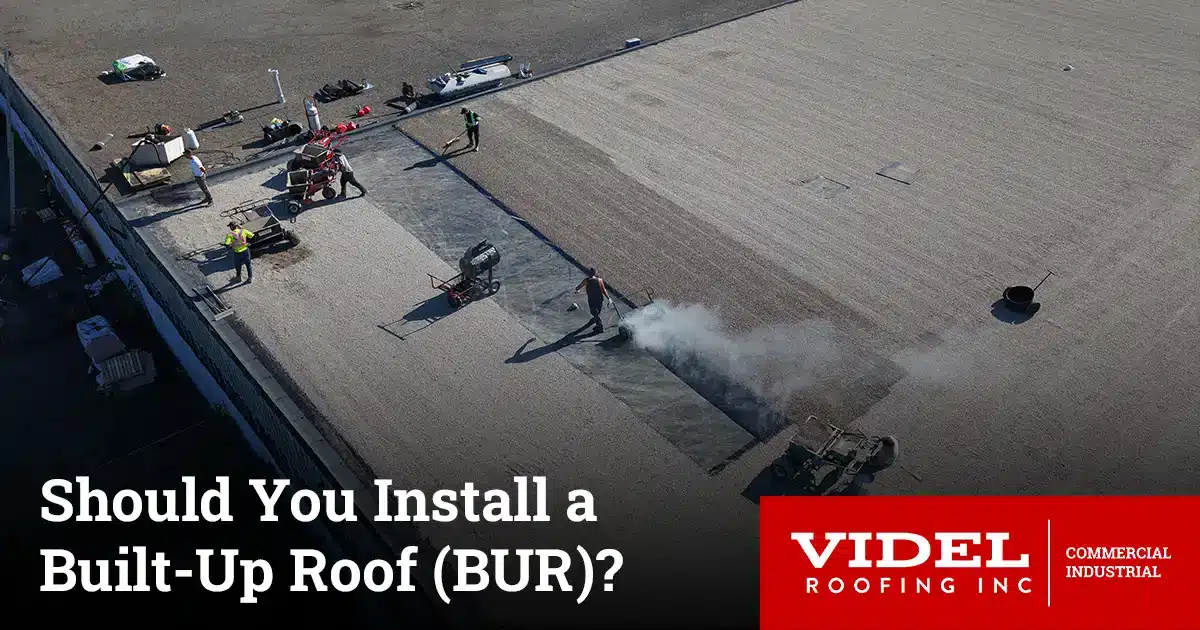
A Built-Up Roofing (BUR) system is exactly what the name describes: multiple layers of waterproofing, fused together with hot asphalt, built up on top of the roof deck and insulation. Every layer is part of the waterproofing system. The roof does not rely on a single sheet to keep water out.
Here is what a standard 4-ply BUR assembly looks like from the deck up on the jobs we install:
- Roof deck. Steel, concrete, or wood. The structural substrate.
- Vapour barrier. Applied directly to the deck to stop interior moisture from migrating up into the insulation.
- Insulation. Typically polyiso (polyisocyanurate), sized to hit the R-value the building requires. On the Vaughan project referenced below, we used 1.5″ polyiso. On newer builds and re-roofs targeting current code, we specify thicker boards or tapered polyiso to build slope into the assembly.
- Cover board. A rigid substrate that protects the insulation from foot traffic and gives the membrane a stable surface to bond to.
- Base sheet. The first waterproofing layer, mechanically fastened or adhered to the cover board.
- Three plies of asphalt-saturated felt. Each ply is mopped into hot bitumen, embedded into the layer below, and overlapped so no seam in one ply sits over a seam in another. This is where the redundancy lives.
- Cap sheet or flood coat with gravel ballast. This is the top surface, a granulated cap sheet or a flood coat of asphalt with embedded gravel protects the plies below from UV, hail, and impact.
The result is a bonded, homogeneous assembly with redundant waterproofing layers. No single seam, no single sheet, and no single fastener is responsible for keeping water out. That is the entire design philosophy.

For the technical spec side of the materials, IKO’s commercial division is our primary supplier of base sheets, cap sheets, and BUR felts across Ontario. Their product data sheets are a good reference for the specific membranes and felts we use.
Why Redundancy Matters Under Ontario Freeze-Thaw
A single-ply membrane, whether TPO or EPDM, relies on one sheet of material and the integrity of its seams. When that sheet splits, shrinks, or pulls at a seam, the roof leaks. There is no second layer and Ontario’s climate makes that a problem.
A typical winter will cycle a flat roof through freezing and thawing dozens of times between November and April. Water that gets under a seam freezes, expands, and pushes the seam open a little further. Spring melts it, summer bakes it, fall rewets it, and winter cracks it open again the following year. Every season puts stress on every seam, every fastener, every penetration, and every flashing detail on the roof.
BUR handles that cycle differently:
- A single layer can fail without the roof leaking. If the cap sheet blisters or the top ply develops a crack, the plies below are still bonded and waterproof. The roof stays dry while we diagnose and repair the defect.
- There are no large continuous seams to fail. Each ply is lapped in short overlaps, staggered across the assembly. A failure in one lap does not telegraph through the system.
- The mass of the assembly absorbs thermal movement. A BUR is heavier and thicker than a single-ply. Expansion and contraction happen across the assembly rather than concentrated at a handful of welded seams.
- Mechanical damage from foot traffic, hail, or dropped tools rarely penetrates all four plies. Repairs are localized and straightforward. A single-ply hit in the same way often needs a full patch and hot-weld, and the failure point becomes a long-term weakness.
That redundancy is why we still specify BUR on buildings where a leak is expensive. When the tenant is a food processor, a manufacturer with sensitive equipment, or a retail space with inventory below the roof deck, the insurance of having four layers of waterproofing instead of one is worth the higher install cost.
The freeze-thaw problem is not theoretical. Our field data from commercial roofs across Toronto and the GTA shows single-ply systems failing at split seams and pulled fasteners far more often than BUR systems of comparable age, and the Ontario Roofing Report documents the dollar impact of those failures across the 15 properties we studied.
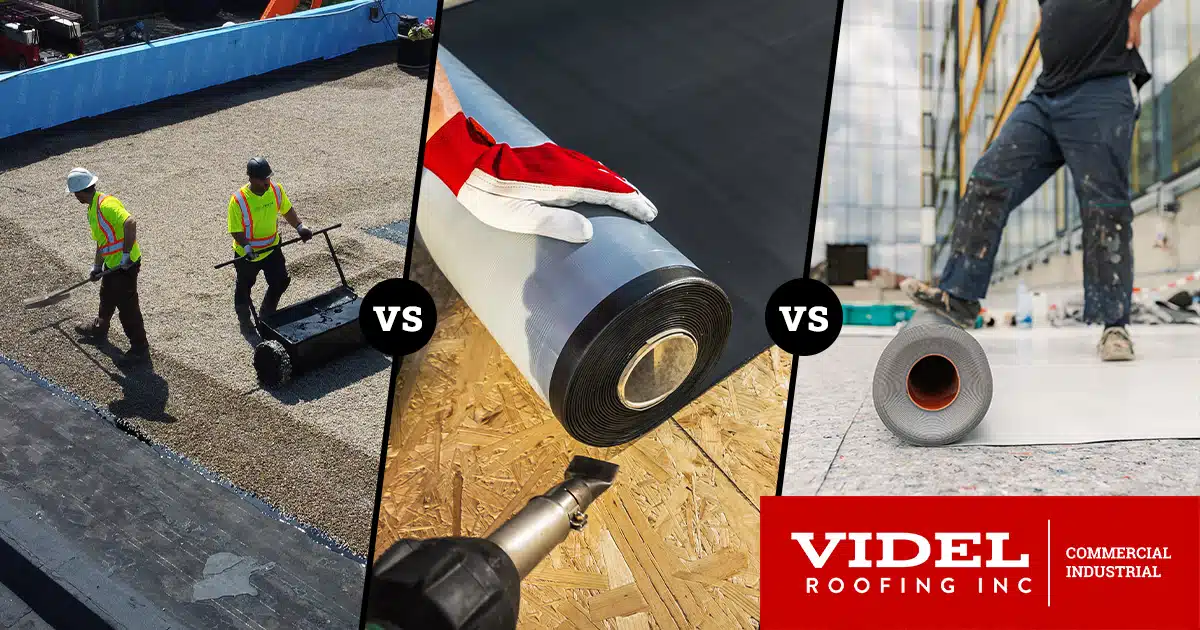
How BUR Compares to TPO, EPDM, and 2-Ply Modified Bitumen
BUR is not the only flat roof system we install. We specify 2-ply modified bitumen on plenty of jobs, and there are buildings where the budget or the structural load rules out a BUR. Here is how we think about the tradeoffs.
4-Ply BUR
- Lifespan: 25 to 30+ years with proper maintenance.
- Strengths: Redundant waterproofing, excellent impact and traffic resistance, proven performance in Canadian freeze-thaw, long service life under maintenance.
- Weaknesses: Highest up-front cost, longest install time, heavy (structural load must be verified), requires skilled crews.
- Best fit: Commercial plazas, industrial buildings, food processing facilities, warehouses, institutional properties, any roof that will see foot traffic or rooftop equipment.
2-Ply Modified Bitumen (SBS)
- Lifespan: 20 to 25 years with proper maintenance.
- Strengths: Two layers of waterproofing, torch-applied or cold-applied, flexible at low temperatures thanks to SBS polymer modifiers, strong freeze-thaw performance.
- Weaknesses: Fewer plies than BUR (less redundancy), torch application requires careful fire safety protocol, surface can be vulnerable to foot traffic without protection.
- Best fit: Mid-size commercial buildings, retail plazas, and re-roofs where a 2-ply provides the redundancy the budget allows. A strong choice in its own right when specified correctly.
TPO (Thermoplastic Polyolefin)
- Lifespan: 15 to 20 years in ideal conditions. Often shorter in Ontario.
- Strengths: Reflective white surface, lower up-front cost, fast install.
- Weaknesses: Single-ply (no redundancy), heat-welded seams can fail under freeze-thaw stress, vulnerable to punctures and foot traffic, surface cracking and shrinkage well-documented on older installs.
- Ontario risk: A welded seam that opens on a cold January night is the entire waterproofing system failing. We have torn off TPO roofs under 15 years old where the membrane had shrunk hard enough to pull at every perimeter detail.
EPDM (Ethylene Propylene Diene Monomer)
- Lifespan: 15 to 25 years depending on seam quality and maintenance.
- Strengths: Flexible rubber membrane, relatively cheap, long track record.
- Weaknesses: Single-ply, seams are adhered rather than welded (historically a weakness, though modern tapes have improved), black surface absorbs heat in summer and shrinks in winter, puncture-prone.
- Ontario risk: Adhesive seam failure under freeze-thaw is still the most common EPDM defect we document on roof condition reports.
If you want the longer version of this comparison with photo documentation from our field work, our BUR vs. EPDM vs. TPO breakdown for Ontario properties goes deeper into the failure mechanisms.
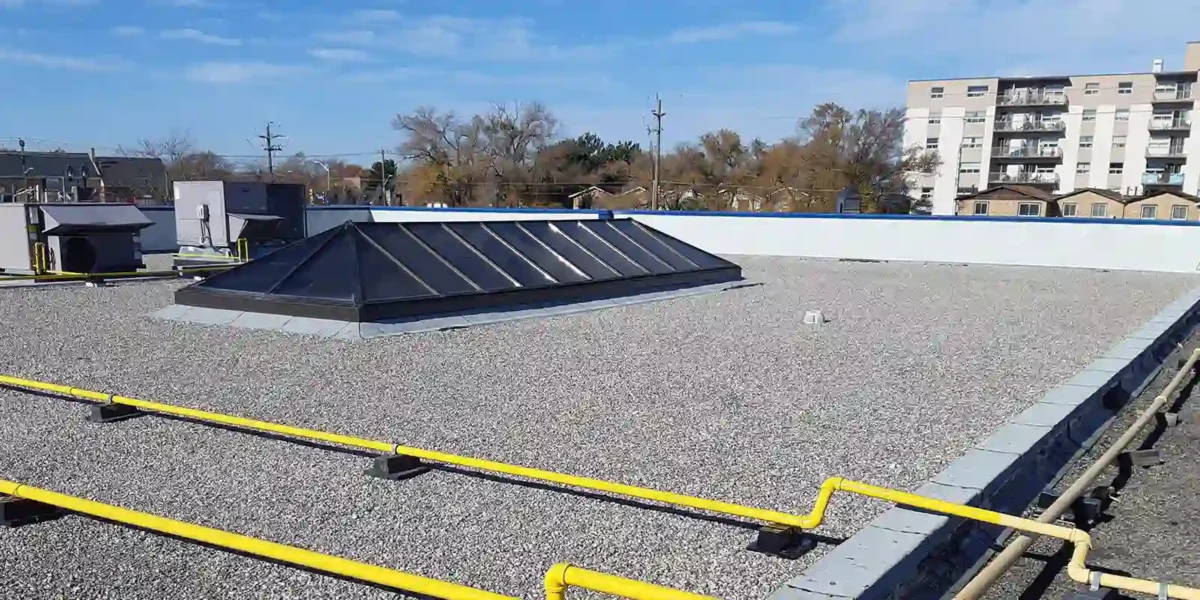
Which Building Types Should Specify BUR
BUR may not be the right answer for every roof. It is the right answer on most of the roofs we work on, because most of our work is commercial plazas, industrial buildings, and institutional properties where the tenant, the inventory, or the equipment below the roof makes a leak expensive.
Here is where BUR roofing systems are a smart investment:
- Commercial plazas and strip mall roofs. Multi-tenant retail is one of the worst places to have a roof fail. Every tenant has inventory, every leak is a claim, and every landlord is juggling HVAC curbs, exhaust fans, grease traps, and restaurant vents across the roof deck. BUR handles the rooftop traffic, the penetrations, and the long service life a plaza needs.
- Industrial and manufacturing buildings. Industrial roofs see the heaviest rooftop loads in the province: exhaust stacks, process vents, make-up air units, crane rails, and regular tradesperson traffic. BUR’s impact resistance and the ability to absorb a dropped tool or a dragged ladder without creating a puncture that threatens the entire waterproofing is what makes it the default spec.
- Food processing and cold storage facilities. A leak above a production line or a cold storage cell is a shutdown, a health authority visit, and a claim in that order. The redundancy of four plies is exactly the insurance these buildings need.
- Warehouses and distribution centres. Large-footprint warehouses with long service life expectations benefit from BUR’s 25-to-30 year lifespan. The per-square-foot premium over single-ply becomes negligible amortized across that timeline.
- Institutional buildings: schools, hospitals, municipal, community centres. Long holds, public budgets, and high consequences for failure. BUR is the mature, proven, low-risk specification.
Where we would consider a different system?
Small standalone buildings with minimal rooftop equipment, no foot traffic, and a short expected hold can often be served adequately by a 2-ply modified bitumen assembly. Structural load restrictions on older buildings sometimes rule out the weight of a full BUR. Budget-driven re-roofs where ownership is planning to sell inside 5 years may not recover the BUR premium. In those cases we quote the appropriate system for the actual use case.
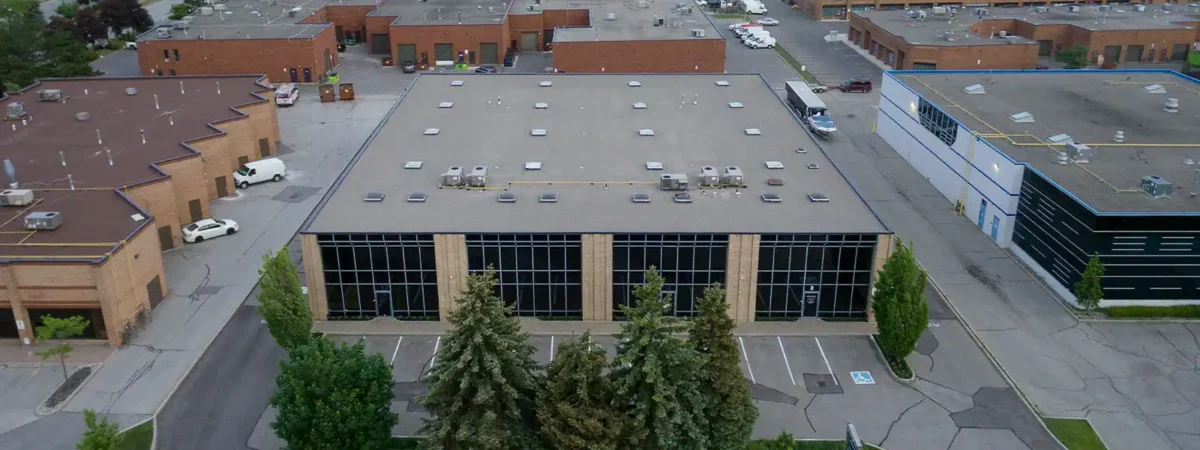
Case Study: 30-Year-Old Vaughan Plaza, 4-Ply BUR Replacement
The clearest way to explain why we keep specifying BUR is to show one. This was a 23,000 sq ft commercial plaza in Vaughan with a 30-year-old roof that had failed in exactly the way old flat roofs fail in Ontario.
The problem:
- Membrane splits and failed perimeter flashings had turned the roof into a funnel. Water ran off the edge, down the brick face, and froze inside the masonry overnight. Every winter, mortar crumbled a little further. Every summer, repair invoices arrived. The building owner had been patching for years and the patches were not keeping up with the damage the water was doing to the brickwork.
The roofing solution we recommended:
- Full tear-off to the deck.
- 1.5″ polyiso insulation (supplied through manufacturers like Atlas and Dow for the polyiso lineup we specify across Ontario).
- 4-ply BUR system installed over the insulation.
- Perimeter detail extended ¾″ past the brick face with plywood and sloped back toward the roof surface, redirecting water away from the masonry and into the drainage system.
- Sealed penetrations and new drain details.
- 10-year warranty on workmanship, labour, and materials.
Timeline:
- Five days on site.
Why BUR was the right call?
A single-ply replacement would have gone in faster and cost less. It would also have put one membrane over a roof that gets regular HVAC service traffic and sits exposed to full sun, full winter, and full freeze-thaw for decades. The ownership group had already paid for one premature failure cycle. The four-ply assembly was specified to give them 25 to 30 years before they have to think about the roof again, with redundancy built in so a localized defect does not become a leak.
MAXIMIZE ROOF LIFE WITH A
Preventative Roof Maintenance Plan
Avoid surprise repairs and extend the time between costly replacements with expert maintenance tailored to your roof.
Reduce costly repairs
Prevent leaks & damage
Extend roof life
How Much Do Built Up Roofing Systems Cost?
BUR is typically more expensive than other flat roof systems we install. The materials cost more, the labour takes longer, and the crews who install it well are fewer. Ownership groups who price BUR against a single-ply quote usually see 30 to 50 percent higher up-front numbers.
Here is a general cost comparison for the four flat roof systems we work with most in Ontario. The ranges below assume a full replacement: tear-off to deck, new insulation, new membrane, flashings, and standard perimeter details.
(Please note: The pricing below are general estimates and do not include tapered insulation packages, drain replacements, structural deck repairs, or parapet rebuilds, which are often quoted separately based your roof specs.)
| System | Installed cost (per sq ft) | Expected lifespan |
|---|---|---|
| 4-Ply BUR | $8.50 – $14.00 | 25 to 30 years |
| 2-Ply Modified Bitumen (SBS) | $7.00 – $9.50 | 20 to 25 years |
| TPO (single-ply) | $4.50 – $7.00 | 15 to 20 years |
| EPDM (single-ply) | $3.50 – $6.50 | 15 to 25 years |
What the table leaves out:
- Maintenance cost across the service life. A BUR under a Preventative Roof Maintenance Plan has a predictable annual spend. A single-ply that is patched reactively every time a seam opens accumulates emergency service calls, ad-hoc repairs, and eventually a premature replacement. Across 20 years, the reactive path can double the total spend.
- Insurance exposure and claim risk. A redundant four-ply assembly does not fail from a single damaged seam. A single-ply can. The cost of a tenant interior claim after a membrane split is not in the installed price of the roof.
- Replacement cycles. A 15-year TPO or EPDM replaced inside a 30-year hold means two tear-offs, two disposals, two install windows, and two rounds of tenant disruption. A 30-year BUR means one.
The math works on the back end. Amortized across a 25-to-30 year service life, BUR’s per-year cost is almost always lower than the cost of a TPO or EPDM roof replaced twice during the same period. Add in the maintenance savings, the reduced insurance exposure, and the documented cost of deferred maintenance across the 173+ Ontario properties we service, and the lifecycle numbers consistently favour BUR on buildings with a long hold.
The Flat Roof ROI Calculator is how we run those numbers with clients. Give it a try to see how much you can save (and how much roof life you can extend) with our preventative maintenance.
Should You Install BUR on Your Next Replacement?
Not every flat roof replacement calls for a 4-ply BUR, and we do not pretend it does. The specification decision comes down to how long you plan to hold the building, what the roof actually has to endure, and what a premature failure would cost you.
Lean toward BUR when:
- The ownership hold is 15+ years and the lifecycle math matters more than the cheapest bid.
- The roof carries heavy rooftop equipment, regular service traffic, or frequent trades access.
- A leak above the tenant space would trigger insurance claims, shutdowns, or inventory loss.
- The building is a commercial plaza, industrial facility, food processor, warehouse, or institutional property.
- You have already replaced a single-ply on this building and do not want to do it again in 15 years.
Consider a 2-ply modified bitumen instead when:
- The structural load cannot support the weight of a full 4-ply assembly.
- The hold is 10 to 15 years and the redundancy of two plies is adequate.
- The building footprint is modest and rooftop activity is light.
Neither of those conversations is a quote-by-phone exercise. Getting the right system on the right roof means someone walks the building, checks the deck, measures the insulation, documents the drainage, and puts a real specification on paper.
What does BUR stand for in roofing?
BUR stands for built-up roofing. It refers to a flat roof system assembled from multiple layers (plies) of reinforcing felt bonded together with hot asphalt, topped with a cap sheet or a flood coat and gravel ballast. A 4-ply BUR has four layers of waterproofing fused into a single redundant assembly.
How long does a 4-ply BUR roof last in Ontario?
A properly installed 4-ply BUR with regular maintenance will typically last 25 to 30 years on an Ontario commercial or industrial building. Without maintenance, expect 18 to 22 years. The gap is almost entirely about whether penetrations, flashings, and drains are serviced on a preventative schedule or left until something fails.
Is BUR still used on new commercial buildings?
Yes. Built up roofing is actively specified on new commercial plazas, industrial buildings, food processing facilities, schools, and hospitals across Ontario when long-term performance and redundant waterproofing matter more than install speed or the cheapest up-front quote. It is not as common as single-ply on spec buildings because developers optimize for initial cost, but on owner-occupied and long-hold properties it remains the default.
Why do most contractors quote TPO or EPDM instead of BUR?
Single-ply systems are faster to install, cheaper to bid, and easier to train a crew on. Contractors competing on price will almost always lead with a single-ply quote because it wins more bids. That does not mean it is the right specification for the building. Learn more about the differences between roof systems and common causes of failure of in our State Of Roofing Report.
Can a BUR roof be repaired, or does it need full replacement when it fails?
Built up roofing systems repair well. Because the assembly has four layers of waterproofing, localized defects (a cracked cap sheet, a failed flashing, a damaged penetration) are typically addressed with targeted repairs that restore the waterproofing without replacing the whole system. Full replacement is only required when the insulation is saturated, the deck is compromised, or the membrane has reached the end of its service life across the majority of the roof.
Get a Quote on a Roof That Lasts
If you are planning a flat roof replacement in the next few years and want to know whether a Built Up Roofing System is the right specification for your building, we will walk the roof and put a written spec in front of you. Learn more about our flat roof replacement service, then call (905) 397-1198 or contact us online for a free quote.