
Key Takeaways
- Roofing fumes in occupied Ontario schools have been a documented safety concern, with parent protests and news coverage on record.
- Modern torch-applied 2-ply modified bitumen and hybrid systems replace the overwhelming hot-mop tar kettles many of us remember.
- A full school roof section can be stripped, insulated, and replaced in 5 to 7 working days with the right crew and planning.
- Every school roofing job we work on includes WSIB-covered workers, $5 million liability with hot-torch coverage, and a safety protocol that minimizes disruptions to classrooms.
When I was in elementary school, I remember sitting in a classroom near the end of June, trying to focus on a test while the entire building reeked of hot tar. Up on the roof, a crew was mopping down buckets of liquid asphalt right above our heads. Our teacher turned on the fans, but they just circulated the fumes. We opened the windows, but that only invited the smell in faster. Back then, “suffering through it” was just part of the process.
School roofing has had to evolve since then.
Driven by a push for better air quality and fewer disruptions from parents and staff alike, the industry has shifted toward smarter, cleaner technologies. If you manage facilities for a school board, run an independent school, or sit on a council overseeing a major project, here is how modern roofing has changed—and how we prioritize low-VOC materials and zero-disruption schedules to protect your learning environment.
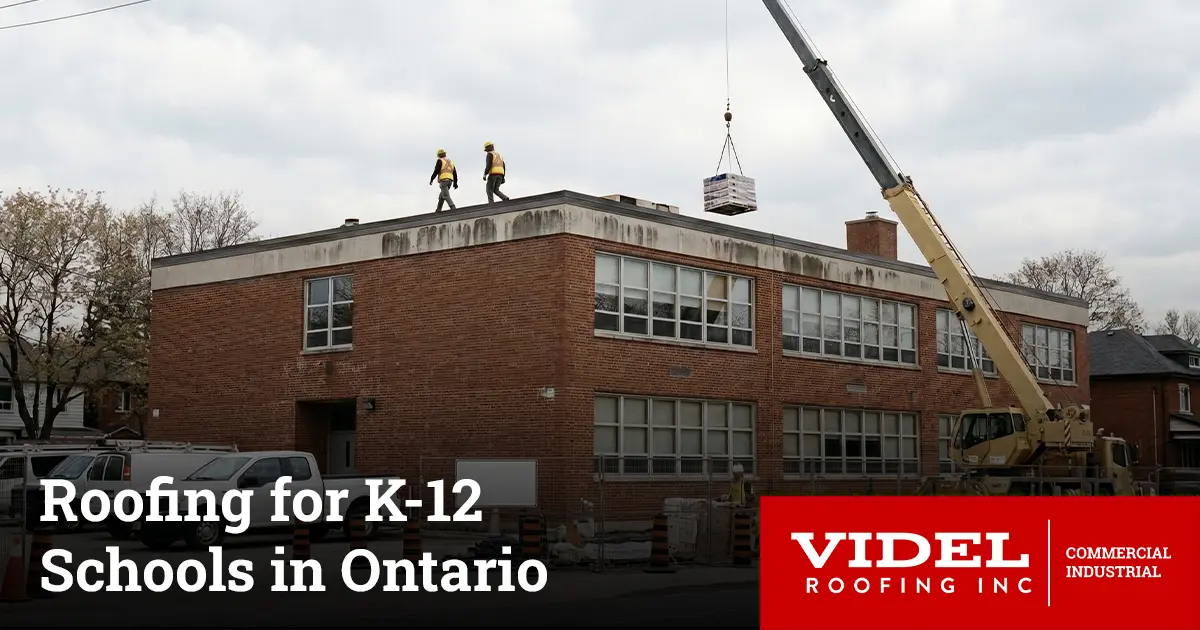
Why School Roofing Is a Safety Issue, Not Just a Construction Issue
In May 2014, parents and students at Ossington Old Orchard Public School in Toronto staged a protest over a TDSB roof replacement being done during school hours. Students had been sent home with headaches, nausea, sore throats, and breathing problems from the hot asphalt fumes drifting into classrooms. The story ran on CBC, CP24, CTV, and Global News. Toronto Public Health said the fumes weren’t a long-term health risk, but short-term symptoms were real enough that classrooms had to be relocated and some children stopped attending for the duration of the project.
“Most repairs on schools are now reactive or urgent, therefore more and more frequently, school repairs are conducted while students are in school.”
Fix Our Schools, an Ontario advocacy group tracking the condition of provincial school buildings, has documented similar stories across the province: students in classrooms alongside ongoing construction, fumes no fan could remove, increased asthma incidents, and parents keeping kids home until the roof work finished.
What Changed After Ossington (and What Didn’t)
The TDSB formalized its roof work safety protocol after the 2014 protest, and the requirements are now public. For any school roof project, the contractor and school facility staff are required to:
- Turn off or modify air handling systems during roofing so fumes aren’t drawn into the school.
- Seal all windows and openings near the kettle.
- Place the asphalt kettle downwind of the school wherever possible.
- Run air handling systems and HEPA/charcoal filtration fans after the kettle shuts down to clear particulates.
- Vacate the classrooms below and provide alternative accommodation for students and staff during disruptive phases of the work.
Pre-construction meetings with school staff and an information meeting with the community are held before any project starts. All of that is a real shift in how school roofing is planned.
What Modern School Roofing Looks Like
The other thing that changed is the material itself. That overwhelming hot-mop bitumen kettle most of us remember from 20 years ago is still in use, but contractors have alternatives that weren’t mainstream in 2005.
Torch-applied 2-ply modified bitumen uses the same asphalt chemistry with tighter emissions control and no open kettle on the roof. Cold-applied adhesives with low VOC are an option on some projects where the weather and schedule allow. Newer hybrid roofing systems pair a mod-bit base with a reflective single-ply membrane on top and are designed specifically for K-12 and college campuses with heavy rooftop equipment.
What all of these have in common: less of what used to drift down into the classrooms below, and more working time inside a school year calendar where the window for non-disruptive work is tight.
How We Do It at Videl
Videl isn’t a TDSB contractor, but the same rules apply to any school property we work on, public or private, in Southern Ontario. Our protocol on any school or institutional roof includes:
- WSIB clearance on every worker. No exceptions, documented on file with the school before work starts.
- $5 million liability coverage. Every job, every crew, from start to finish. More on our liability coverage here.
- Notice of Project filed under the Ontario Health and Safety Act for any project meeting the threshold, and a formally identified Constructor on every job.
- Material planning around the building. Where the calendar allows, we specify torch-applied mod-bit or cold-applied adhesives instead of open-kettle hot asphalt. We never run a kettle upwind of an occupied school wing.
- A site plan that prioritizes summer and break scheduling. Our default is to book school roof replacements for July and August, March Break, or Winter Break. When the roof can’t wait, we run the in-session protocol above and block staging, lifts, and noise-generating work around class times and lunch periods.
- A 5 to 7 day target for a full section replacement. Strip to the deck, new polyiso insulation, 2-ply mod-bit or hybrid system installed, flashings finished, site handed back clean.
We’ve worked on institutional properties across Southern Ontario, including elevator shaft waterproofing at Mohawk College in Hamilton. The insurance, documentation, and safety standards are the same whether it’s a K-12 school, a college campus, or a board administrative office.
Can a school roof be replaced while the school is occupied?
Yes, and most Ontario school boards do some of their roofing work during the school year because the volume of projects can’t fit into summer and holiday breaks alone. The project needs to be phased, ventilation systems need to be managed to keep fumes out of classrooms, and in some cases occupants below the work zone need to be temporarily relocated. Pre-construction meetings with school staff and the community are standard practice.
Are asphalt roofing fumes dangerous to children?
Toronto Public Health and most provincial health authorities classify short-term exposure to hot-applied asphalt fumes as low risk for healthy adults and children, with possible temporary effects including headaches, nausea, and respiratory irritation. Children with asthma or other respiratory conditions are more sensitive. Following the proper safety protocol, including shutting down air intakes during kettle operation and running filtered air circulation, is what keeps the exposure manageable.
How long does a school roof replacement take?
Our standard timeline for a single-section school roof tear-off and replacement is 5 to 7 working days, weather permitting. A larger campus with multiple roof sections gets phased, with each section running on that same rhythm.
What insurance and safety requirements apply to school roofing projects?
School roofing contractors should carry WSIB clearance on every worker and a minimum of $5 million in liability insurance. A Notice of Project must be filed under the Ontario Occupational Health and Safety Act where the project threshold is met, and a Constructor must be formally identified on every job. These are not optional on school property.
Planning a School Roof Replacement?
If you’re on a school board facilities team, a private school administrator, or a property manager handling an educational or institutional campus, the first step is a proper assessment of what shape the roof is in and what window is available to work with. Learn more about our flat roof replacement services, then call (905) 397-1198 or contact us online for a free quote.