
Most building owners assume that when a roof leaks, it’s simply “worn out.” But in our 25+ years working on commercial and industrial properties across Ontario, we’ve seen the truth:
The real damage starts years earlier—when routine maintenance is skipped, inspections are rushed, or small issues are ignored.
- A single tear left unpatched…
- A clogged drain left uncleared…
- A patch job done wrong by someone who “mostly does residential”…
These small oversights snowball into big problems—structural repairs, rotted insulation, mold, interior damage—often right when you can least afford it.
The good news? Most of it is completely preventable.
In this article, we’ll break down the top reasons flat roofs fail, share real-world scenarios we’ve seen across Ontario, and explain how the right maintenance plan can save your roof—and your budget—from disaster.
7 Common Reasons Why Flat Roofs Fail
1. High Foot Traffic (The Silent Roof Killer)
Flat roofs often double as utility spaces—home to HVAC systems, exhaust fans, satellite dishes, and other equipment that requires regular servicing. That means technicians, maintenance staff, and contractors are up there often—sometimes weekly, sometimes daily, depending on the building.
And that foot traffic adds up.
One of the most common issues we see, especially with EPDM roofing, is punctures from debris—like dropped screws, bolts, or small metal parts. When someone unknowingly steps on that debris, it presses through the rubber membrane, leaving a tear that’s nearly invisible until it starts leaking.
Other times, it’s general wear and tear from high-use access paths, especially around roof hatches, mechanical units, and walkways. Without proper protection—like walkway pads or reinforced areas—these high-traffic zones degrade faster and are much more prone to failure.
Even something as simple as grit or gravel stuck in a boot tread can lead to micro-tears when dragged across the membrane surface.
“If your roof regularly sees foot traffic, especially from equipment or personnel, make sure it’s protected. Neglecting this can result in damage that’s far costlier to repair down the line.”
— Videl Roofing Team
2. Lack of Preventative Maintenance
This one of the most common reasons flat roofs fail—and it’s also the easiest to avoid.
Many building owners put off regular maintenance because the roof “seems fine.” There’s no active leak, no visible damage, and no time to think about it during a busy season. But roofing issues often develop slowly and invisibly, long before water shows up inside.
Here’s what we typically find on roofs that haven’t been maintained:
- Clogged drains causing ponding water
- Open seams or flashing starting to peel back
- Punctures from debris that have gone unnoticed
- UV damage and surface deterioration, especially on older membranes
And when these small issues go unchecked, they lead to big problems: soaked insulation, rotting substrate, mold, interior leaks, and emergency repair bills.
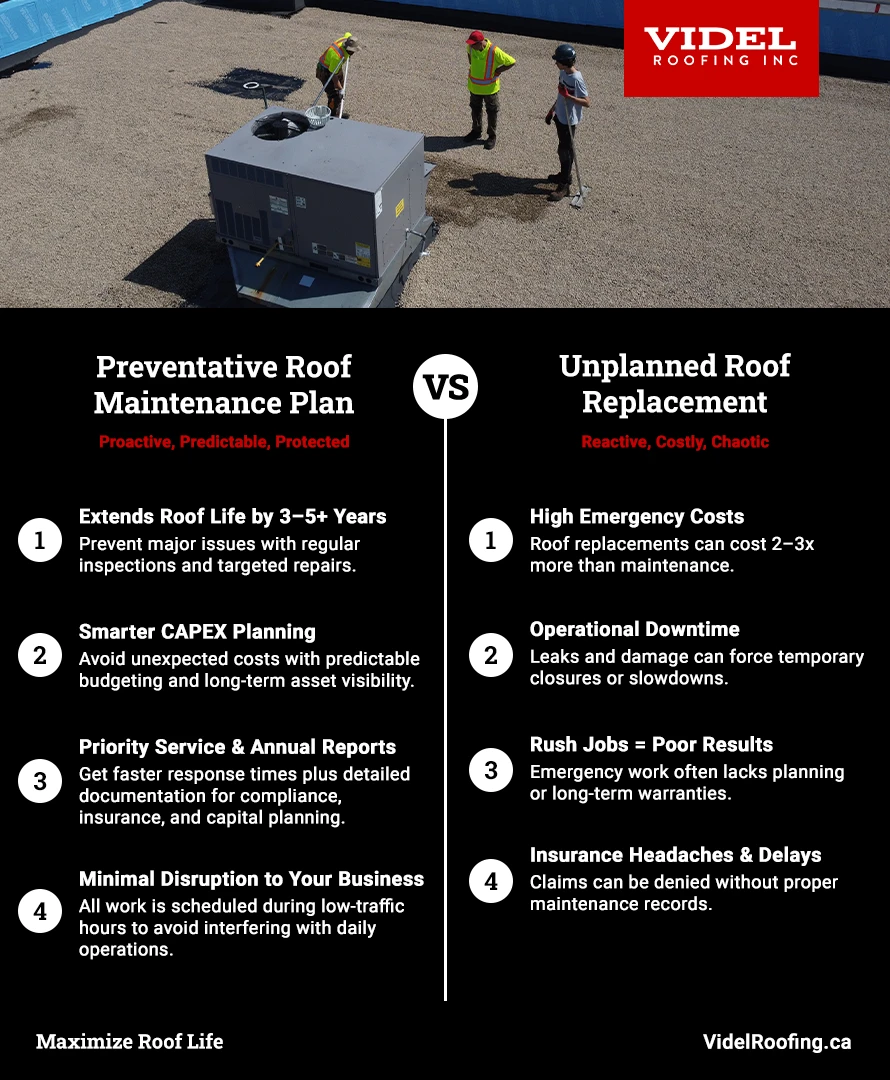
We’ve worked with clients who came to us after years of paying for “maintenance” without any actual reporting or follow-up. Once we got up there, it was clear no one had been doing the work—no photos, no updates, and no record of what was inspected or repaired.
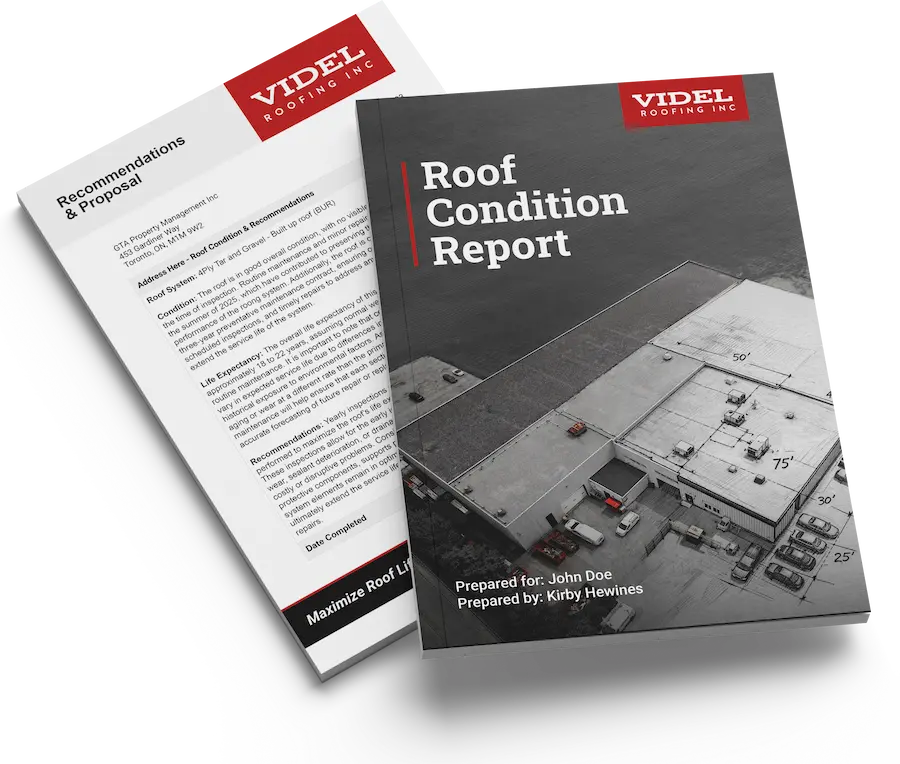
That’s exactly why our maintenance plans include documented reports, photos, and a clear action plan after every visit—so there’s no confusion about what’s happening on your roof and no wasted budget on invisible service.
“Skipping preventative maintenance might save money this year—but it usually costs far more in the years that follow.”
— Videl Roofing Team
3. Regional & Environmental Conditions
Not all flat roofs in Ontario face the same challenges. Local climate and geography play a much bigger role than most building owners realize—and some areas come with very specific risks.
Take Wasaga Beach, for example.
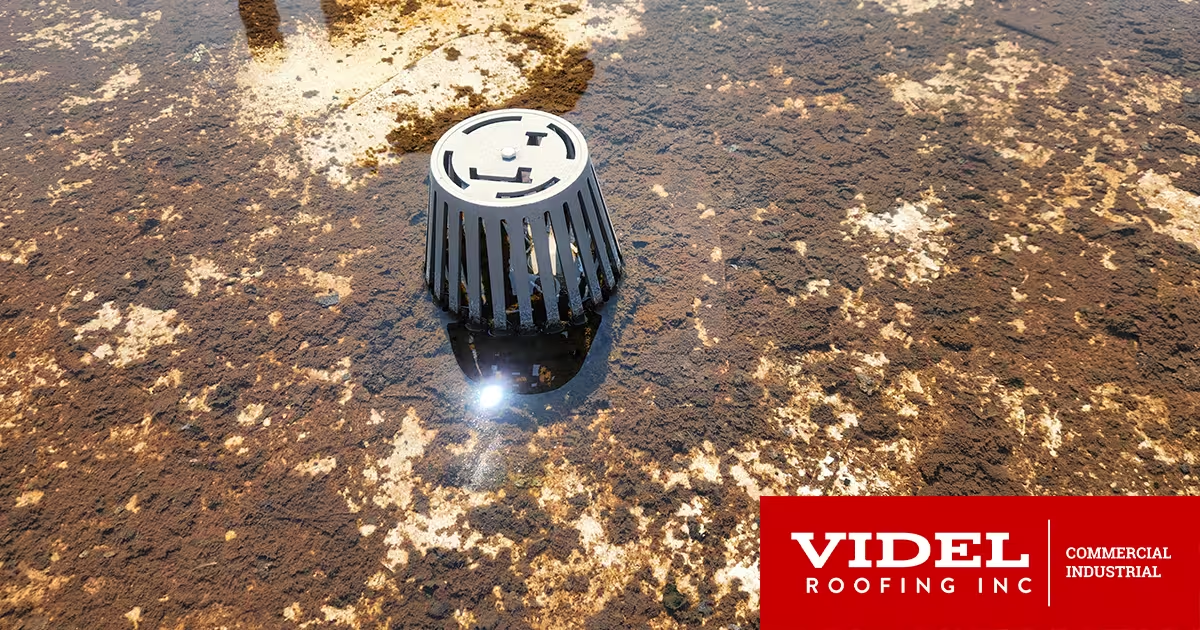
In this lakeside region, we regularly see algae growth on rooftops—especially during warm, humid months. Algae may not seem like a major concern, but over time it can degrade membrane surfaces, clog drainage paths, and increase moisture retention. That extra moisture, when combined with heat, creates the perfect environment for material breakdown and accelerated wear.
Another common issue in the area? Sand.
During the summer, high winds can blow fine sand onto flat rooftops where it collects in corners, around drains, and under equipment. If it’s not cleared out, that sand builds up and traps moisture—clogging drains and putting unnecessary stress on both the membrane and the drainage system.
In the winter, these same roofs face the opposite problem: heavy snow loads. Snow adds weight, but more importantly, it introduces large amounts of water when it melts. If the roof’s drainage system is already blocked by debris or sand, that meltwater has nowhere to go—increasing the risk of leaks, saturation, and freeze-thaw damage.
At Videl Roofing, we regularly help clients clear snow in the winter and algae in the summer, especially in areas where seasonal weather patterns push flat roof systems to their limits.
“If you don’t understand the environmental stress your roof is under, it’s only a matter of time before the damage shows up inside.”
— Videl Roofing Team
4. Poor Drainage & Standing Water
Flat roofs aren’t truly flat. They’re designed with a subtle slope to guide water toward drains and scuppers—but when drainage fails, everything starts to break down.
Standing water—also known as ponding—is a major red flag. If water remains on the roof for more than 72 hours after a rainfall, it’s a sign that something’s wrong. Whether it’s clogged drains, insufficient slope, or debris buildup, the result is the same: accelerated roof failure.
Here’s what ponding water leads to over time:
- Premature membrane breakdown
- Increased UV exposure, which cooks and cracks the surface
- Added structural load, especially during freeze-thaw cycles
- Water intrusion once even the smallest crack or seam separation forms
We’ve inspected roofs where just a few inches of standing water masked underlying damage to insulation layers, which had been soaking up moisture like a sponge for months. In some cases, the membrane looked fine—but once we did a core sample, the damage was already done underneath.
And it doesn’t take a major storm. Even small, recurring puddles are a serious concern, especially in older systems where seams and flashings are already under stress.
“If water is sitting on your roof, it’s already working its way in. The question is just how far it’s gotten—and when it will turn into a major issue.”
— Videl Roofing Team
5. Poor Installation or Repair Work
Some roofs don’t fail because of weather, traffic, or neglect—they fail because they were installed wrong in the first place.
We’ve seen it firsthand: seams that weren’t heat-welded properly, flashing that pulls away within a year, incompatible materials used together, and patches that actually cause more problems than they fix.
In the commercial roofing world, bad installation doesn’t always show up right away. It often hides under the surface, slowly causing water to infiltrate insulation, rust out metal decking, or compromise structural components.
Here are some common red flags we’ve found on poorly installed or serviced roofs:
- Improper slope or drainage layout
- Overlapping seams without proper bonding
- Flashing installed too tightly around penetrations (so it splits over time)
- Temporary patches applied with incompatible materials
- No documentation or post-job photos—just a bill
And here’s the worst part: by the time the leak shows up inside, it’s already too late to do a quick fix. The damage has spread, and your repair turns into a costly replacement.
At Videl Roofing, we’ve been brought in to clean up the aftermath of poor workmanship more times than we’d like to admit. It’s frustrating—because most of these failures could have been avoided with quality control, experienced installers, and honest reporting.
“A roof only performs as well as the team that installed it. If they cut corners—you’ll pay for it, one way or another.”
— Videl Roofing Team
“80% of Commercial & Industrial Flat Roofs Are Replaced Too Early”
Industry data shows the majority of commercial roofs are replaced before it’s truly necessary—costing property owners hundreds of thousands in avoidable capital loss.
Most replacements happen not because of failure, but because of fear, assumptions, or pressure from contractors who profit from urgency—not long-term strategy.
Use Our ROI Calculator to See If a Roof Replacement Really Makes Sense
Get a data-backed cost comparison between repair, maintenance, and replacement—so you can protect your reserves and plan CAPEX with confidence.

6. Freeze-Thaw Cycles & Seasonal Stress
Ontario’s winters are no joke—and your roof feels every shift in temperature.
Flat roofs in Canadian climates endure months of freeze-thaw cycles, where melting snow and pooled water seep into even the tiniest crack… only to freeze again overnight, expand, and make that crack even worse.
Over time, this cycle leads to:
- Splitting membranes
- Pulled seams and flashing
- Cracked coatings
- Delamination of layered systems
It’s one of the most common long-term stressors on commercial flat roofs—and it’s made worse when snow isn’t cleared or drains are blocked, forcing meltwater to sit on the surface longer than it should.
And it doesn’t end in winter.
Spring often brings rapid thaw, putting huge strain on drainage systems that may be partially clogged from sand, leaves, or winter debris. Summer, on the other hand, introduces intense UV exposure, which causes surface breakdown—especially on older or poorly maintained membranes.
We help clients across Ontario deal with both ends of the spectrum: clearing snow in the winter and removing sand and debris in the summer, particularly in lakeside areas where seasonal weather patterns amplify wear and tear.
“Your roof doesn’t just need to survive one season—it has to survive all of them. And in Ontario, that means constant stress from every direction.”
— Videl Roofing Team
7. No Visibility, No Reporting, No Accountability
It’s not always the roof’s fault. Sometimes, it’s the lack of information that causes the real damage.
We’ve seen too many cases where building owners assume maintenance is being handled—because they’re paying someone to “check the roof.” But if you’re not getting photos, reports, or detailed updates, how do you know what’s actually being done?
The answer: you don’t.
Without visibility into what’s happening up there, you’re left with assumptions. And in our world, assumptions are dangerous—because roofing issues rarely announce themselves until it’s too late.
- Was that tear from six months ago ever repaired?
- Is that drain really clear, or is it just “on the list”?
- Was that ponding water noted and tracked, or simply ignored?
At Videl Roofing, we believe documentation isn’t optional—it’s essential. That’s why our maintenance plans come with clear reports, photos, and honest communication every step of the way. So you’re never left wondering if your roof is being taken care of—you’ll know it is.
“If no one’s tracking your roof’s condition, no one’s protecting your investment.”
— Videl Roofing Team

The Best Time to Protect Your Roof Is Before It Fails
Every issue we’ve covered in this article—whether it’s foot traffic, ponding water, or weather-related damage—has one thing in common:
It’s preventable.
That’s why we created our Preventative Roof Maintenance Plans—to give building owners peace of mind, budget clarity, and long-term protection against failure.
Whether you manage one facility or multiple properties across Ontario, we customize every plan to fit:
- Your roof type and system complexity
- Your budget and long-term CAPEX planning
- Your existing maintenance and compliance programs
With annual or bi-annual inspections, our team becomes an extension of yours—documenting, tracking, and maintaining your roof so issues are caught early and handled right.
We also work with facilities in regulated industries like food processing, where even a small leak can compromise quality assurance and daily operations. Our detailed reports and proactive service help you stay compliant, avoid emergencies, and make informed decisions with zero surprises.
Want a clear picture of your roofing system’s condition?
Book a free on-site assessment today to explore how a maintenance plan can maximize your roof’s life.