
Key Takeaways
- EPDM is a synthetic rubber membrane that has been used on commercial flat roofs for over 50 years. It’s durable, flexible, and proven, but not without real failure modes in Ontario’s climate.
- Typical thicknesses run 45, 60, and 90 mil. Seams are joined with tape, adhesive, or factory-welded in wider sheets.
- The most common failure mode we see in the field is shrinkage, which pulls the membrane away from edges, curbs, and penetrations. Also called “tenting.”
- EPDM roof membranes can be the right fit for small commercial buildings, low-traffic roofs, and budget-constrained retrofits. It’s not our default recommendation for heavy-use or multi-tenant commercial roofs in Ontario.
EPDM has been on North American commercial roofs since the 1960s. It’s one of the most widely installed single-ply membranes in the world, with a long track record, legitimate engineering behind it, and manufacturer warranties that stretch into the 30-year range.
What EPDM also has, when installed on Ontario commercial roofs and left to age without maintenance, is a set of failure modes that show up consistently in the field. Shrinkage, seam failure, punctures from rooftop traffic. The factors that shorten EPDM’s real-world service life in our climate aren’t unique to our region, but freeze-thaw cycling accelerates them.
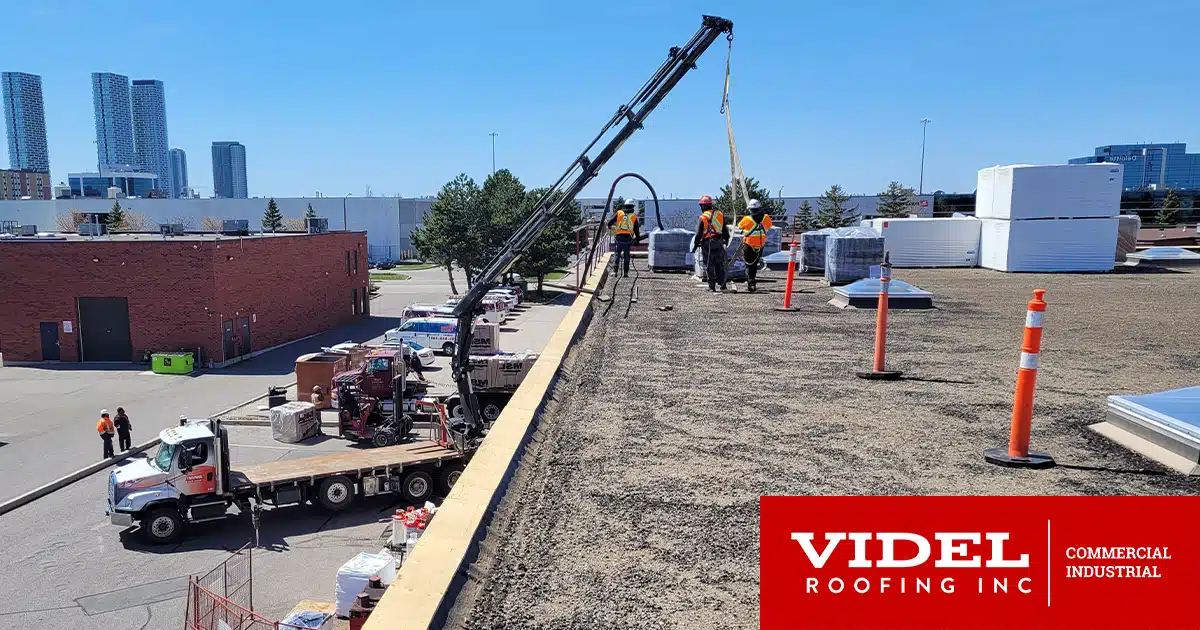
At Videl Roofing, we install, repair, and replace EPDM roofs across Southern Ontario. This post covers what EPDM roof membrane is, how it performs, where it fits, and where it doesn’t. It includes a recent Brampton retail plaza case where we pulled a failing EPDM roof off a multi-tenant building and replaced it with 4-ply BUR.
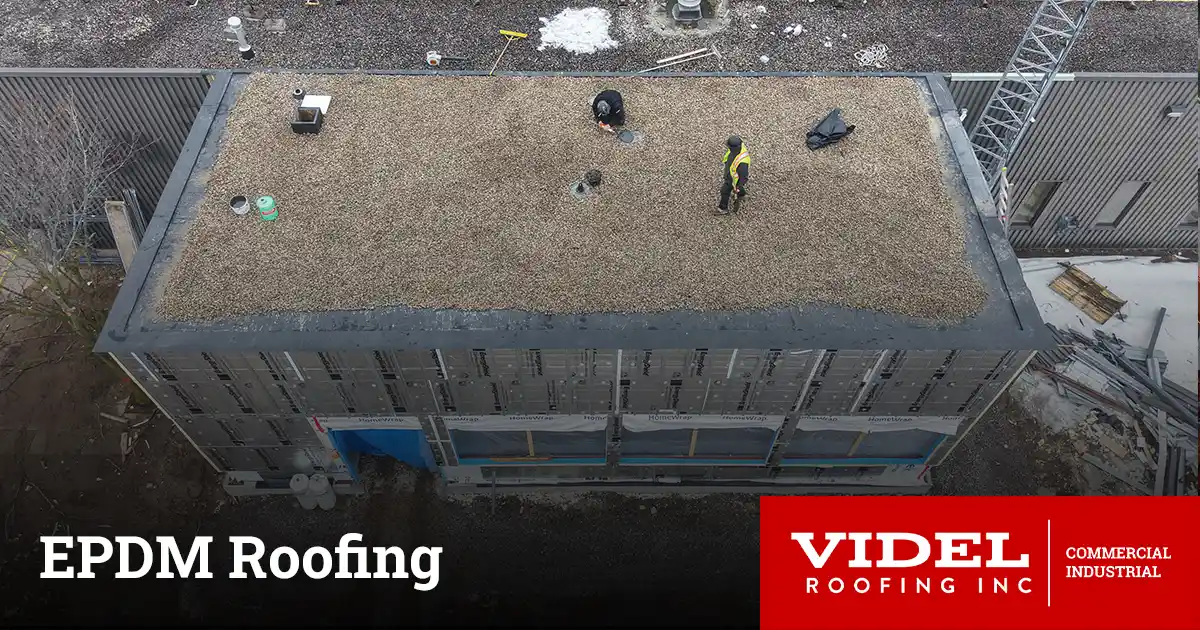
What is EPDM roofing?
EPDM stands for ethylene propylene diene monomer, a synthetic rubber compound. Manufactured as a thin, flexible sheet and installed as a single-ply membrane over insulation and a roof deck, it has been the dominant single-ply commercial roofing material in North America for decades.
Several properties make EPDM useful on commercial flat roofs:
- Flexibility. The rubber compound stays pliable across a wide temperature range, which matters in climates with large seasonal swings.
- UV resistance. EPDM handles sustained sun exposure well without the surface degradation that affects some other membranes.
- Long manufacturer lifespans. Warranties from major manufacturers run 20 to 30 years on properly specified assemblies.
- Simple repair. Patches and seam repairs are straightforward when done by a trained crew.
An EPDM roof membrane is almost always black, though white and reflective versions exist for buildings with cooling load or LEED requirements. Black EPDM absorbs solar heat, which is actually a benefit in a heating-dominated climate like Ontario’s. It helps reduce snow load in winter by accelerating melt.
Thickness options and what they mean
EPDM is manufactured in three common thicknesses:
- 45 mil/0.045 inches
- 60 mil/0.060 inches
- 90 mil/0.090 inches
Thicker membranes cost more upfront but resist punctures, UV degradation, and foot traffic damage better over time.
For commercial applications in Ontario, we consider 60 mil the practical minimum. 45-mil EPDM is thin enough that rooftop trade traffic (HVAC technicians, telecom installers, seasonal maintenance crews) creates a meaningful puncture risk. The 90-mil option adds cost but extends service life, particularly on buildings with heavy equipment or frequent roof access.
Thickness is one of the spec decisions that separates a roof that lasts 15 years from one that lasts 25. We’ve seen plenty of 45-mil EPDM installations that were value-engineered at installation and became the owner’s problem at year 12.
Seam options: tape vs. adhesive vs. factory-welded
Single-ply systems stand or fall on their seams. EPDM has three main seam technologies, each with tradeoffs:
- Splice tape. A factory-applied adhesive tape bonds two sheets of EPDM at the overlap. Modern splice tapes produce strong, reliable bonds when installed correctly. Installation quality matters. A seam rolled poorly, installed in wet conditions, or bonded to a contaminated surface fails earlier.
- Liquid adhesive. Field-applied adhesive is brushed or rolled onto both mating surfaces and joined. This was the original EPDM seam method and is still used, particularly for repairs. Liquid adhesive seams require more skill and are more sensitive to temperature, humidity, and substrate condition than splice tape.
- Factory-welded wider sheets. Some manufacturers produce EPDM in wider rolls with factory-bonded seams, reducing the number of field seams on the finished roof. Fewer seams means fewer failure points. For larger commercial roofs, wider sheets are worth specifying.
Regardless of seam type, every failure mode starts with a seam that wasn’t done right at installation or was stressed beyond its bond strength afterward. Which brings us to the real-world failures we see most often.
Real-world EPDM roof membrane failures we see in the field
Shrinkage and tenting
EPDM shrinks as it ages. The rubber compound loses volume slowly over time, and the effects compound. Once shrinkage begins, the membrane pulls tight against the roof and starts lifting off edges, parapets, curbs, and penetrations.
Roofers call it tenting. The membrane lifts off the substrate and forms a visible ridge around the edges and around every HVAC curb, drain, and skylight on the roof. Once tenting starts, seams open and causes water to leak inside.
This is the single most common reason we get called to replace EPDM roofs in Ontario. The building owner has spent several seasons patching edges and curbs, each patch lasting shorter than the one before, and the final call is to talk about replacement.
Seam failure
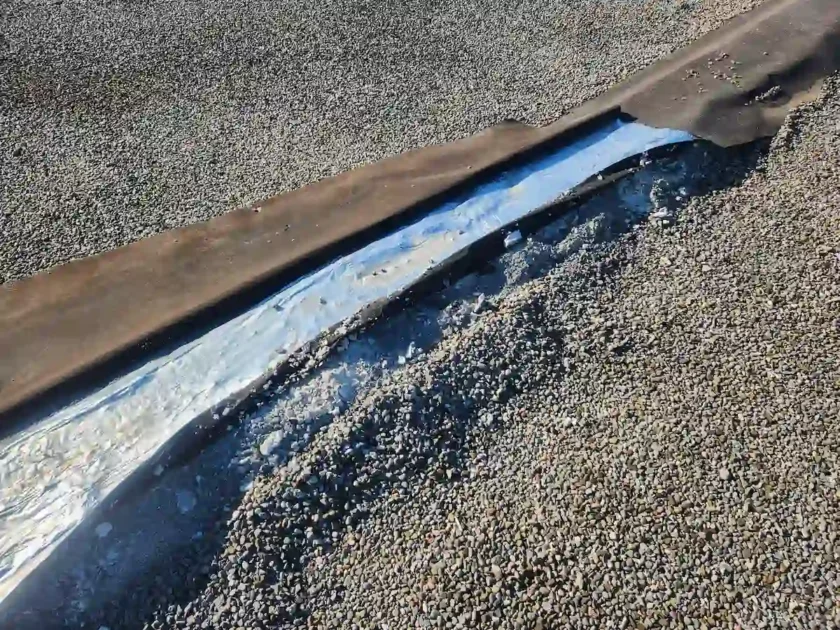
Seam-related failures show up in two forms. The first is a seam that was marginal at installation, rolled poorly, installed on a contaminated substrate, or bonded in weather that was outside spec. These seams fail in years 3 to 8, long before the membrane itself is at end-of-life.
The second form is seam stress from shrinkage or thermal cycling. Even a well-installed seam can separate after enough freeze-thaw cycles pull on the bond. Ontario’s climate accelerates this. Seam separation on an aging EPDM roof is common by year 15 to 20.
Punctures and mechanical damage
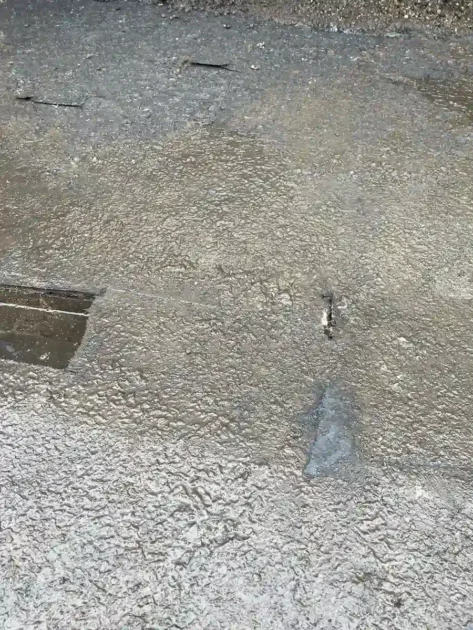
Because EPDM is a single-ply system, a puncture is a direct path to the insulation and deck. Trade traffic is the most common cause. Dropped tools, pointed boots, dragged equipment, HVAC service crews working around curbs. On buildings with regular rooftop access, punctures accumulate over the life of the roof and become a maintenance expense that wasn’t budgeted.
UV and ozone exposure on exposed edges
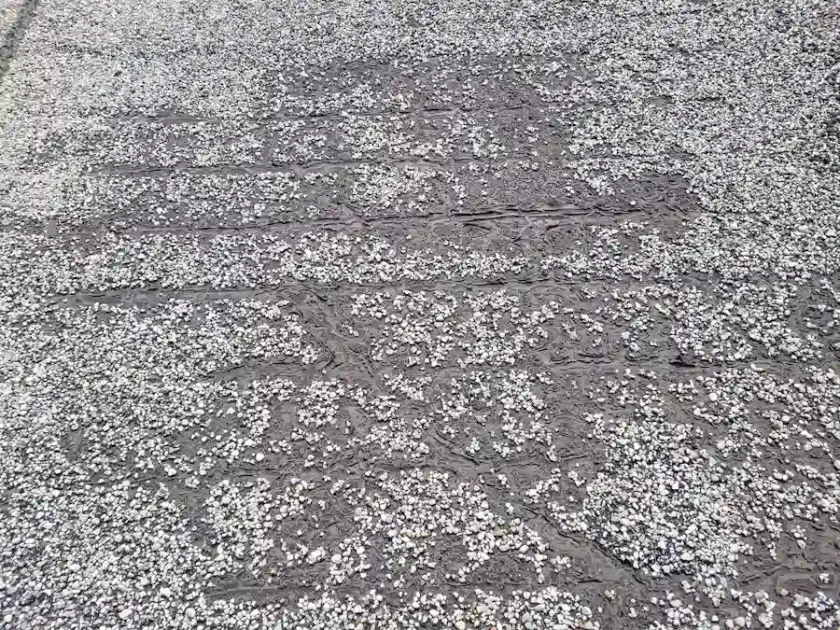
The main membrane field holds up well under UV. Edges, parapet caps, and penetration details are where UV damage tends to show first, particularly if flashings weren’t installed with adequate UV-stable components.
Case study: EPDM to 4-Ply BUR Conversion in Brampton
Earlier this year, we replaced a 4,720 sq ft EPDM roof on a multi-tenant retail plaza in Brampton. The original EPDM system had been in place for years and had developed exactly the shrinkage issue described above. Patch repairs had stopped holding, and winter was weeks away.
The building profile made the decision straightforward. With food service tenants in the plaza underneath, a single leak can shut down a kitchen, trigger a health inspection, and cost a tenant their business. Another round of patch-and-pray was not a workable plan.
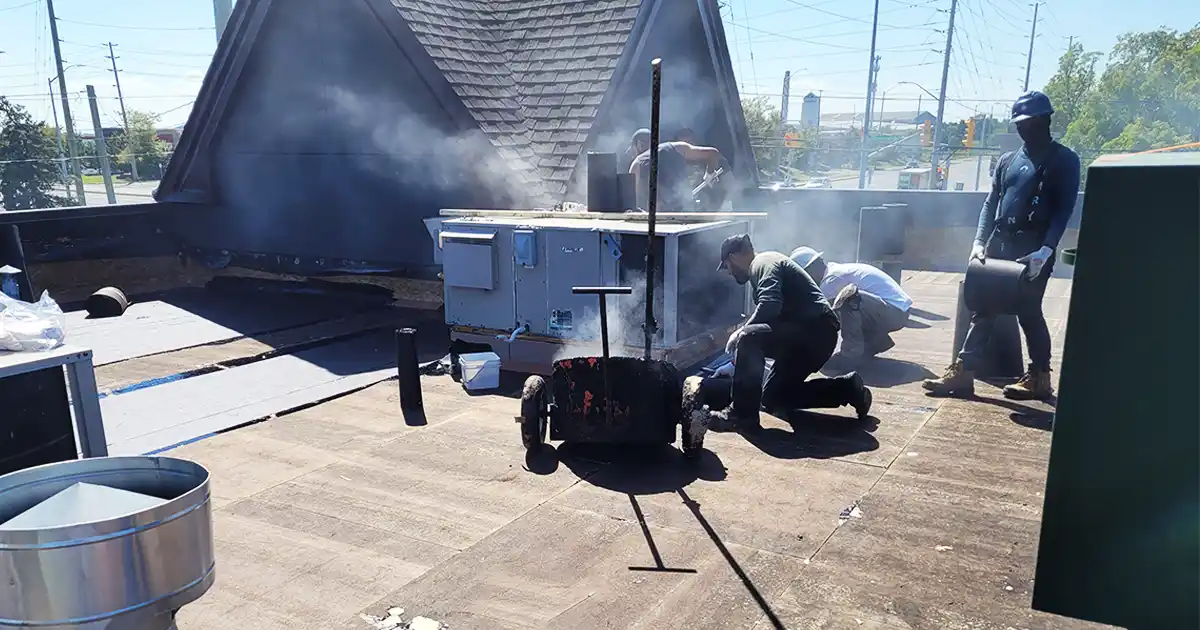
We stripped the old EPDM down to the deck over five days and replaced it with a 4-ply BUR system. BUR was the recommended alternative for two specific reasons: it handles foot traffic significantly better than single-ply, and it doesn’t suffer from the shrinkage mode that killed the original membrane. Every penetration and edge was sealed with dedicated waterproofing, addressing the points where the old EPDM had been pulling away.
The finished system carries a 10-year warranty on workmanship, labour, and materials, with a projected service life of 35 to 40 years when maintained on schedule.
See the full Brampton EPDM to 4-Ply BUR project →
The takeaway from the Brampton job applies to most EPDM replacements we handle: once shrinkage has started, patching becomes a cost centre with diminishing returns. At that point, the replacement system matters more than the EPDM repair. For heavy-use commercial buildings with sensitive tenants, BUR is the direction we recommend most often.
Where EPDM is the right call
EPDM is a legitimate option on specific buildings. Honest positioning:
- Small commercial buildings with low rooftop traffic. A simple-profile roof, minimal penetrations, and infrequent service traffic gives EPDM the conditions it performs best in.
- Warehouse roofs with large uncomplicated spans. Fewer penetrations means fewer failure points, and a 60 or 90-mil assembly can deliver strong service life in these applications.
- Budget-constrained retrofits. Where the capital isn’t available for a multi-ply system and the alternative is deferring the project, EPDM protects the building at a lower upfront cost.
- Short planned hold periods. If the property is a five-to-seven-year hold, EPDM’s shorter real-world lifespan matters less.
- Sloped or geometrically complex roofs where single-ply flexibility is an advantage. EPDM handles irregular geometries with fewer seams than some plied alternatives.
Where EPDM is the wrong choice
On other buildings, specifying EPDM is a cost decision that becomes a maintenance problem. In our field experience, EPDM is rarely the right choice for:
- Multi-tenant commercial buildings with sensitive operations. Food service, medical, office tenants with electronics. Any property where a leak creates a tenant crisis, not just an inconvenience.
- Buildings with heavy rooftop trade traffic. Complex penetration fields with regular HVAC, telecom, or equipment service work accelerate puncture risk.
- Long-hold commercial and industrial properties. On a 25 to 30-year hold, the total lifecycle cost of EPDM often exceeds BUR once replacement is factored in.
- Properties with food processing or cold storage uses. Moisture integrity is more critical, and the shrinkage-driven seam failures common to aging EPDM are not acceptable.
MAXIMIZE ROOF LIFE WITH A
Preventative Roof Maintenance Plan
Avoid surprise repairs and extend the time between costly replacements with expert maintenance tailored to your roof.
Reduce costly repairs
Prevent leaks & damage
Extend roof life
Our recommended alternative for most commercial roofs
For most heavy-use commercial and industrial buildings in Ontario, we recommend 4-ply Built-Up Roofing (BUR) over EPDM. BUR handles trade traffic, doesn’t shrink, and delivers a longer service life. The upfront cost is higher, but on a 25-to-30-year hold, the total cost of ownership typically favours BUR.
For a side-by-side comparison of BUR, TPO, EPDM, and modified bitumen for Ontario commercial buildings, see our comparison guide.
Ultimately, the EPDM vs. BUR decision depends on three specific inputs:
- the building’s expected hold period,
- the rooftop traffic profile,
- and the upfront capital available.
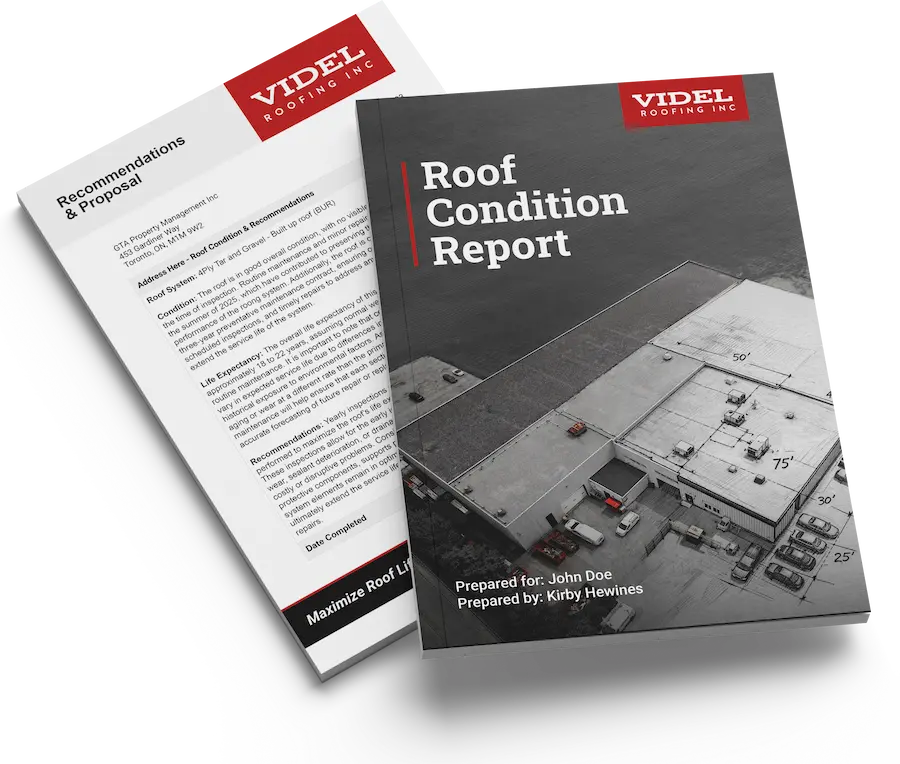
If you’re evaluating an aging EPDM roof or comparing EPDM against BUR for a replacement, a free Roof Condition Report documents what’s on the building and what the right next system should be. Run the lifecycle numbers on the Flat Roof ROI Calculator. Or call (905) 397-1198 for more information.
How long does an EPDM roof last in Ontario?
Manufacturer warranties run up to 30 years. Real-world service life on Ontario commercial roofs typically sees meaningful wear starting at 15 to 20 years, with shrinkage and seam issues driving most end-of-life decisions. Maintenance extends that timeline; neglect shortens it significantly.
What’s the difference between EPDM and TPO?
Both are single-ply commercial roofing membranes. EPDM is a synthetic rubber, while TPO is a thermoplastic polyolefin. Beyond the base chemistry, the two systems differ in colour, seaming method, and climate strengths: EPDM is usually black and joined at seams with tape or adhesive, while TPO is usually white and heat-welded at seams. TPO has higher solar reflectance, and EPDM has better low-temperature flexibility. See our honest assessment of TPO for Ontario commercial roofs for a direct comparison.
Is EPDM cheaper than BUR?
Yes, at installation. EPDM is typically 20 to 30 per cent less expensive than a 4-ply BUR assembly of equivalent square footage. Over a 25 to 30-year hold, the comparison often flips once lifecycle replacement and maintenance are factored in. Use the Flat Roof ROI Calculator to model it for your specific building.
Can an EPDM roof be repaired, or does it need full replacement?
Localized damage can be patched with EPDM patch material and either tape or liquid adhesive. Once shrinkage and tenting have started across multiple edges and curbs, patching becomes a losing battle. At that point, a replacement conversation is more cost-effective than ongoing repairs.
When should I replace an EPDM roof instead of patching it?
Several signals point to replacement rather than repair. Shrinkage pulling the membrane away from edges, curbs, or penetrations. Multiple failed seams despite recent repairs. Ponded water that’s been sitting on the roof long enough to show staining. Interior water damage that keeps recurring. A free Roof Condition Report documents all of these and gives you a three-to-five-year outlook for planning.