
Key Takeaways
- TPO roofing is a single-ply thermoplastic membrane with legitimate strengths: lower upfront cost, reflective white surface, and faster installation than multi-ply systems.
- The weakness TPO has in Ontario is its heat-welded seams, which carry more stress under freeze-thaw cycling than plied membrane systems do.
- TPO is typically 45 to 80 mil thick. That’s a fraction of a multi-ply BUR assembly, which matters on roofs with regular trade traffic.
- For most heavy-traffic Ontario commercial roofs, 4-ply BUR delivers longer service life and more redundancy at a modest premium over TPO.
TPO has been one of the fastest-growing commercial roofing membranes in North America for over a decade. It’s cheaper than plied systems, it reflects sunlight, and it goes down fast. For those reasons, it shows up on a lot of specs.
Whether it’s the right choice for an Ontario commercial building is a different question. At Videl Roofing, we install and maintain roofs across the GTA, Hamilton, Halton, and Niagara, and we see how each membrane type performs in our climate over 10, 15, 20 years. TPO roofing has its strengths. But it also has real weaknesses that don’t always show up in the marketing.
This post is a trade-honest assessment: what TPO is, where it makes sense, where it doesn’t, and why we recommend 4-ply BUR for most heavy-traffic commercial and industrial roofs in Ontario.
What is TPO Roofing?
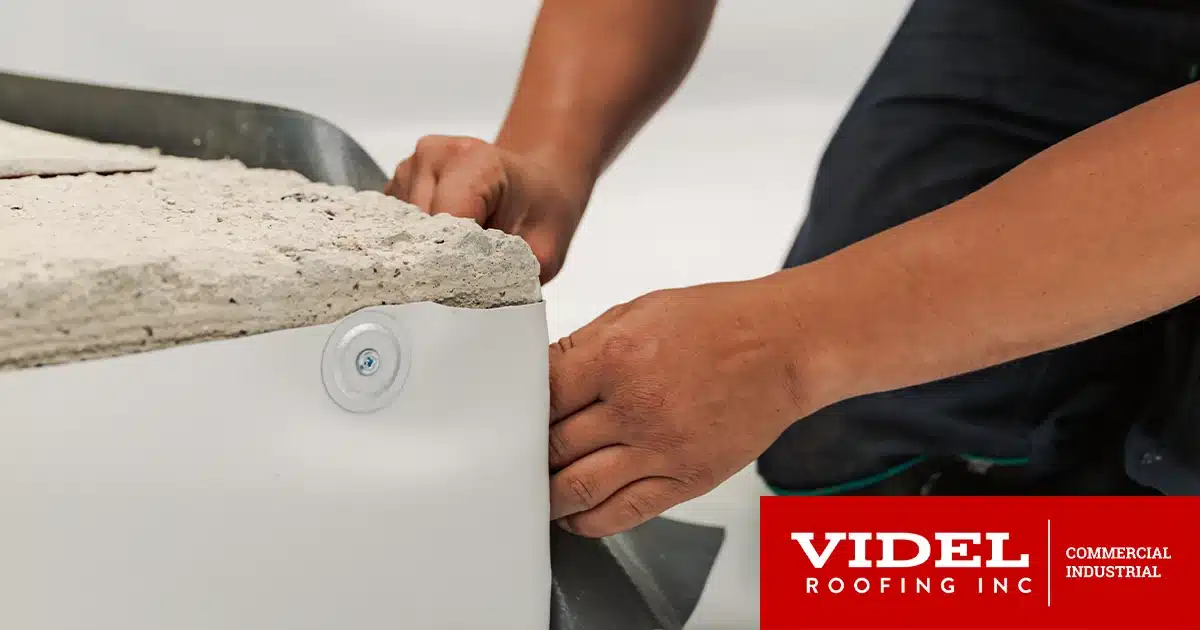
TPO stands for thermoplastic polyolefin. It’s a single-ply membrane manufactured as a thin sheet, typically 45, 60, or 80 mils thick (0.045 to 0.080 inches). A polyester reinforcement scrim runs through the membrane to provide tensile strength. The membrane rolls are unrolled across the roof deck, fastened or adhered in place, and joined at overlaps using heat-welded seams.
The underlying chemistry is a polymer blend of polypropylene and ethylene-propylene rubber, with UV stabilizers and other additives built into the formulation. The white version is the most common because its reflective surface qualifies for LEED credits and can reduce cooling loads in hot climates.
TPO is governed by ASTM D6878, which sets the performance standards for thickness, tear resistance, weathering, and heat aging.
Where TPO’s strengths are real
TPO isn’t a bad membrane. It has attributes that make it the right choice on specific projects:
- Lower upfront cost. TPO is typically 15 to 25 per cent cheaper than a 4-ply BUR assembly of equivalent square footage.
- Faster installation. A single-ply system goes down faster than four plies of alternating bitumen and reinforcing felt. For a tight project schedule, this matters.
- Reflective surface. The white version has a solar reflectance around 0.78, which is useful for buildings with significant cooling loads or LEED requirements.
- Lightweight. TPO adds less dead load to the structure than plied systems, which can matter on buildings with limited structural capacity.
- No torches or hot bitumen during install. Heat-welded seams reduce fire-hazard concerns during installation compared to torch-down modified bitumen.
- Available with long warranties. Manufacturers offer warranties up to 30 years on TPO systems when installed by certified applicators.
Those are real advantages, and on the right building they add up to a sound choice.
MAXIMIZE ROOF LIFE WITH A
Preventative Roof Maintenance Plan
Avoid surprise repairs and extend the time between costly replacements with expert maintenance tailored to your roof.
Reduce costly repairs
Prevent leaks & damage
Extend roof life
Where TPO struggles in Ontario’s climate
The advantages above are climate-neutral. They apply in Arizona and Ontario equally. The problems start when you factor in what Ontario actually does to a roof.
Seam vulnerability under freeze-thaw cycling
TPO’s primary failure pathway is the heat-welded seam. When two rolls are welded together, the bond depends on correct temperature, correct pressure, correct speed, and a clean substrate. Even a properly installed seam is still a seam: a linear joint where the membrane is doubled over and bonded to itself.
Southern Ontario sees dozens of freeze-thaw cycles between November and April. Each cycle expands and contracts the membrane, and every expansion and contraction puts stress on the seams. Over time, that stress reveals weaknesses: small gaps at the start or end of a weld, spots where the bond was marginal at installation, locations where the welder was moving too quickly. TPO roofing can fail anytime in year 8, 12, 15 — long after the installation crew has moved on.
Manufacturers acknowledge cold-weather installation requires “special considerations” for primer, adhesive, and seam welding. That’s a polite way of saying installation quality variability goes up when TPO is installed outside a narrow temperature window, which is most of the installation calendar in Ontario.
Thinner membrane on high-traffic roofs
A 60-mil TPO membrane is 0.060 inches thick whereas a 4-ply BUR assembly has four plies of reinforcing felt and four interleaving layers of bitumen, plus a cap sheet. The total built-up thickness is significantly greater, and more importantly, it provides redundancy. Also, when there’s a puncture in a single-ply TPO membrane, it creates a direct path to the insulation and deck. In contrast, a puncture in the cap sheet of a BUR assembly still has three more layers below it.
Also, many commercial roofs in Ontario see regular trade traffic:
- HVAC technicians,
- telecom installers,
- window washers,
- sometimes snow removal crews.
Each visit is an opportunity for a dropped tool, a pointed boot, or an equipment wheel to compromise the membrane. Single-ply systems don’t absorb that traffic as well as plied systems do.
Shorter real-world lifespan in Ontario’s climate
Manufacturers will quote TPO lifespans of 20 to 30 years. In practice, on an Ontario commercial roof with normal trade traffic and the full freeze-thaw cycle, we see TPO systems starting to show significant wear at 15 to 20 years. Seam separations. Surface cracking. Punctures that were patched and re-patched. By year 20, many TPO roofs are past their serviceable life.
A properly maintained 4-ply BUR system on the same building will still be serving its purpose at 30 years, and we’ve seen some older BUR installations approaching 40.
Repair economics are not always favourable
TPO repairs are heat-welded, same as the original seams. A small puncture or seam separation can be cleanly patched by a trained technician. Larger failures — a section of membrane that has degraded, a seam that has separated over a long run — often require removing and replacing significant membrane area.
Unlike plied systems, where a compromised cap sheet can sometimes be overlaid, TPO repairs tend to be either simple patches or major re-sections with less middle ground.
When TPO makes sense in Ontario
It’s not a system we specify often, but there are buildings where TPO is a reasonable choice:
- Low-traffic roofs on newer construction. If the building is new, the roof traffic is minimal, and the owner is optimizing upfront cost, TPO’s limitations are less exposed.
- LEED-driven or cool-roof-mandated projects. Where solar reflectance requirements are specified, TPO’s white surface is a direct answer.
- Buildings with short planned hold periods. If the property is a five-to-seven-year hold and the next owner will handle replacement, TPO’s shorter lifespan is someone else’s problem.
- Structural capacity constraints. On older buildings where adding the dead load of a plied system requires structural upgrades, a single-ply TPO membrane can be the practical answer.
- Tight project budgets. If the choice is TPO now or nothing because the budget doesn’t stretch to BUR, TPO protects the building while a better system is planned for later.
What we recommend instead, for most commercial roofs
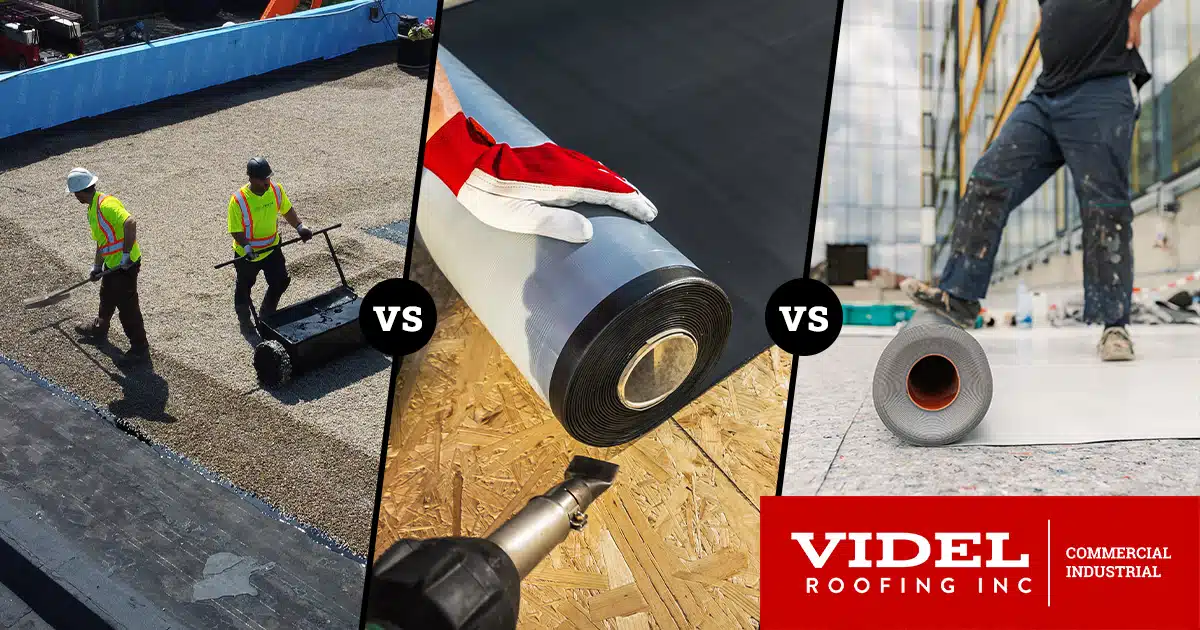
For heavy-traffic commercial and industrial roofs in Ontario, we recommend 4-ply Built-Up Roofing (BUR). The reasoning is straightforward:
- it delivers longer service life,
- handles trade traffic without compromising the barrier,
- and absorbs Ontario’s freeze-thaw cycle through its redundancy rather than through seam integrity alone.
A full comparison of BUR vs. TPO vs. EPDM vs. modified bitumen for Ontario commercial buildings covers the tradeoffs in detail. The short version: BUR costs more upfront, lasts longer, and protects the asset better over a 30-year hold.
Our commercial roofing materials page covers the specific suppliers and systems we work with, including the multi-ply assemblies from IKO Commercial and BP Canada, both of which are engineered for Canadian freeze-thaw performance.

Quantifying the decision for your building
The TPO vs. BUR choice is not universal. It depends on the building’s traffic profile, the owner’s hold period, the available upfront budget, and the projected service requirements. What looks cheaper upfront may or may not be cheaper over the full lifecycle.
Try our Flat Roof ROI Calculator to help you visualise the costs for your specific building. Simply choose your square footage, roof complexity, and the maintenance assumptions, and it compares the lifecycle cost of different approaches for up to 5 years. In most cases involving heavy-traffic commercial buildings on long holds, BUR comes out ahead even accounting for the higher upfront cost.
How long does a TPO roof last in Ontario?
Manufacturer warranties run up to 30 years. Real-world performance on Ontario commercial roofs typically sees meaningful wear starting at 15 to 20 years, with major seam and membrane issues common by year 20. Maintenance extends that, neglect shortens it.
Is TPO cheaper than BUR?
Yes, at installation. TPO is typically 15 to 25 per cent less expensive than a 4-ply BUR assembly of equivalent square footage. Over a 30-year hold, the cost comparison often flips once lifecycle replacement and maintenance are factored in. The Flat Roof ROI Calculator models this on a per-building basis.
Can TPO be repaired easily?
Small punctures and seam separations can be patched by heat-welding new TPO material over the damaged area. Larger membrane failures often require re-sectioning significant areas of roof rather than spot repairs, which is different from how plied systems are repaired.
Why don’t you recommend TPO for most Ontario commercial roofs?
Seam vulnerability under freeze-thaw, thinner membrane on roofs that carry trade traffic, and shorter real-world lifespan compared to 4-ply BUR. None of these are dealbreakers on every building, but for heavy-traffic commercial and industrial roofs held long-term, BUR generally outperforms TPO. See our guide to choosing flat roof materials for the full comparison.
What’s the best alternative to TPO for commercial roofing in Ontario?
For most commercial and industrial buildings in Ontario, 4-ply Built-Up Roofing (BUR) is our recommended alternative. A 2-ply modified bitumen system is the mid-range option for shorter hold periods or lower-traffic roofs. Both handle freeze-thaw cycling better than single-ply TPO.
Not sure what system to use for your flat roof?
Choosing a membrane system is one of the longest-consequence decisions on a commercial building.
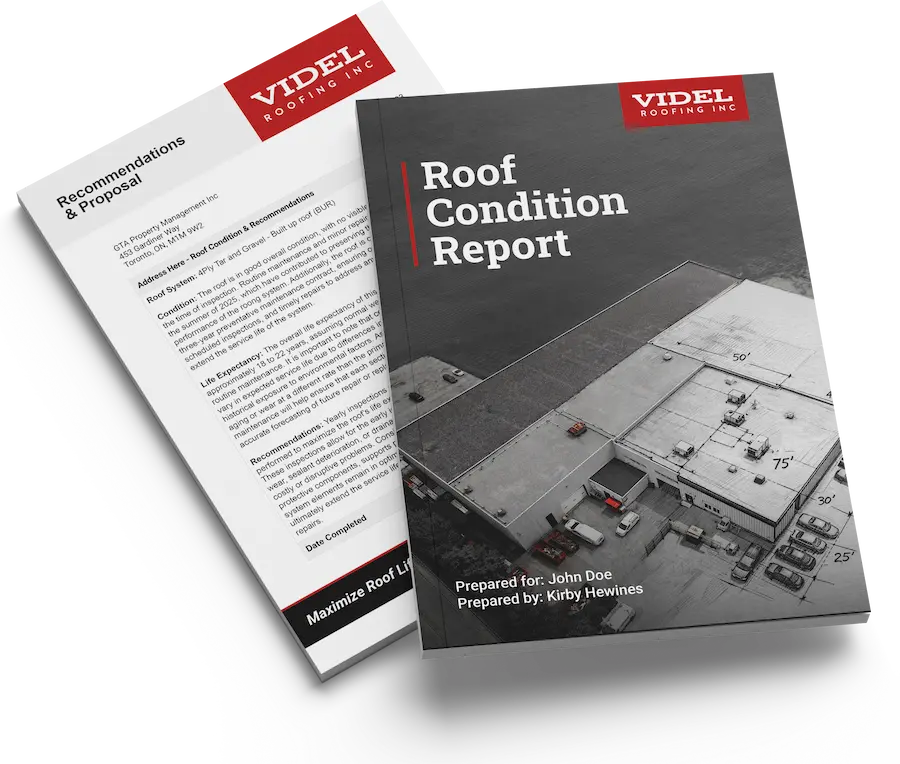
If you’re evaluating TPO, BUR, or modified bitumen for a new roof or a replacement, a free Roof Condition Report documents what’s currently on the building and what the right next system should be. Or call (905) 397-1198 to get a quote today!