
Key Takeaways
- A healthy flat roof should be completely dry within two days of rainfall; lingering water indicates structural deflection or saturated insulation that requires immediate attention.
- Silt and gravel buildup in drain bowls creates back-pressure, forcing water into membrane seals that would otherwise stay watertight during light rain.
- Identifying a minor flashing defect in April can defer a six-figure capital replacement for 5–10 years, preserving your building’s budget for tenant-facing upgrades.
- A professional spring inspection provides the paper trail necessary for insurance claims, property valuations, and defensible capital planning.
In Ontario, the transition from winter to spring puts a commercial building’s roofing system under a lot of stress. Freeze-thaw, snow load, and ice damming all leave their marks on a flat roof, and problems usually do start appearing until a major rainfall in spring.
A spring inspection is how you get ahead of that. At Videl Roofing, we recommend walking every commercial roof in late March or early April to catch any high-cost defects that occured during Winter and before the snow falls again.
Below is our spring flat roof maintenance checklist, written for someone who is not a roofer. Forward this to your property manager or a staff member with safe roof access. It should take under an hour to complete. If you would rather skip it and have one of our flat roofer experts handle the inspection, contact us online.
Spring Flat Roof Maintenance Checklist
1. Clear drains, scuppers, and overflow drains
A flat roof is only as good as its ability to stay dry. That’s why the first thing to cheak after winter is any debris (gravel, silt, wind-blown trash) blocking your drains.
- Clear strainers and bowls. Remove the “birdcage” strainers and manually clear the sump. Silt buildup in the drain bowl acts as a filter that slows water exit, causing back-pressure leaks at the drain seals.
- Scupper and overflow audit. Ensure scupper openings are unobstructed. Check the integrity of the metal-to-membrane seal around the scupper sleeve. Ice expansion often shears these connections.
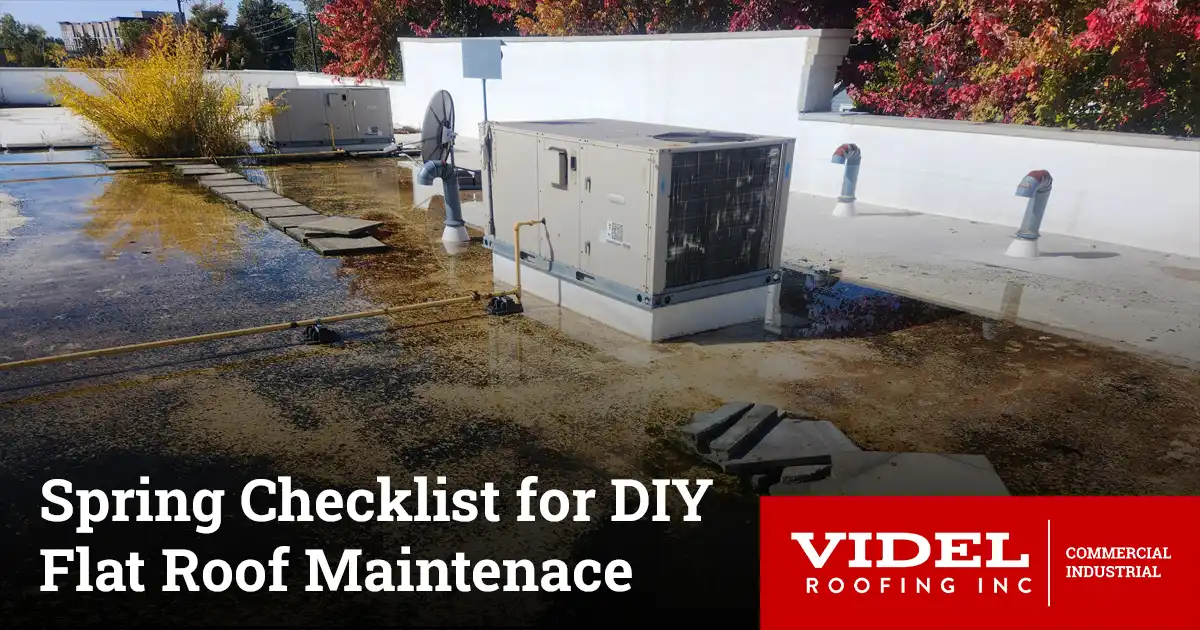
- The 48-hour rule. After a rainfall, the roof should be dry within 48 hours. Any remaining ponding water is a symptom of structural deflection or compressed insulation that requires immediate attention to prevent membrane checking.
A drain that is partially blocked will likely continue to work during a light rain. However, heavy rain falls tend to lead to more phone calls to our office asking for emergency leak repairs.
2. Membrane integrity and field analysis
Catching ponding early is the difference between a few thousand dollars in targeted repair and a partial tear-off later in the season. When we’re on a flat roof, here’s a few things we look for specific after winter:
| Defect Type | The Cause | The Risk |
|---|---|---|
| Splits/Ridges | Thermal expansion and contraction. | Immediate water entry to the insulation. |
| Blisters | Trapped moisture expanding in the sun. | Membrane puncture under foot traffic. |
| Granule Loss | Ice scouring or heavy foot traffic. | UV degradation of the underlying bitumen. |
A small ring of water within a few feet of a drain is normal, though something to keep an eye on. Standing water elsewhere on the roof usually means one of four things:
- The slope of the deck is inadequate.
- A drain is blocked or set too high.
- The tapered insulation that was supposed to direct water has compressed.
- The insulation under the membrane is wet and the assembly has slumped.
Be sure to photograph any ponding and note where it is. If the problem persists, drain replacement or installing a better drainage system may be needed.
3. Flashings and Terminations
Roughly 90% of roof leaks occur at transitions. This is where different materials (steel, masonry, bitumen) meet and move at different rates.
- Parapet walls. Inspect the reglet or termination bar. Winter ice often gets behind these bars, prying them away from the wall and creating an open throat for rain.
- Coping joints. Metal cap flashings expand in the spring sun. If the sealant in the joints has dried or cracked, water will run down the inside of the block wall, bypassing the roof membrane entirely.
- Mastic audit. Look for alligatoring in old repairs. If a previous roofer used temporary plastic cement (mastic), it likely cracked over the winter and needs a permanent reinforced patch.
One thing to pay close attention to is anywhere a previous roofer has applied a patch on top of a patch. We see this often where a flashing failed and somebody slathered mastic on it three years ago. When the mastic failed, another layer gets reapplied. This results in the whole detail with layers of DIY roof repairs that need to be fixed over and over again.
4. Equipment Penetrations
HVAC units, gas lines, and electrical conduits are common points of failure. The vibrations from rooftop units, combined with winter wind loads, can break the seal of pitch pockets or curbing.
- HVAC curbs. Flashing should be tucked securely under the unit’s counter-flashing. Look for separation at the corners, where movement concentrates.
- Pitch pockets. Top up with sealer if they have shrunk or cracked. They are notorious for holding standing water and are one of the first details to fail.
- Plumbing vent stacks. Pipe boots crack and split as they age. Lead boots tear at the top fold. EPDM boots split where UV has hardened them.
- Gas vents and B-vents. Storm collars and high-temp flashings degrade faster than standard penetrations because of the heat.
- Electrical conduits and rooftop disconnects. Often added after the original install, often poorly flashed.
- Exhaust fans and gravity vents. Curb flashing fails the same way HVAC curbs do, but smaller equipment gets less attention.
- Skylights. Look at the sealant bead at the curb-to-membrane junction and the condition of the skylight frame itself.
- Roof hatches. Hinges and lid seals get exercised constantly and the flashing around the curb takes the most foot traffic on the roof.
- Lightning protection cables and anchors. Adhered base plates lift at the edges. Through-bolted anchors are sometimes installed without proper flashing.
- Solar mounting points. Where present, every standoff is a penetration that needs the same attention as a vent stack.
When something at one of these details has failed (a torn pipe boot, a split pitch pocket, a separated curb flashing), the fix is rarely a top-up of sealant. Our roof penetration repairs cover the full range: pipe boots, pitch pockets, gas vents, conduit penetrations, and odd one-offs that may not have been flashed correctly to begin with.
We can also rebuild the detail with the right materials and the right geometry so it lasts the rest of the roof’s service life, not the rest of the season. For curb work specifically, our HVAC curb repair and installation handles any failing areas around a rooftop unit .
5. Document and prioritize
As you conduct a spring roof maintenance inspection, sort your findings into three buckets:
- Repair now: anything that will leak in the next significant rain.
- Repair within twelve months: defects that are not active leaks but may become an issue before fall.
- Capital planning: larger repairs or partial replacement to be budgeted over the next three to five years.
That document is what makes the year’s roofing spend defensible to ownership. It is also what protects you in an insurance dispute, what supports your numbers in a refinance, and what a buyer’s PCA will want to see if the building changes hands.
MAXIMIZE ROOF LIFE WITH A
Preventative Roof Maintenance Plan
Avoid surprise repairs and extend the time between costly replacements with expert maintenance tailored to your roof.
Reduce costly repairs
Prevent leaks & damage
Extend roof life
What spring maintenance saves you
A 30,000 square foot commercial flat roof replacement can cost between $12 to $17 per square foot. That works out to $360,000 to $510,000 in capital coming out of your building’s budget.
In contrast, identifying and fixing a $2,500 flashing issue in April often extends the life of that $500,000 asset by several years.
This is how we approach roof maintenance at Videl. Our goal is to defer a costly replacement for as long as the roof can safely support it. We’ve found that most commercial flat roofs in Ontario can run 5 to 10+ years past their expected end of service when they are properly maintained.
Here’s what that means:
- A six-figure capital expense is pushed years into the future.
- The freed budget goes to upgrades tenants actually notice: HVAC, lighting, parking, lobby, tenant improvements.
- Insurance renewals are easier because the roof has a documented inspection history.
- Sales, refinances, and lease renewals are easier because the roof has a paper trail.
- The building stays watertight without an emergency callout pattern.
You can model the savings on your own roof with our Flat Roof ROI Calculator.
Is Your Flat Roof Overdue for Spring Maintenance?
If it is safe to do so, building staff can walk the roof, clear visible debris from drains, and note what looks wrong.
However, a professional inspection becomes worth booking when:
- The roof has not been formally inspected in eighteen months.
- Any leak calls came in over the winter.
- Ponding is visible 48 hours after rain.
- Flashings show patches stacked on patches.
- An insurance renewal, sale, or refinance is on the horizon.
Want a flat roof expert to inspect your property?
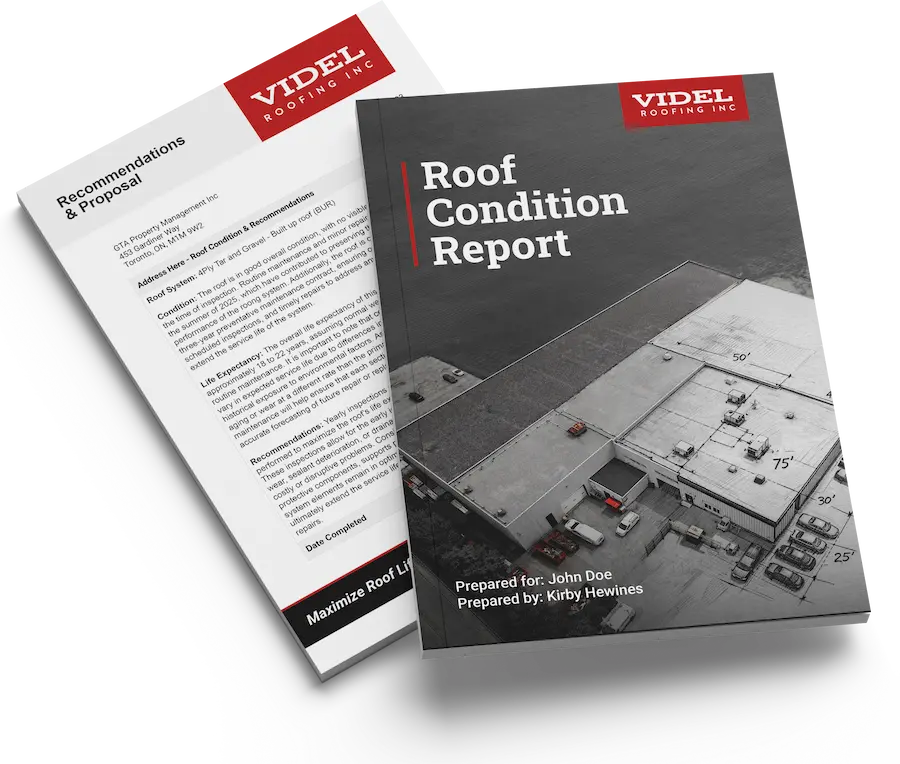
Contact us to schedule a time for us to pop by for a free Roof Condition Report on qualifying commercial properties across the GTA. The walkthrough takes a few hours and includes a written report with photos and defect locations. You get the documented baseline that everything downstream depends on, at no cost.
When should spring flat roof maintenance be done in Ontario?
Late March through early May. Wait until snow is fully off the roof and freeze-thaw has stopped, but get the inspection done before consistent spring rain begins.
What gets inspected on a commercial flat roof in spring?
Drains and scuppers first, then the membrane, then every flashing detail, then every roof penetration. Wet insulation gets checked with infrared or core sampling where the surface walk flags concerns.
How often should a commercial flat roof be inspected?
Twice a year. Once in spring after freeze-thaw ends, once in fall before the first hard freeze. Buildings over fifteen years old or with known drainage issues benefit from a third walk in mid-summer.
What does ponding water on a flat roof actually mean?
Standing water 48 hours after rain means the slope, the drains, or both are not doing their job. Ponding voids most membrane warranties and is a leading cause of premature roof failure. A small ring of water within a few feet of a drain is normal. Anything else is a defect.
Can building staff handle spring maintenance, or is a contractor required?
Staff can walk the roof, clear drain debris, and note obvious surface conditions. A contractor adds infrared scanning, core sampling, a written report with prioritized actions, and a defensible scope for any repairs.
If you want a documented baseline on your roof before this spring’s heavy rain, we provide a free Roof Condition Report for qualifying commercial properties across the GTA. Learn more about our Preventative Roof Maintenance Plan, then call (905) 397-1198 or contact us online for a free quote.