
Key Takeaways
- Reactive maintenance always costs more — not only in emergency repair bills, but in downtime, interior damage, premature replacement, and lost operational time.
- Proactive roof maintenance is the only approach that produces forecastable CapEx, documented records, and an extended roof life.
- A flat roof on a maintenance schedule typically lasts five to ten years longer than one that isn’t, based on our field data across 15 Ontario commercial properties.
There are two ways to run a flat roof: wait for something to fail, or prevent it from failing in the first place. Nobody chooses reactive maintenance on purpose. It happens because the roof is out of sight, the budget is tight, and the building has bigger fires to put out every month.
Then a drain clogs. A flashing pulls. A pipe freezes. And suddenly the building has a much bigger problem.
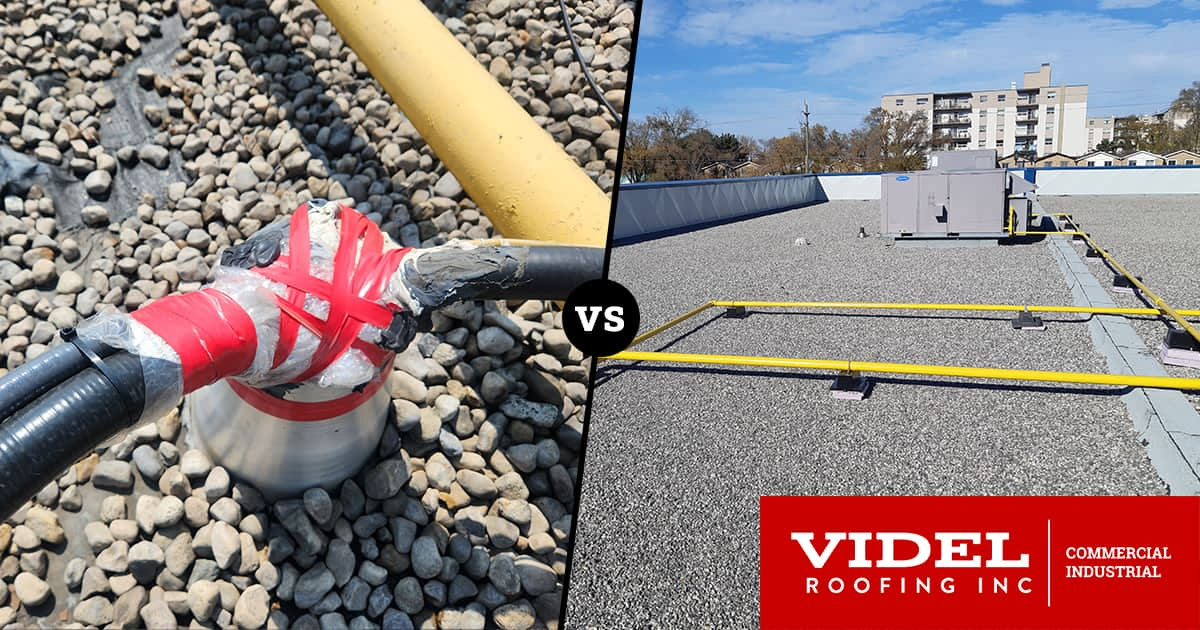
At Videl Roofing, we’ve documented the cost difference between these two approaches across the commercial and industrial properties we maintain in Ontario. The pattern is consistent. Reactive maintenance costs more, not by a little, but by a multiple — once you count emergency repair rates, interior damage, operational disruption, and the years of roof life that never get recovered.
This post breaks down what each approach actually looks like, what they cost in practice, and how to move a building from reactive to proactive before the next failure forces the decision.
Why this matters more than most buildings realize
A commercial flat roof protects millions of dollars in assets: the structure, the HVAC equipment, the inventory or tenants below, and the operational continuity of whatever the building exists to do. It’s also one of the most neglected systems in a building, because it’s invisible from ground level and doesn’t announce problems until they’ve already caused damage.
Two approaches exist. One waits for problems. The other prevents them. The difference between them compounds every year the roof is in service.
What reactive maintenance often looks like
Reactive maintenance means the roof gets attention only after something goes wrong. A leak appears on a ceiling tile. A tenant reports water pooling on their inventory. A section of membrane fails during a storm.
On the ground, it looks like:
- Emergency calls during storms or after hours
- Tarping and temporary patches applied under pressure
- Interior water damage repaired without addressing the roof cause
- Rushed replacement of large sections that failed prematurely
- Rates that reflect the urgency of the work, not the scheduled cost of it
It feels cheaper in the moment because nothing is spent until something breaks. But every dollar avoided in the short term typically costs three to five times more once the failure arrives, and that’s before counting interior remediation, downtime, and the shortened lifespan of the roof itself.
MAXIMIZE ROOF LIFE WITH A
Preventative Roof Maintenance Plan
Avoid surprise repairs and extend the time between costly replacements with expert maintenance tailored to your roof.
Reduce costly repairs
Prevent leaks & damage
Extend roof life
What proactive maintenance actually looks like
Proactive maintenance means the roof is inspected, documented, and maintained on a schedule that catches problems before they cause damage. The work happens in predictable windows, at planned cost, with records that survive beyond any one property manager’s tenure.
A proactive program includes:
- Twice-yearly inspections aligned to Ontario’s freeze-thaw cycle
- Seam, flashing, and membrane condition documentation
- Drain clearing and debris removal
- Targeted minor repairs performed on-site during inspection
- Photographic reporting for each visit, retained for insurance and resale
- A three-to-five-year outlook so CapEx planning stays ahead of major spend
The underlying principle is simple: every problem we document in its early form is a problem we’re not responding to at 2 a.m. in February.
Reactive vs. proactive: a direct comparison
| Reactive Maintenance | Proactive Maintenance | |
|---|---|---|
| When Action Happens | After damage is visible or urgent | On a set schedule—before issues become critical |
| Cost Predictability | Unpredictable, often high | Budgeted, consistent |
| Repair Costs | Emergency rates, rushed labor | Planned repairs at lower cost |
| Roof Lifespan | Often shortened due to delayed care | Extended 3–5+ years with proper upkeep |
| Operational Impact | Disruptions, shutdowns, risk of interior damage | Minimal—work is planned around your schedule |
| CAPEX Planning | Difficult—expenses come as surprises | Easier—issues are forecasted and phased |
| Compliance & Records | Rarely documented | Fully documented with photo reports |
| Risk Exposure | High—issues go unnoticed until damage occurs | Low—risks are flagged early and addressed in time |
| ROI | Poor—money often spent after damage is done | Strong—maximizes existing asset before replacement |
Roof Maintenance Is Like Car Maintenance: If You Ignore It, You Pay the Price
Nobody drives a car 100,000 kilometres without changing the oil. The consequences are too familiar. The oil breaks down, the engine wears, small issues compound, and eventually the choice is a seized engine or a replacement. All of it avoidable with a $100 service every few months.
Commercial flat roofs work the same way. They continue doing their job quietly for years. Then one day a storm hits, or a drain finally overflows, or a split seam lets water into the insulation. The call comes in as an emergency, and the bill arrives with it.
The maintenance program we run is the equivalent of an oil change: scheduled, minor, and cheap relative to the cost of skipping it. What gets caught on a spring inspection is a clogged drain that gets cleared in 15 minutes. What doesn’t get caught on that inspection is the interior damage you’re mopping up in June.
The ROI of proactive maintenance, quantified
The conversation about reactive vs. proactive always comes back to cost. Not the cost of the inspection — the cost of everything the inspection prevents. Those numbers are specific to each building, but they’re not hypothetical. They’re the difference between:
- Scheduled repair rates vs. emergency response rates
- A 30-year roof life vs. a 15 to 20-year roof life forced by neglect
- Predictable annual maintenance spend vs. unbudgeted emergency invoices
- Insurance claims supported by documentation vs. claims disputed for lack of records
- Zero tenant disruption vs. interior damage that affects lease renewals
We built the Flat Roof ROI Calculator specifically for this conversation. It lets you input your building’s square footage, current condition, and maintenance history, then compares the lifecycle cost of a proactive plan against the projected cost of continuing reactively. Most properties that run the numbers discover the maintenance plan pays for itself within two years.
What a proactive maintenance plan includes
Our Preventative Roof Maintenance Plans are built around the condition and specific system of each building. Whether the property is a food processing facility, a commercial building under property management, or a multi-site industrial portfolio, the structure of the plan is consistent:
- Annual or bi-annual inspections scheduled to Ontario’s climate
- Full condition reports with high-resolution photographs
- Seam, flashing, and membrane assessments
- Drain clearing and debris removal
- Targeted minor repairs completed during the inspection visit
- Documentation formatted for insurance, audit, and internal records
Every plan is backed by our $5,000,000 liability insurance on the jobsite.
Ready to move from reactive to proactive?
The starting point for any building without a current maintenance record is a documented baseline. We can’t plan forward without knowing what’s there today.
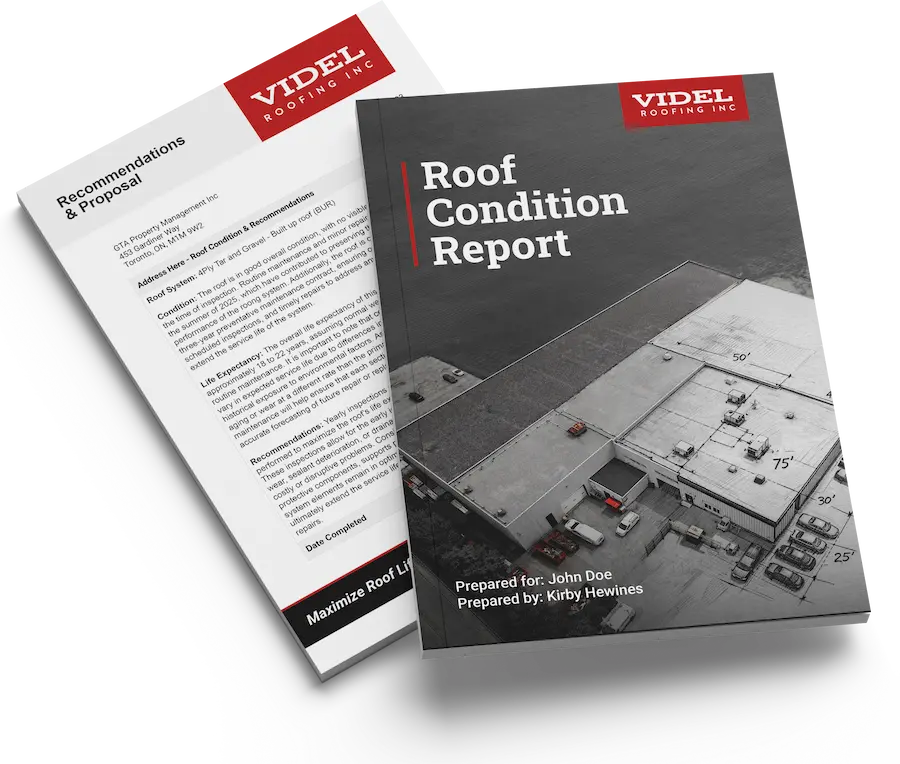
That baseline is the free Roof Condition Report. It identifies the current membrane type, insulation condition, drainage performance, and three-to-five-year outlook. From there, the maintenance plan is built around what the roof actually needs, not what a template assumes.
For properties across Toronto and the GTA, our offices in St. Catharines and Mississauga handle scheduling across both regions.
Is proactive maintenance worth it on a newer roof?
Yes, and in some ways more than on an older roof. New roofs start with a warranty, and most warranties require documented maintenance to remain valid. A proactive plan protects both the warranty and the decades of performance the roof was installed to deliver.
How much does a commercial roof maintenance plan cost?
It varies by roof size, system type, and condition. For most mid-sized commercial and industrial properties in Ontario, annual maintenance is measured in cents per square foot. The Flat Roof ROI Calculator provides building-specific numbers based on actual inputs.
Can proactive maintenance actually extend roof life?
Yes, typically by five to ten years on a commercial flat roof. Our field data across 15 Ontario properties shows a consistent pattern: maintained assemblies outlive neglected ones by a significant margin, often long enough to change the replacement decision entirely.
What’s the first step if our building has no maintenance history?
Request a free Roof Condition Report. It establishes the baseline without committing to a plan, and the documentation it produces is yours to keep regardless of what you do next.
Is reactive maintenance ever the right choice?
Only in narrow cases: a building on the edge of demolition, a roof scheduled for replacement within 12 months, or a property being sold where the new owner will handle the decision. For any other commercial building, reactive maintenance is a deferred cost that arrives with interest.