
Key Takeaways
- Single-ply roofs are installed as one sheet of membrane (TPO or EPDM).
- Built-up roofs use multiple layers of asphalt and reinforcing felts bonded into one assembly.
- Under Ontario freeze-thaw cycling, single-ply seams are the most documented for failure. BUR’s staggered plies distribute stress across the whole assembly, lasting longer and surviving damage better.
- On buildings with heavy rooftop equipment or high tenant risk, BUR’s lifecycle cost is lower than single-ply replaced twice.
A flat roof replacement quote usually comes with a system recommendation attached such as: TPO, EPDM, modified bitumen, or a 4-ply built-up roof. For property owners, the question is whether this recommendation is actually right for the building, or whether it’s the system that’s easiest for the contractor to install.
Hint: you may not need to replace you roof. We’ve found that 80% of flat roof are replaced prematurely.
But in this post, we’re comparing two main categories of flat roof systems installed on commercial and industrial buildings across Ontario:
- Single-ply membrane (TPO and EPDM) versus built-up roofing (BUR).
Keep reading to uncover the differences in installation, cost, lifespan, performance under freeze-thaw, and which buildings are the right fit for each.
What is a Single-ply Membrane Roof?
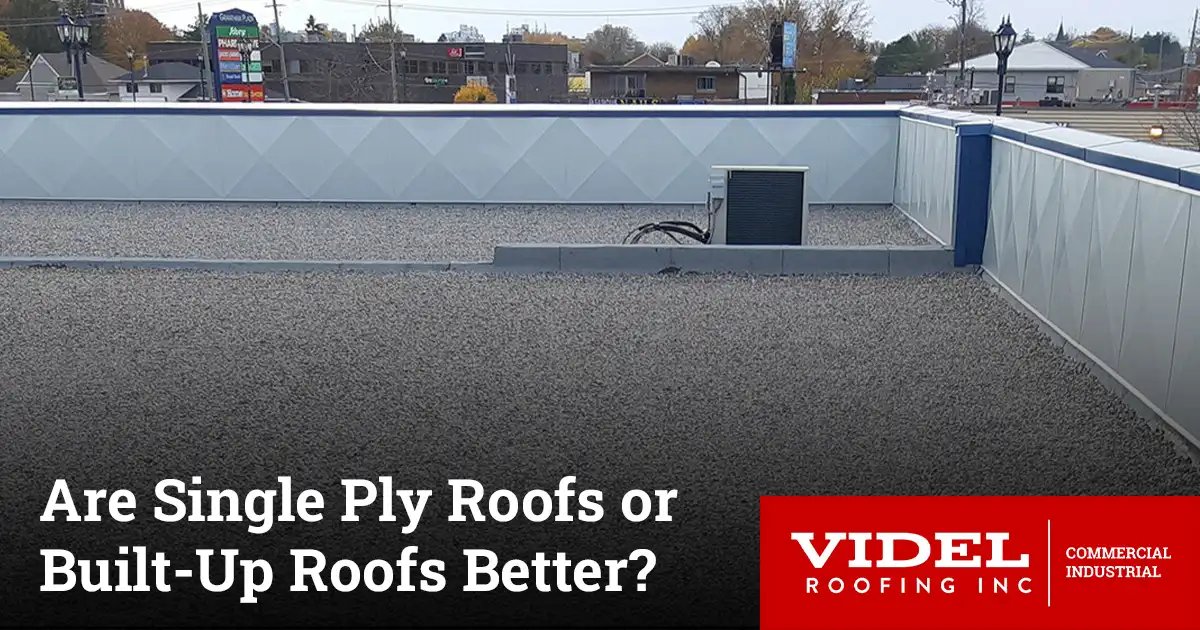
Single-ply membrane is exactly what the name says: one sheet of synthetic material rolled out across the insulation and cover board, with seams welded or taped together where sheets meet. Two systems dominate the single-ply market:
- TPO (Thermoplastic Polyolefin). White reflective surface, heat-welded seams, widely used on newer commercial construction.
- EPDM (Ethylene Propylene Diene Monomer). Black rubber membrane, seams adhered with tape or glue, long track record on older commercial buildings.
Single-ply roofs install quickly. A crew can cover a large commercial roof in a few days, the materials are relatively cheap, and the installation technique is easier to train. That combination is why single-ply dominates the North American commercial roofing market by volume.
But is it the right fit for Ontario’s four seasons? We’ll go into that in a moment.
What is a Built-up Roof (BUR)?
Built-up roofing is a layered assembly. The roof is constructed on site from multiple plies of asphalt-saturated felt, bonded with hot bitumen, and finished with a cap sheet or gravel ballast. A standard 4-ply BUR includes a base sheet, three plies of felt, and a cap sheet or flood coat, all fused into a single monolithic waterproofing system.
BUR has been installed in North America for more than 100 years, and the reason it persists on serious commercial and industrial buildings is redundancy. Every layer is part of the waterproofing system. No single seam or sheet is responsible for keeping water out. For the technical background on how BUR assemblies are engineered, GAF’s overview of built-up roofing is a good reference.
Side-by-side Comparison of Single-ply vs BUR
| Factor | Single-Ply (TPO/EPDM) | 4-Ply Built-Up Roofing |
|---|---|---|
| Layers of waterproofing | 1 | 4 |
| Installed cost (per sq ft) | $3.50 to $7.00 | $8.50 to $14.00 |
| Expected lifespan | 15 to 20 years | 25 to 30+ years |
| Install time (20,000 sq ft) | 2 to 4 days | 5 to 7 days |
| Redundancy | None | Yes (3 backup plies) |
| Foot traffic resistance | Low (punctures frequent) | High (gravel ballast or cap sheet) |
| Seam vulnerability | High (welded or taped) | Low (lapped and staggered) |
| Freeze-thaw performance | Moderate to poor | Excellent |
| Typical warranty | 15 to 20 years | 20 to 30 years |
| Repair complexity | Requires matching membrane and hot-air welder | Localized patching possible |
Cost ranges are general Ontario estimates for a full tear-off replacement, including insulation, membrane, and standard flashings. Actual quotes vary with roof size, deck condition, tapered insulation requirements, and site access.
Installation: how each system goes on the roof
Single-ply installation
Single-ply goes on fast. The existing roof is prepped (torn off or recovered), insulation and cover board are laid down, and the membrane is rolled out in sheets. Seams are welded with a hot-air gun for TPO, or taped and adhered for EPDM. The membrane is attached to the roof in one of three ways: mechanically fastened, adhered with bonding agent, or ballasted with stone. A single crew can complete a 20,000 sq ft install in 2 to 4 days on a straightforward roof.
BUR installation
BUR takes longer and requires a skilled crew. A base sheet is laid first, mechanically fastened or adhered to the cover board. Then three to five plies of asphalt-saturated felt are mopped into hot bitumen one at a time, each ply overlapping the last, with seams staggered across the assembly so no two seams ever align. A cap sheet or flood coat with gravel ballast is applied as the top surface.
For our crew at Videl Roofing, the whole process takes 5 to 7 days on a 20,000 sq ft roof, and requires crews trained in hot asphalt application, fire safety, and multi-layer sequencing.

Cost: up front vs over 25 years
Up-front cost is where single-ply wins, and it’s usually the first number contractors highlight in a quote. For an owner comparing bids on a single replacement event, the $5 to $10 per square foot gap between single-ply and BUR can look decisive.
The picture changes when you run the numbers across a 25-year hold.
- A single-ply roof installed at $5 per square foot with a 15-year lifespan will be replaced at least once during that period, and likely twice if the ownership group holds the building for 30 years. Each replacement means a new tear-off, new insulation (or insulation reuse if conditions allow), new membrane, and new tenant disruption.
- A 4-ply BUR installed at $12 per square foot lasts 25 to 30 years on a proper maintenance schedule. One install, one replacement cycle, one round of tenant disruption.
The total lifecycle cost of BUR is often lower than single-ply replaced twice, and that’s before factoring in insurance exposure, tenant interior claims, and the emergency repair cost of single-ply seam failures that compound between replacements.
For property owners planning a replacement and looking to reduce upfront cost without cutting corners on the roof system, reusing existing insulation is often an option when the insulation is dry and intact. Keeping the sound insulation in place while replacing the membrane above it is a legitimate cost-saving strategy on either a BUR or a modified bitumen install.
Performance: how each system holds up in Ontario
Ontario’s climate is harder on flat roof systems than most of North America. Between November and April, a commercial roof cycles through freezing and thawing dozens of times. Snow load, ice damming at drains, UV exposure in summer, and thermal shock from rapid temperature swings all stress the membrane in different ways.
Where single-ply struggles
Single-ply roofs have one membrane and the seams that hold that membrane together. A seam that opens under thermal stress, or a membrane that shrinks and pulls away from a parapet, or a sheet that splits from foot traffic, all produce the same outcome: the roof leaks. There’s no backup layer.
The failure modes we document on single-ply roofs in Ontario include:
- Seam separation on EPDM from adhesive breakdown under freeze-thaw cycling
- Heat-weld failures on TPO at field seams, perimeter details, and penetrations
- Membrane shrinkage on aging EPDM, pulling at perimeter flashings and corner details
- Puncture damage from foot traffic, dropped tools, or HVAC service equipment
- UV-driven surface cracking on older TPO installs, particularly on south and west exposures
A single-ply hit by any of these failure modes leaks until it’s repaired. There’s no redundancy.
Where BUR holds up
BUR handles freeze-thaw differently because the assembly absorbs the stress across multiple layers rather than concentrating it at a single seam. If the cap sheet blisters or the top ply cracks, the three plies below are still bonded and waterproof. The roof stays dry while the defect is diagnosed and repaired.
Mechanical damage from foot traffic or dropped tools rarely penetrates all four plies. Thermal movement distributes across the assembly rather than concentrating at welded seams. The mass of the roof absorbs temperature cycling in a way that single-ply cannot.
The result, over 25 years in Ontario, is a roof that fails slowly and predictably rather than suddenly and expensively.
Advantages and disadvantages at a glance
Single-ply membrane
Advantages:
- Lower up-front installation cost
- Faster install time (2 to 4 days on most commercial buildings)
- TPO’s reflective surface can reduce cooling loads in summer
- Lightweight, suitable for structures with load restrictions
- Easier for crews to install correctly
Disadvantages:
- Single layer of waterproofing, no redundancy
- Seam failure is the most frequently documented defect
- Shorter lifespan (15 to 20 years in Ontario)
- Puncture-prone, vulnerable to foot traffic and service work
- Replacement cycles often land twice within a 30-year hold
Built-up roofing (BUR)
Advantages:
- Four layers of waterproofing, true redundancy
- Longer lifespan (25 to 30+ years)
- Excellent impact and traffic resistance
- Proven performance under Ontario freeze-thaw
- Gravel ballast protects membrane from UV and hail
Disadvantages:
- Higher up-front cost (roughly 30 to 50 percent more than single-ply)
- Longer install time (5 to 7 days on most commercial buildings)
- Heavier assembly, structural load must be verified
- Requires skilled crews with hot asphalt experience
- Not suitable for structures with strict weight limits
A real example: 4-ply BUR replacement on a Brampton plaza
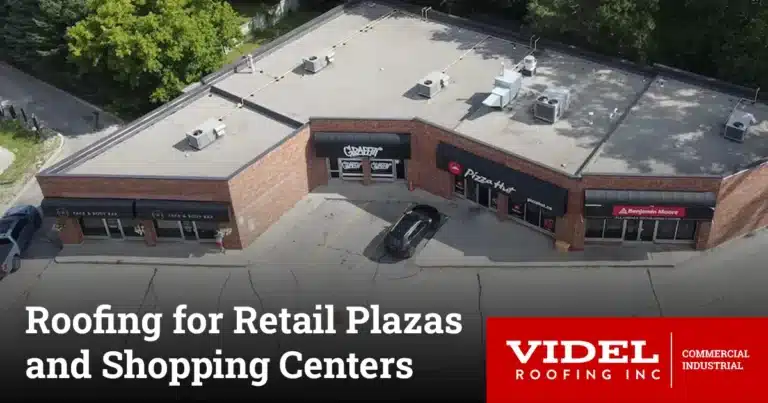
We were hired for a flat roof replacement on a multi-tenant commercial plaza in Brampton. The building’s existing roof had reached end of life, with failed flashings, membrane splits, and drainage issues that were starting to affect tenant spaces below. The property owner had been quoted a single-ply replacement by another contractor. We recommended a 4-ply BUR instead.
The decision came down to what the roof actually had to endure. The plaza has regular rooftop equipment, service traffic, and tenant activity that would have put a single-ply membrane under continuous stress for its entire service life. A 4-ply assembly was the right spec for the building’s long-term ownership timeline.
Take a look at the full project breakdown, including scope, timeline, and on-site photos, in our Brampton roof replacement case study.
Which system is right for your building?
The right answer depends on three things: how long you plan to hold the building, what the roof has to endure, and what a premature failure would actually cost.
Specify BUR when:
- The ownership hold is 15+ years
- The roof carries heavy rooftop equipment or regular service traffic
- The building is a commercial plaza, industrial facility, food processor, or warehouse
- A leak above the tenant space would trigger claims, shutdowns, or inventory loss
- You’ve already replaced a single-ply on this building once
Specify single-ply (TPO or EPDM) when:
- The building’s structural load cannot support a full 4-ply assembly
- The hold is short (5 to 10 years) and the upfront cost gap matters
- The roof has minimal rooftop equipment and light traffic
- Reflective surface (TPO) is a priority for cooling load reduction
- Budget is the binding constraint and the tradeoff is accepted
The fastest way to get an honest answer is an on-site inspection. A contractor should walk the roof, check the deck, measure the existing insulation, document drainage conditions, and put a specification in writing before issuing a quote. If the recommendation comes without any of that, the recommendation is a guess.
Is Built-up Roofing always better than single-ply?
No. Builit-up roofing (BUR) is just the better choice on buildings with long holds, heavy rooftop activity, or high tenant risk. Which, we find, describes the majority of commercial and industrial buildings in Ontario. Single-ply can be the right choice on smaller buildings with light rooftop activity, short ownership holds, or structural load restrictions that rule out the weight of a full BUR assembly.
How many plies are in a built-up roof?
Commercial BUR installations in Ontario are typically either 4-ply or 5-ply. A 4-ply assembly uses a base sheet, three plies of asphalt-saturated felt, and a cap sheet or flood coat. A 5-ply adds one additional ply of felt for extra redundancy, typically specified on roofs with especially heavy service loads or long service life expectations.
Will documented maintenance help with an insurance claim?
Documented inspection and repair records help establish the condition of the roof before a loss event, which supports the distinction between covered sudden damage and excluded wear or neglect. Coverage specifics and documentation requirements vary by carrier and policy, so property managers should confirm expectations directly with their insurer. The Insurance Bureau of Canada publishes general guidance on commercial property coverage.
What’s the difference between TPO and EPDM?
TPO is a thermoplastic membrane, usually white, with heat-welded seams. EPDM is a synthetic rubber membrane, usually black, with seams adhered using tape or glue. Both are single-ply systems. TPO is more reflective and reduces summer cooling loads. EPDM has the longer field track record but its adhered seams are more vulnerable to failure under Ontario freeze-thaw than TPO’s heat-welded seams.
Can you install BUR over an existing roof?
Sometimes, but it depends on the existing roof’s condition, the current insulation, and the structural load capacity of the building. BUR installs we perform are predominantly full tear-offs rather than overlays, because adding the weight of a new 4-ply assembly over an existing roof often exceeds what the deck was designed to carry. A structural assessment is required before any overlay decision.
Which system has the longer warranty?
Warranty length depends on the manufacturer and the installer, not the system category alone. BUR manufacturers typically offer warranties in the 20 to 30 year range. Single-ply manufacturers typically offer 15 to 20 year warranties, with some extended-warranty options available on premium products. The more important question is what the warranty actually covers: materials only, or materials plus workmanship.
What’s the cheapest flat roof system?
EPDM is typically the cheapest to install, with costs starting around $3.50 per square foot. TPO is close behind at $4.50 per square foot and up. The cheapest system to install is rarely the cheapest system to own, because replacement cycles and repair costs accumulate over the roof’s shorter lifespan. Total cost of ownership is the number that matters.
Get a free spec recommendation for your roof
Whether the right answer for your building is single-ply, modified bitumen, BUR, or a targeted repair, the specification should be based on an on-site assessment, not a phone call. Learn more about our flat roof replacement service, or call (905) 397-1198 or contact us online for a free quote.