
Key Takeaways
- Ponding water, separated flashing, blisters, ceiling stains, loose membrane, and age are the six issues that turn into expensive leaks fastest.
- Most of these start as small defects that a walk-over catches in an hour and a repair crew fixes in a day.
- Ignored, the same defects pull insulation, deck, and interior finishes into the repair scope.
- Ontario’s freeze-thaw cycle accelerates every one of these problems between November and March.
- A documented inspection tells you what needs attention now versus what you can budget for next year.
Flat roofs take a beating. Foot traffic from HVAC service techs, ponding water after a heavy rain, freeze-thaw cycles that pull seams apart through the winter. On a commercial or industrial building, the roof is doing more work than any other part of the envelope.
Catching problems early is the difference between a $2,000 repair and a $200,000 replacement. The six signs below are the ones we see most often on properties across Ontario, and they’re the ones building owners tend to miss until water is already inside.

Sign 1: Water Ponding Across the Roof
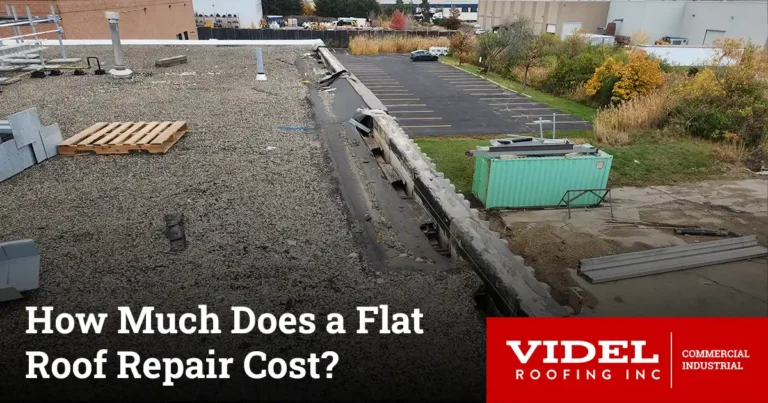
Ponding water is water that’s still sitting on the roof 48 hours after the rain stops. It’s the single most common defect we document on commercial roofs across Toronto and the GTA, and it’s almost always caused by one of three things: clogged drains, insufficient slope, or compressed insulation under a low spot.
Standing water degrades the membrane, concentrates UV damage, and freezes in place every winter. Once it freezes, it expands, lifts seams, and opens the path for the next thaw to get underneath.
What to do: Clear the drains first. If the pond is still there a day later, the slope or the insulation underneath is the problem, and that’s a flat roof repair scope, not a maintenance item.
Sign 2: Flashing That’s Pulling Away from Walls or Curbs
Flashing is the metal or membrane detail that seals the transition between the flat field and anything vertical: parapet walls, HVAC curbs, skylights, roof drains. When flashing lifts, opens, or separates, water gets in behind it and runs down inside the wall cavity, not across the roof where you’d see it.
This is one of the most underestimated problems on a flat roof. The membrane itself can be fine and you still have an active leak because a single flashing detail has failed.
What to do: Every flashing transition should be inspected at least twice a year. Repairs are typically straightforward: re-terminating, re-caulking, or replacing the failed section. If multiple details are failing at once, that’s usually a workmanship issue from the original install and worth a closer look.
Sign 3: Blisters and Ridges in the Membrane
Blisters are bubbles where moisture or air is trapped between the layers of the membrane or between the membrane and the substrate. Ridges are long, raised lines, usually over a seam or a fastener row.
Both happen for the same reason: something is moving under the membrane that shouldn’t be. On a BUR (built-up roof), blisters often come from moisture that got into the insulation during install. On TPO or EPDM, they usually mean adhesion has failed or the substrate is wet.
Small blisters aren’t urgent. Large ones, clusters, or blisters near seams and drains are. Once a blister splits, you have an open leak path straight to the insulation.
What to do: Have them mapped and photographed in a Roof Condition Report so you can watch for growth. If they’re already split or concentrated around penetrations, repair them before the next freeze cycle.
Sign 4: Water Stains on Interior Ceilings
By the time you see a stain on the ceiling tile or drywall below the roof, water has already gotten through the membrane, soaked the insulation, and run along the deck until it found the path of least resistance. The stain rarely lines up with the actual leak point on the roof.
This is an active leak. The insulation under that area is almost certainly wet, which means you’re losing R-value, growing mould risk, and adding dead weight to the deck.
What to do: Don’t patch the ceiling and move on. Trace the leak back to the roof, document the failure point, and fix it. If the insulation underneath is saturated, that section has to come out too — dry insulation doesn’t reappear on its own, and wet insulation will keep telegraphing problems through the membrane above it.
Sign 5: Membrane That’s Lifting, Flapping, or Loose at the Edges
High winds across an open flat roof can catch a loose edge and pull a sheet of membrane right off the deck. Once that happens, the whole section is exposed, and you’re now in emergency leak repair territory.
What usually fails first: perimeter edge metal, fastener rows near parapets, and termination bars at roof-to-wall transitions. If you’re walking the roof and you hear the membrane flutter under your feet, or you see it lift in the wind, it’s already failing.
What to do: Re-secure the perimeter and replace any sections that have lost adhesion or mechanical attachment. This is not a DIY fix — the fasteners, plates, and bar terminations have to match the original assembly or you’ll just fail at the next attachment point.
Sign 6: A Roof That’s at or Past Its Expected Life
Most commercial flat roofs in Ontario are rated for 20 to 30 years, and the ones that hit 30+ years almost all had a real maintenance plan behind them. The ones that fail at 12 to 15 years usually didn’t.
Age on its own isn’t a reason to replace. A 28-year-old 4-ply BUR with good drainage and intact flashings can outlast a 10-year-old TPO that was installed over wet insulation. What matters is the condition, not the calendar.
What to do: Once a roof is past year 15, it needs an annual documented inspection, not just a visual check. The report should flag what’s failing now, what’s expected to fail in the next 3 to 5 years, and what budget window you’re looking at for replacement.
What’s Actually Causing the Deterioration
The six signs above are symptoms. The causes are shorter to list:
- Ontario’s freeze-thaw cycle. Water gets into a small defect in the fall, freezes and expands through winter, and the defect is twice as big by spring. This is the single biggest driver of flat roof failure in this climate.
- Drainage that never worked properly. Undersized drains, wrong placement, or flat sections with no slope. These issues get built in at construction and stay until the roof is replaced.
- Workmanship on the original install. Missed fasteners, poor flashing details, wet insulation rolled in during a bad-weather install. Problems that show up 5 to 10 years later and get blamed on age.
- No maintenance plan. A roof with nobody responsible for it drifts toward failure. Drains fill with debris, seams open up, blisters grow, and nobody logs any of it.
- Foot traffic from service work. HVAC, telecom, solar, satellite. Every technician on the roof is a potential source of membrane damage, and most of them don’t report what they did or where.
MAXIMIZE ROOF LIFE WITH A
Preventative Roof Maintenance Plan
Avoid surprise repairs and extend the time between costly replacements with expert maintenance tailored to your roof.
Reduce costly repairs
Prevent leaks & damage
Extend roof life
How a Roof Condition Report Catches All Six of These
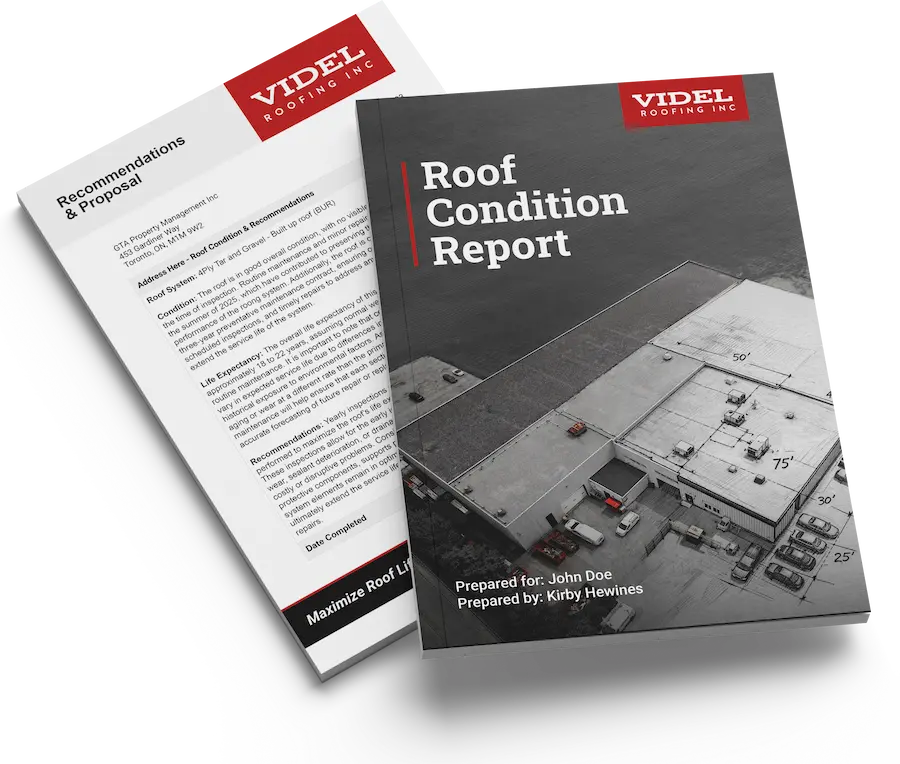
A proper Roof Condition Report documents every one of the signs above with photos, locations, and severity. You get a single deliverable that shows you what’s failing now, what’s going to fail in the next 3 to 5 years, and what the repair or replacement scope looks like.
That’s different from a quick look from a ladder or a verbal update after a service call. A documented report is something you can hand to ownership, a lender, an insurance broker, or a second roofer for a quote. It doesn’t need you to explain it.
Every Videl RCR includes 50+ inspection points across the field, perimeter, and penetrations. See what’s in the report.
When to Repair vs. When to Replace
One or two of these signs in isolation almost always means repair. Multiple signs across the same roof, or signs concentrated in the same section, usually means the assembly underneath is compromised and you’re looking at partial or full replacement.
The tipping point is wet insulation. Once the insulation is saturated across more than 20 to 25% of the roof area, spot repairs stop making economic sense. You’re paying to fix the symptom while the underlying system keeps failing.
A Roof Condition Report will tell you where you are on that spectrum. If the numbers point toward replacement, the Flat Roof ROI Calculator will show you what reactive repairs are actually costing you compared to a planned replacement.
Showing Signs Your Flat Roof Needs Immediate Repair?
You don’t need to guess which of these signs is on your roof. Get a Free Roof Condition Report and we’ll document everything: ponding locations, flashing failures, blister counts, membrane condition, and where you stand on the repair-versus-replace question.
Call (905) 397-1198 or contact us online. We’ve been serving commercial and industrial properties across the GTA, Niagara, Hamilton, and southwestern Ontario since 1998.
How often should a commercial flat roof be inspected?
Twice a year is the standard: once in spring after the freeze-thaw cycle and once in fall before winter. Roofs past year 15 or with known drainage issues benefit from a third inspection after any major storm. Each inspection should be documented with photos, not just a verbal update.
Can I repair a flat roof in winter?
Emergency leak repairs can be done in winter, but most membrane work needs surface temperatures above 5°C and a dry deck to bond properly. Hot-applied BUR and most adhesives have temperature minimums that Ontario’s winter rarely meets. If a leak starts in January, the right move is a temporary repair to stop the water, then a permanent fix when conditions allow.
What’s the cheapest flat roof problem to ignore?
None of them. Ponding water, open flashing, and small blisters are all cheap to fix early and expensive to ignore. The cost curve is not linear: a $1,500 flashing repair becomes a $15,000 insulation-and-membrane repair once water gets in, and that becomes a $150,000 tear-off once the deck is compromised.
How do I know if my roof is leaking if I don’t see stains inside?
Ceiling stains are the last symptom, not the first. Earlier signs include elevated humidity in the top floor, musty smells near exterior walls, higher heating bills (wet insulation loses R-value), and visible damage on the roof itself. A documented inspection finds leaks before they show up indoors.
Is it normal for a flat roof to have some water on it after rain?
Some water during and immediately after rain is normal while drains clear. Water still sitting on the roof 48 hours later is not normal and indicates a drainage problem, whether from clogged drains, insufficient slope, or compressed insulation under a low spot.