
Key Takeaways
- Two inspections per year, aligned to Ontario’s freeze-thaw cycle, prevent most of the failures that cause premature roof replacement.
- 80% of premature roof replacements are avoidable. Most start as a 20-minute fix someone skipped.
- Insurance carriers increasingly require documented maintenance. Without records, a denied claim after a leak is common.
- Drain clearing and HVAC curb inspection are the two items property managers under-schedule most — and the two that cause the most interior damage when missed.
- Deferred maintenance compounds. Small items become leaks, leaks become interior damage, and interior damage becomes coverage disputes.
If you manage a commercial or industrial property in Ontario, your flat roof is under constant stress. The climate swings from sub-zero winters to humid 30-plus-degree summers, and the membrane absorbs every degree of it. Left alone, a roof that should serve the building for 30 years can be compromised in half that time.
After nearly three decades of working on flat roofs across southern Ontario, there’s a common theme: the roofs that reach or exceed their design life are almost always the ones that have been inspected on a regular schedule. The ones that don’t are rarely the victims of bad material choices or poor installation. They’re the ones no one walked between the day they were installed and the day they started leaking.
This guide covers what a real commercial roof maintenance program looks like in Ontario, why each element matters, and how property managers can use maintenance documentation to protect both the asset and the insurance coverage on it.

Why Ontario’s Climate Changes the Maintenance Equation
A commercial flat roof in Toronto, Hamilton, or St. Catharines does not fail the way a roof in Atlanta or Phoenix fails. The failure modes here are shaped by three conditions that rarely coincide elsewhere in North America.
Freeze-thaw cycling
Southern Ontario typically sees dozens of freeze-thaw transitions between November and April. Every cycle pulls moisture further into membrane seams, flashings, and insulation boards. A pinhole or micro-split that would sit dormant in a dry climate becomes an active failure pathway here within a single winter.
Thermal cycling of the membrane
Membrane temperatures on a black roof in July can reach 70°C or higher on a 30°C day. The same surface in January can sit below -15°C. That temperature differential causes the membrane to expand and contract repeatedly, stressing seams and fasteners. As covered in our guide to R-value for flat roofs, adequate insulation slows the rate of thermal transfer and directly extends membrane life.
Ponding and ice loading
Flat commercial roofs rely on drainage geometry to shed water. When drains clog, slope is inadequate, or snow accumulates unevenly, water sits. In summer that water degrades the membrane. In winter it freezes, expands, and pries at seams and flashings. Tapered insulation resolves this at the design level during a replacement. Maintenance catches it between replacements.
What a Professional Commercial Roof Inspection Covers
A proper inspection is not a walk-around with a clipboard. It’s a documented assessment of every failure pathway the roof system has, with photographs, measurements, and a projected timeline for each item flagged.
Here is what gets documented on every inspection we conduct.
Membrane and surface condition
- Blisters, pinholes, and surface degradation — typically worst on south-facing exposures.
- Seam integrity — split seams are the first indicator of freeze-thaw stress.
- Granule loss on cap sheets, UV checking, and soft spots underfoot.
- Base and counter flashings at walls, parapets, and penetrations.
Drainage system
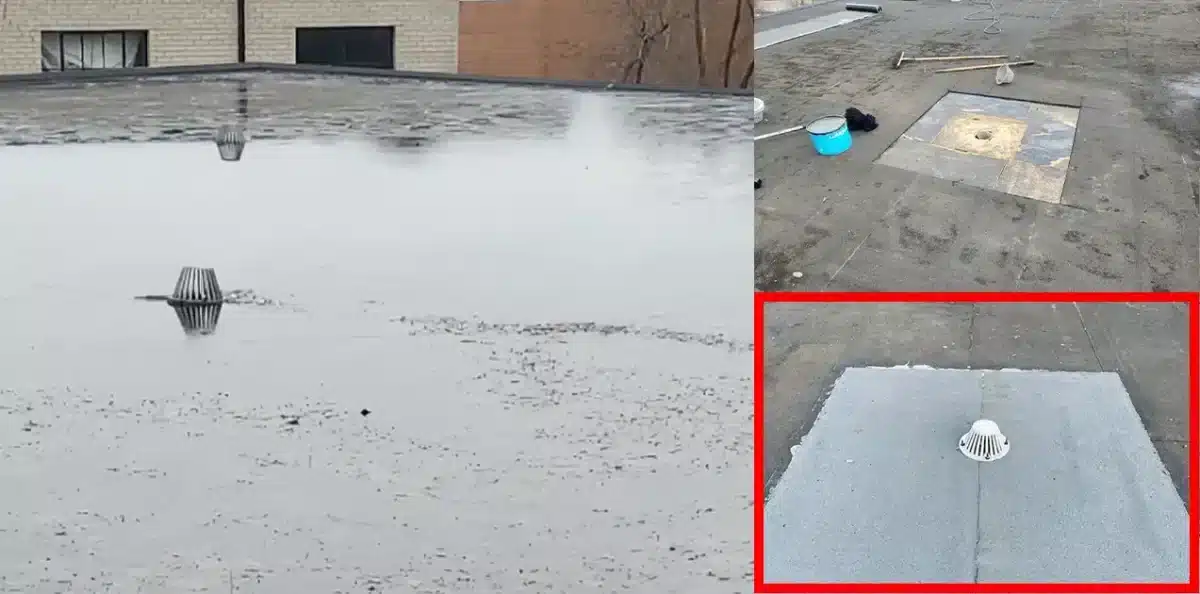
- Drain bowls, strainers, and clamping rings — clogs, corrosion, or loose fasteners.
- Ponding evidence — stain rings indicating water that remains more than 48 hours after rainfall.
- Scuppers and overflow drains — properly elevated relative to primary drains and unobstructed.
- Slope adequacy — where ponding is documented, a drainage correction or tapered insulation retrofit is often more cost-effective than patching the membrane.
Penetrations and rooftop equipment
- HVAC curbs — cracked curb caps, pulled flashing, corroded fasteners. See HVAC curb repair and installation.
- Skylights — gasket failure, frame leaks, cracked glazing. See skylight repair and installation.
- Pipe penetrations and pitch pans — one of the most common leak origins, especially where gas, plumbing, or electrical penetrations were added after the roof was installed. See roof penetration repairs.
- Elevator shafts and access hatches — flashing and waterproofing integrity. See elevator shaft repair.
Structural and envelope elements
- Deck condition — soft spots, spongy areas, or staining visible from underneath.
- Parapet walls — brick pointing, cap flashings, and expansion joints.
- Roof-mounted solar, satellite, or telecom installations — improper membrane penetrations by third-party installers are a recurring issue.
The Maintenance Schedule That Works in Ontario
Ontario’s climate dictates when meaningful inspection and repair work can be performed. Attempting scheduled maintenance in deep winter is both unsafe and ineffective. The schedule below reflects how we structure every Preventative Roof Maintenance Plan.
| Season | Inspection focus | Why it matters in Ontario |
|---|---|---|
| Spring (April–May) | Winter damage: split seams, blisters, flashing pulls, ice-dam aftermath at parapets and scuppers. | Catches damage before the first heavy spring rain finds it for you. |
| Summer (June–August) | HVAC curbs, skylights, drains, penetrations — anything cut into or set on the membrane. | Trade traffic peaks in summer. Many leaks begin at something someone walked on or opened up. |
| Fall (September–October) | Drain clearing, debris removal, seam inspection, caulking at curbs and walls. | A clogged drain in November becomes ponding, then freeze damage by January. |
| Winter (November–March) | Post-storm walks after heavy snow or ice loading; emergency response only. | Winter is not the season for scheduled work. It is the season skipped work catches up. |
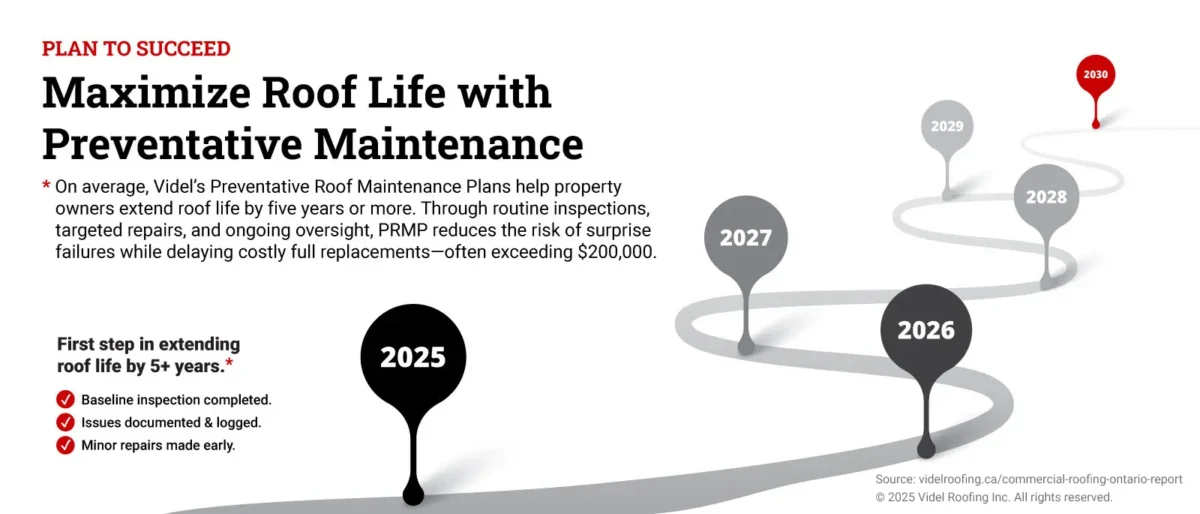
Two inspections a year — spring and fall — is the baseline. Post-storm walks are added after significant weather events. The Preventative Roof Maintenance Plan is structured around this cadence and includes documented reports for each visit.
MAXIMIZE ROOF LIFE WITH A
Preventative Roof Maintenance Plan
Avoid surprise repairs and extend the time between costly replacements with expert maintenance tailored to your roof.
Reduce costly repairs
Prevent leaks & damage
Extend roof life
What a Maintenance Program Actually Delivers
The commercial case for maintenance is not abstract. It is measurable in roof lifespan, interior damage avoidance, energy performance, and claim documentation. Each of these is worth understanding in its own right.
1. Extended roof lifespan
A 4-ply Built-Up Roofing system designed for a 30-year service life will frequently reach it when maintained on a regular schedule. Without maintenance, the same system often fails by year 15 to 20, not because of material defects but because small issues compounded into systemic failure. Across the field data we have assembled for the Ontario Roofing Report, maintained assemblies consistently outperform neglected ones by a decade or more.
2. Early intervention on small problems
Most of the emergency leak calls we respond to involve conditions that were visible months earlier. A pitch pan that needs a 20-minute top-up becomes a $30,000 to $50,000 interior remediation if rain water finds drywall, insulation, or tenant equipment. The economics of catching it early are not close.
3. Tenant retention and building value
Water damage is the most disruptive and most visible failure mode for a building’s occupants. Ceiling stains, wet inventory, and operational interruptions affect lease renewals and tenant satisfaction in ways that compound over time. A well-maintained roof is invisible to tenants, which is precisely the goal.
4. Preserved thermal performance
Wet insulation loses R-value, sometimes dramatically. A roof assembly specified to R-30 can be operating at R-18 or lower if water has penetrated the insulation layer. The R-value guide covers the mechanism in detail. The practical result is higher heating and cooling costs until the wet board is identified and replaced — a cost that maintenance programs are specifically designed to prevent.
5. Supporting documentation for insurance
Commercial property insurance policies generally distinguish between sudden, accidental events — wind, hail, fire, falling debris — and gradual damage from wear, age, or deferred maintenance. The former is typically covered. The latter is typically not.
When a loss occurs, the adjuster’s job is to determine which category applies. A documented maintenance history — dated inspection reports, photographs of prior condition, records of repairs performed — helps establish that the damage was the result of a covered event rather than accumulated neglect. The Insurance Bureau of Canada publishes general guidance on commercial property coverage and risk management for business owners.
Policy specifics vary significantly by carrier and jurisdiction. Property managers should confirm their own carrier’s documentation expectations directly. What we can say with confidence is that the maintenance records we produce have been used successfully by clients to support claims in the field.
Warning Signs to Watch For Between Scheduled Inspections
Visible from inside the building
- Staining on ceiling tiles, including dried marks that appear stable.
- Musty odours in upper floors or storage areas, particularly after rainfall.
- Peeling paint or bubbling drywall at the junction of exterior walls and ceilings.
- Heating or cooling costs trending upward without an operational explanation.
Visible from ground level or adjacent buildings
- Ponding water visible from parking lots or neighbouring rooftops.
- Debris, branches, or displaced equipment on the roof after a storm.
- Overflow from gutters or downspouts during moderate rainfall.
- Ice dams or heavy icicle formation along parapets in winter.
A Maintained Asset: What’s Possible When Records Exist
A Burlington commercial property came to us recently for a replacement assessment. When I walked it, the membrane was at end-of-life, but the previous owner had kept the roof on a maintenance schedule for years. Core samples confirmed the insulation underneath was dry and structurally sound. The project moved forward as an insulation-reuse re-roof rather than a full tear-off, which reduced the scope and the cost substantially.
The documentation mattered. Without the maintenance history, there would have been no basis for trusting the existing assembly. The same principle applies across the projects we’ve completed — the properties with records get lower-cost, more targeted interventions. The ones without records default to full replacement because there is no documented condition to work from.
Services Included in a Maintenance Program
Not every service is required on every visit. The Preventative Roof Maintenance Plan provides access to all of the following as condition requires.
- Flat roof repair — targeted membrane repairs, seam work, flashing replacement.
- Emergency roof leak repair — 90-minute response for active leak events.
- Drain replacement — new bowls, strainers, or full drain assembly retrofits.
- HVAC curb repair and installation — re-flashing, curb cap replacement, new unit curbs.
- Roof penetration repairs — pitch pans, pipe boots, vent stack seals.
- Skylight repair and installation — gasket work, full unit replacement, new skylight installs.
- Drone roof inspection — for large roofs or when walking the roof is not viable.
How often should a commercial flat roof be inspected in Ontario?
Twice a year at minimum: once in spring to assess winter damage, and once in fall to prepare for the coming winter load. Post-storm walks should be added after significant weather events. This cadence reflects the freeze-thaw stresses specific to Ontario’s climate.
What does a commercial roof maintenance program cost?
Cost varies based on roof size, condition, and the scope of the plan. For most mid-size commercial and industrial properties in Ontario, annual maintenance is measured in cents per square foot rather than dollars, and is structured to be a fraction of what a single unplanned repair or accelerated replacement would cost.
Will documented maintenance help with an insurance claim?
Documented inspection and repair records help establish the condition of the roof before a loss event, which supports the distinction between covered sudden damage and excluded wear or neglect. Coverage specifics and documentation requirements vary by carrier and policy, so property managers should confirm expectations directly with their insurer. The Insurance Bureau of Canada publishes general guidance on commercial property coverage.
What is the difference between a roof inspection and a maintenance plan?
An inspection is a one-time documented assessment of current condition. A maintenance plan is an ongoing engagement that includes scheduled inspections, minor repairs performed on-site, and priority response to issues as they develop. The Preventative Roof Maintenance Plan page outlines what each tier includes.
Can I get a one-time roof assessment without a maintenance contract?
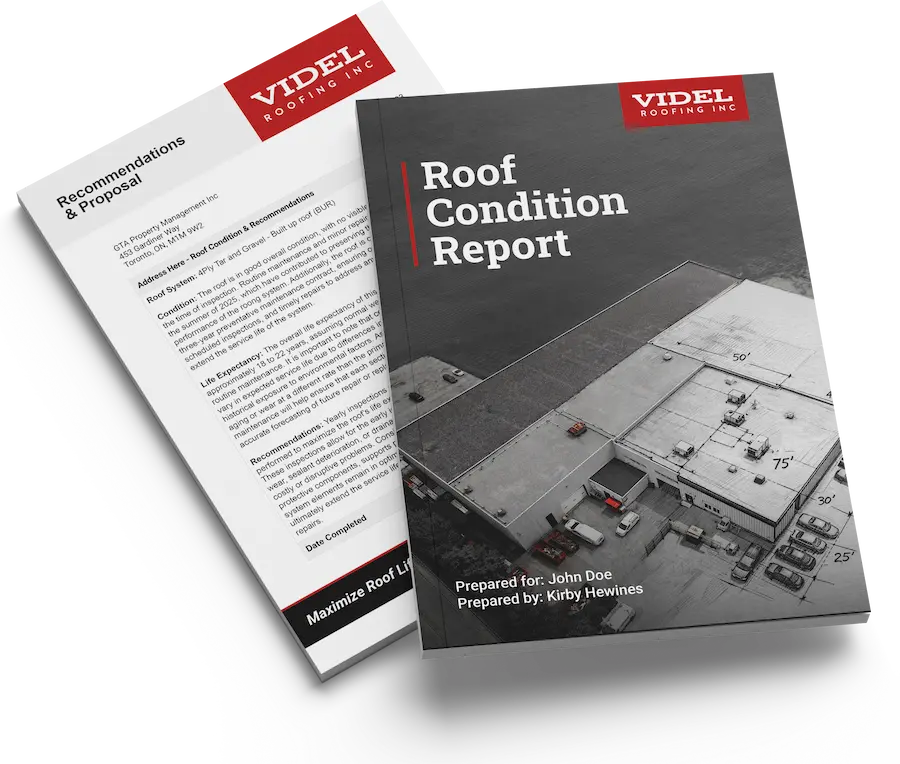
Yes. Videl’s free Roof Condition Report is a standalone deliverable requiring no contract. It documents current condition, identifies immediate concerns, and provides a three-to-five-year outlook suitable for budgeting, insurance documentation, or a second opinion.
The commercial roofs that outlive their warranty are not the ones with the most expensive materials. They are the ones on a maintenance schedule, with records to prove it. If you manage commercial properties across Toronto and the GTA and want to bring yours into that category, start with a free Roof Condition Report. Call (905) 397-1198 or request it online.