
Key Takeaways
- Commercial flat roof replacement in Toronto runs $12 to $17 per square foot installed in 2026, with most projects landing between $14 and $16.
- Tear-off, deck repair, insulation, and edge metal account for more variance than the membrane itself.
- Hidden conditions found during tear-off (wet insulation, deteriorated deck, structural rust) drive 60 to 80 percent of mid-project budget overruns.
If you’re managing a property in the GTA, you know that no two blocks are the same. A 20,000-square-foot warehouse in an industrial park is a completely different animal than a retail strip in North York with tenants who can’t afford a day of downtime.
Over the last nearly three decades, we’ve seen plenty of replacement budgets built off a number from a quick walk on the roof, only to fall apart on day one of tear-off. Usually, it’s not the new roof that costs you; it’s the hidden saturated insulation or the rusted-out structural deck that hasn’t been seen in decades. If your quote doesn’t account for the mess you might find under the surface, that ‘approved’ budget is going to fall apart the moment things get torn off.
This guide breaks down typical flat roof replacement costs in Toronto, the line items that move the budget up or down, and how to plan for a replacement or defer it with preventative maintenance.
Flat Roof Replacement Costs in the GTA (2026)
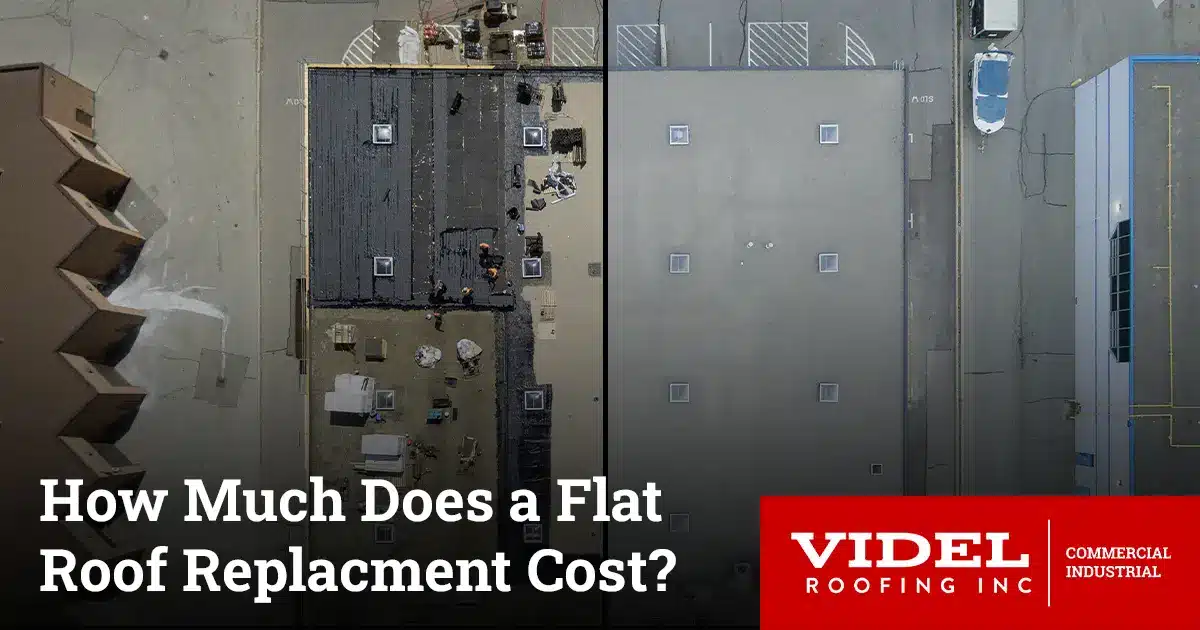
For most industrial and commercial projects in Toronto, you should expect pricing to range between $12 and $17 per square foot. This range covers a full “turnkey” replacement: removing the existing system to the deck, disposal, and installing a code-compliant assembly including new insulation, vapour barrier, and membrane.
For a 20,000-square-foot roof, a realistic project total sits between $240,000 and $340,000.
Where the Budget Shifts?
The $5.00 spread comes down to the specific conditions of your building:
- Tear-off Complexity: A clean, single-layer removal is straightforward. The cost climbs when we find a second “hidden” roof system or saturated insulation that has tripled in weight, significantly increasing disposal fees and labor hours.
- Site Logistics: A standalone warehouse with an open parking lot allows for faster production. Projects in high-density areas like North York or the Downtown Core require hoisting permits, specific crane windows, and tighter material management, all of which add to the bottom line.
- Deck Condition & Equipment: If we find rusted steel decking or rotted wood that requires structural repair, the “per-square-foot” price becomes secondary to the remediation work. Similarly, roofs crowded with HVAC curbs, sleepers, and gas lines require significantly more detailing than an open field.
The Impact of Scale
Total square footage dictates your leverage. Because fixed costs like mobilization, safety setup, and equipment rentals remain relatively constant, they represent a larger percentage of the bill on a 5,000-square-foot retail block than on a 50,000-square-foot distribution center. On those larger footprints, you can typically expect to see the per-square-foot rate drop by $1.00 to $2.00 as those overhead costs are diluted across the larger area.
What’s Included in the Per-Square-Foot Number?
A complete commercial roof replacement in Toronto requires:
- Tear-off and disposal of the existing roof down to the deck. This runs $2 to $4 per square foot on its own, more if there are three or four layers stacked up from past overlays.
- Deck inspection and repair. Steel decks get checked for corrosion. Wood decks get probed for rot. Concrete decks get evaluated for spalling. Anything compromised gets replaced.
- Vapour barrier installed over the deck.
- Insulation, typically polyiso, sized to meet current Ontario Building Code minimums. Most commercial assemblies in 2026 specify R-31 to R-35, which is 5 to 6 inches of polyiso depending on the manufacturer.
- Cover board above the insulation to protect the membrane and provide a stable substrate.
- Membrane system, the actual roofing surface (BUR, modified bitumen, TPO, EPDM, or PVC).
- Edge metal, flashings, and penetration detailing at every parapet, drain, scupper, vent, curb, and skylight.
- Permits and engineering review where required.
- Site protection for parking, landscaping, and pedestrian access during the work.
Anything beyond the basic assembly gets priced separately: tapered insulation for drainage correction, structural reinforcement, equipment lifts, asbestos abatement on older buildings, or full skylight replacement.
At Videl Roofing, we list these line by line on our quotes so the property owners and building managers can see exactly what’s driving the number.
Cost by Roof System: BUR vs. Modified Bitumen vs. TPO vs. EPDM
System choice is the single biggest driver of long-term cost on a commercial roof. Here’s a breakdown of flat roof replacement costs by rooftype:
| System | Installed cost (2026) | Typical service life | Best for |
|---|---|---|---|
| 4-Ply BUR | $15–$18/sq ft | 30–40 years | Heavy-traffic commercial and industrial roofs in Ontario freeze-thaw climate |
| Modified bitumen (2-ply) | $13–$16/sq ft | 20–30 years | Mid-traffic commercial, multi-residential, retail |
| TPO (single-ply) | $10–$14/sq ft | 15–22 years (heat-welded seam dependent) | Cost-driven projects, low-traffic roofs |
| EPDM (single-ply) | $9–$13/sq ft | 18–25 years | Low-slope, low-traffic, smaller footprints |
Built-up roofing (BUR) is what we often recommend for commercial and industrial properties across Toronto and the GTA. A 4-ply assembly using IKO modified bitumen base and cap sheets gives a roof four redundant waterproofing layers, no field-welded seams to fail, and the kind of puncture resistance heavy mechanical equipment and seasonal foot traffic actually demand.
The right way to compare systems is cost-per-year-of-expected-service, factoring in maintenance load. A $16 per square foot BUR with a 35-year service life works out to $0.46 per square foot per year. Compare that to a $12 per square foot TPO that lasts 18 years, which works out to $0.67 per square foot per year, and that’s before adding the seam repairs and patching the single-ply will need.
Hidden Costs That Surface During Tear-Off
The single biggest cause of mid-project budget overruns on commercial roof replacements in Toronto is finding conditions during tear-off that nobody knew about during the bid. Visual inspections, infrared scans, and core samples catch most of it, but not all of it.
The list of what we routinely find once the existing roof comes off:
- Wet insulation across large sections of the roof. Moisture migrates laterally under the membrane long after the original leak entered. We’ve pulled up roofs where 40 percent of the insulation was saturated and only one drain ceiling stain told the property manager something was wrong.
- Deteriorated deck. Steel decks rust through under wet insulation. Wood decks rot. Concrete decks spall around drains and parapets.
- Failed vapour barrier or no vapour barrier at all on older buildings, which is the upstream cause of most of the wet insulation problems.
- Structural members showing rust or fatigue at parapet connections, around penetrations, or at deck-to-wall transitions.
- Hidden penetrations that were sealed over during a previous reroof and never properly flashed: old vent stacks, abandoned conduit, pipe sleeves.
- Asbestos in older flashing materials, vapour barriers, or insulation on buildings constructed before 1990.
Each of these can lead to additional cost. For example, wet insulation needs removal and replacement. However, if its dry, we may be able to reuse it and drive costs down. On a roof replacement job in Burlington, we reduced costs by $16,000 because the existing insulation was in good condition. This led to less materials purchased as well as fewer bins required for waste disposal.
When it comes to deck repairs, those run between $4 to $12 per square foot of affected area depending on the substrate. Structural reinforcement requires an engineer’s stamp and can add five figures to the project.
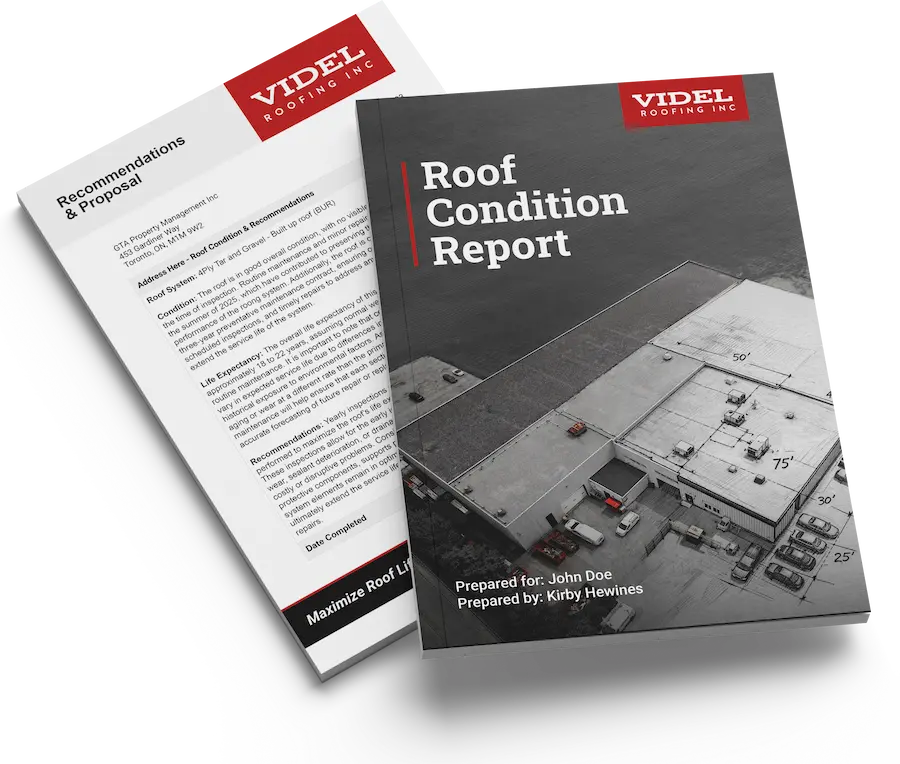
The way to keep these surprises from blowing up the budget is a thorough pre-replacement assessment that includes infrared moisture scanning, core sampling, and a proper roof condition report. We document all of this on our free 50+ point Roof Condition Report, which property managers use as the technical basis for both the budget and the spec.
Repair vs. Replace? When Replacement Is Actually the Right Call
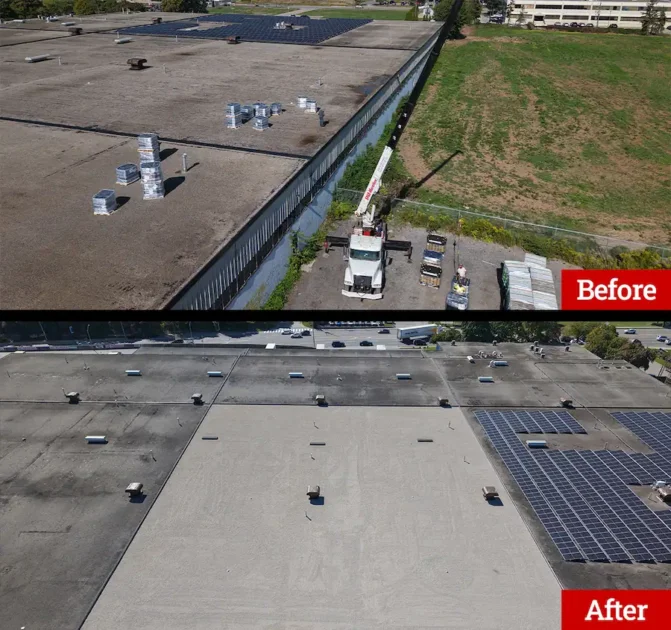
A flat roof at the end of its service life shows specific signs: widespread blistering, extensive seam failures, ponding water that the drains can’t clear, a soft underfoot feel that indicates wet insulation, and multiple active leaks in different areas. When two or more of these are present across more than a quarter of the roof, replacement is usually the right call.
Replacement is not the right call when:
- The membrane is past midlife but functionally intact, with isolated repair points
- A single zone has failed (around a roof access hatch, a single drain, one parapet) and the rest of the field is in good condition
- The roof is under 15 years old and the failure pattern points to installation defects covered by warranty
- The building is being sold within 18 months and the buyer’s diligence will price the roof’s remaining life into the deal anyway
Replacing a roof at year 18 of a 25-year service life means writing off the seven years of life you already paid for. On a $300,000 roof, that’s roughly $84,000 in capital you don’t have to spend yet.
We developed a Flat Roof ROI Calculator for property owners and building managers to model whether maintenance plus targeted repair preserves more capital than a premature replacement does. The math usually favours extending the existing roof by three to five years through a Preventative Roof Maintenance Plan.
MAXIMIZE ROOF LIFE WITH A
Preventative Roof Maintenance Plan
Avoid surprise repairs and extend the time between costly replacements with expert maintenance tailored to your roof.
Reduce costly repairs
Prevent leaks & damage
Extend roof life
Budgeting and Planning Timeline
The replacement projects that come in on budget are the ones planned 12 to 24 months ahead of the work. Projects that blow the budget are usually the ones approved in March for July install.
A defensible commercial roof replacement budget needs four things:
- A current condition assessment. Reserve studies from 5+ years ago use stale per-square-foot numbers and miss conditions that have developed since. A current Roof Condition Report with infrared moisture scanning and core samples gives you the actual scope.
- A spec written to the building’s actual use. A 5,000 square foot retail box and a 50,000 square foot food processing facility don’t get the same assembly. Spec the system to the traffic, the rooftop equipment, the temperature loads inside, and the holding period.
- Three quotes from contractors qualified for the spec. Not three quotes from whoever returns the call. A contractor with a track record on similar buildings, current liability coverage, manufacturer certification on the specified system, and a documented safety program. Our guide to choosing the right roofing company covers what to ask for.
- A 10 to 15 percent contingency for hidden conditions. On a $300,000 project, that’s $30,000 to $45,000 set aside before tear-off starts. It almost always gets used. When it doesn’t, it stays in the reserve.
Learn more about how we help property owners and building managers.
How often should a commercial flat roof be inspected in Ontario?
Twice a year at minimum: once in spring to assess winter damage, and once in fall to prepare for the coming winter load. Post-storm walks should be added after significant weather events. This cadence reflects the freeze-thaw stresses specific to Ontario’s climate.
What does a commercial roof maintenance program cost?
Cost varies based on roof size, condition, and the scope of the plan. For most mid-size commercial and industrial properties in Ontario, annual maintenance is measured in cents per square foot rather than dollars, and is structured to be a fraction of what a single unplanned repair or accelerated replacement would cost.
Will documented maintenance help with an insurance claim?
Documented inspection and repair records help establish the condition of the roof before a loss event, which supports the distinction between covered sudden damage and excluded wear or neglect. Coverage specifics and documentation requirements vary by carrier and policy, so property managers should confirm expectations directly with their insurer. The Insurance Bureau of Canada publishes general guidance on commercial property coverage.
What is the difference between a roof inspection and a maintenance plan?
An inspection is a one-time documented assessment of current condition. A maintenance plan is an ongoing engagement that includes scheduled inspections, minor repairs performed on-site, and priority response to issues as they develop. The Preventative Roof Maintenance Plan page outlines what each tier includes.
Can I get a one-time roof assessment without a maintenance contract?
Yes. Videl’s free Roof Condition Report is a standalone deliverable requiring no contract. It documents current condition, identifies immediate concerns, and provides a three-to-five-year outlook suitable for budgeting, insurance documentation, or a second opinion.
Plan Your Replacement With Confidence
A flat roof replacement is often a six-figure commercial decision, and the budget you approve should be built on actual conditions. Learn more about our flat roof replacement service, then call (905) 397-1198 or contact us online for a free Roof Condition Report.