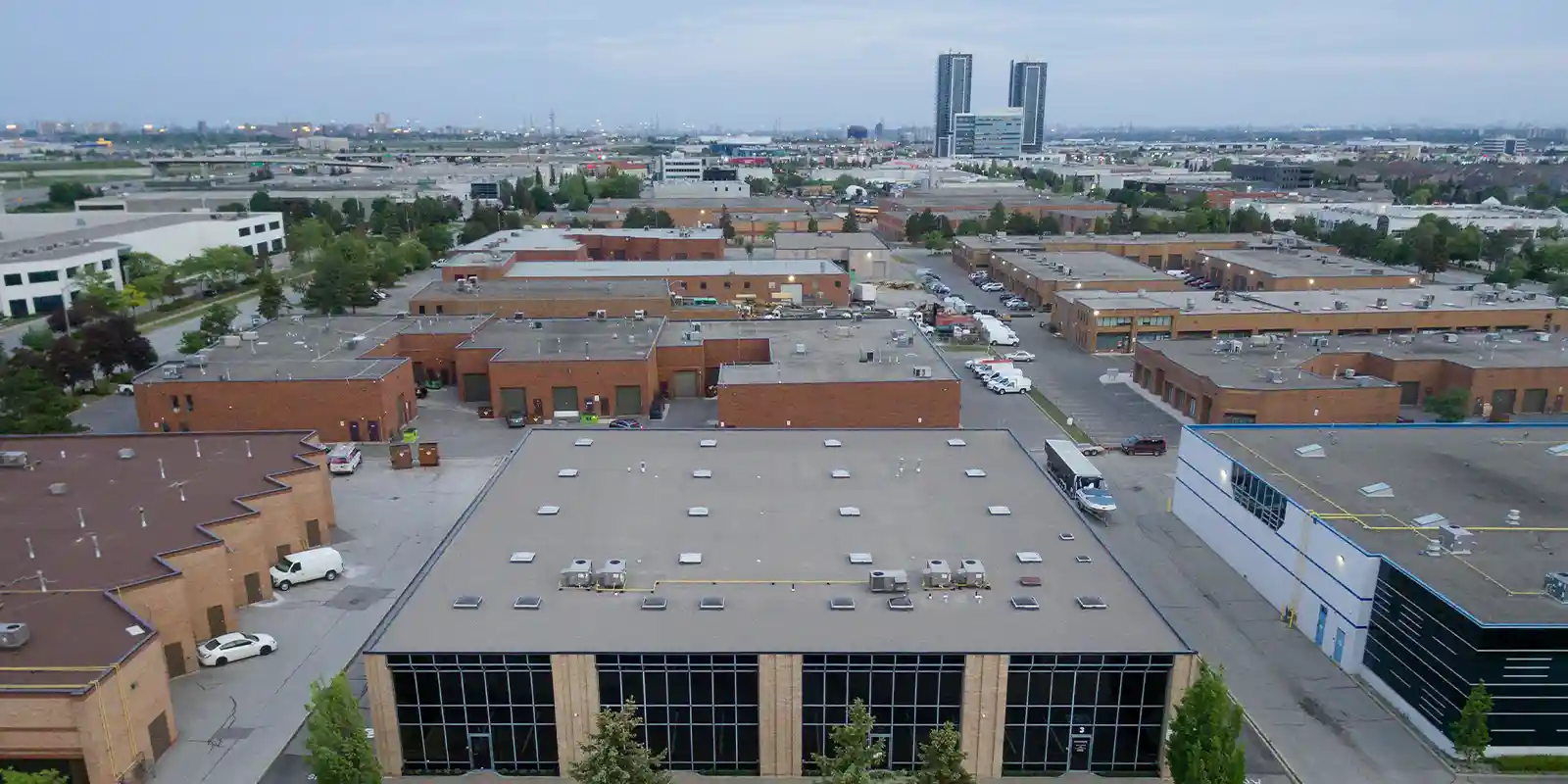

If you manage a commercial property in Ontario, you know our climate is demanding. It swings from brutal winter cold to scorching summer heat. That’s why your flat roof isn’t just a waterproof cap; as far as I’m concerned, it’s the most critical thermal barrier separating your controlled environment from Canada’s harsh weather outside.
When I talk to building managers, one term that comes when discussing performance and cost savings is R-value for flat roofs.
Simply put, R-value is the measure of thermal resistance, or how effective your roof insulation is at stopping heat flow. The higher the number, the better the resistance.
In this article, I’ll guide you through the importance of R-value and provide clear, actionable steps to ensure your property achieves optimal efficiency, code compliance, and long-term asset protection.
What’s the “Science” of R-Value?
R-value measures a material’s resistance to heat flow. In roofing systems, it tells you how well your insulation slows heat moving into or out of the building. The higher the R-value, the better the thermal performance.
The Physics of Heat Flow
Heat always moves from a warm space to a cold space. In winter, heat generated inside your building tries to escape upward through the roof into the cold Ontario air.
In summer, the process reverses. A sun-heated roof membrane pushes heat downward into conditioned, air-conditioned spaces below.
High R-value insulation doesn’t stop heat flow entirely—nothing can—but it slows the rate at which heat transfers through the roof assembly. That rate is what insulation is designed to control.
To quantify how effectively a material resists heat flow, building science uses a measure called R-value.
At its simplest, R-value describes the relationship between an insulation layer’s thickness and how easily heat can pass through it:
Where:
- R = Thermal resistance (R-value)
- L = Thickness of the insulation layer
- meters (SI units)
- inches (Imperial units)
- k = Thermal conductivity of the material
Because roofs are built from multiple materials—not just insulation—the total R-value of a roof assembly is calculated by adding the R-values of each individual layer:
This is how building codes and energy models evaluate full roof assemblies.
You don’t need to memorize the formulas, but you do need to remember the golden rule:
A higher R-value means greater insulation effectiveness and less energy required to maintain your building’s temperature.
Yes, R-Value is Additive
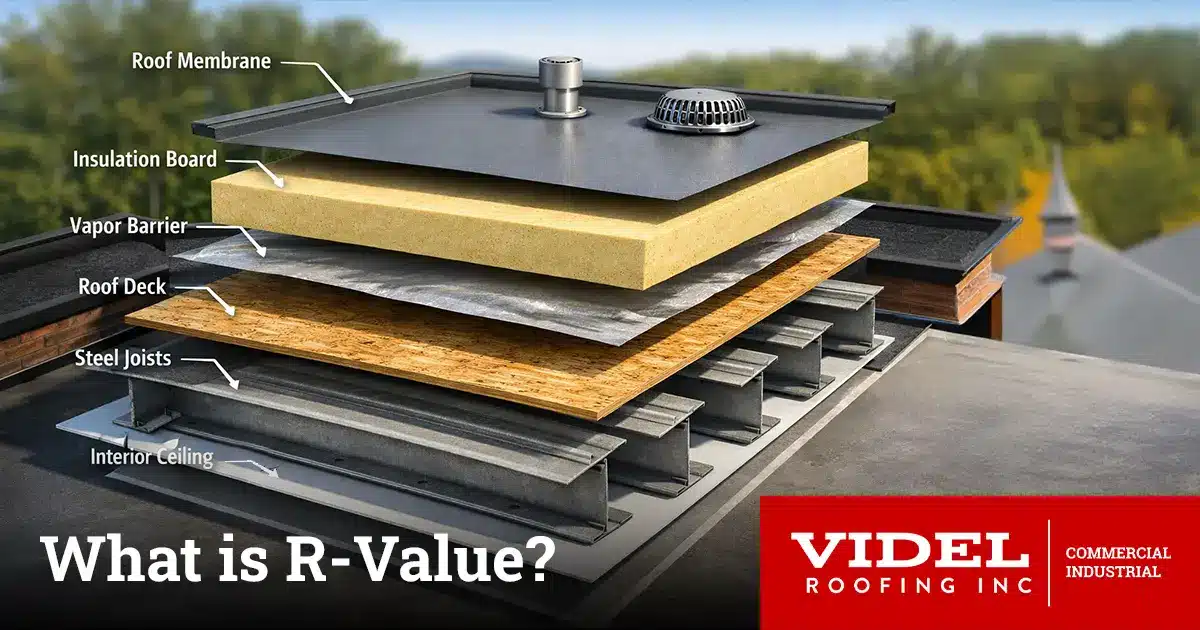
A common mistake in industrial roofing is focusing on the R-value of a single insulation board. In reality, a roof’s thermal performance comes from the entire assembly, not any one layer.
R-value is additive. If you install one layer of R-12 insulation and place another R-12 layer directly on top, the combined insulation value (before accounting for other materials) is R-24.
The final R-value of a roof system also includes minor contributions from the roof deck, air spaces, and the membrane itself. However, the vast majority of thermal resistance comes from the insulation layers, which is where design decisions matter most.
Context for Flat Roof Systems
In both industrial and commercial roofing systems, insulation boards are typically installed between the structural deck and the waterproofing membrane. The material selected has a major impact on how much R-value you achieve per inch of thickness:
- Polyisocyanurate (Polyiso):
Our preferred insulation. Delivers one of the highest R-values per inch (≈ R-5.8 to R-6.0), making it the most space-efficient way to meet or exceed Ontario Building Code requirements. - Expanded Polystyrene (EPS):
A lower-density foam with moderate thermal performance (≈ R-3.8 to R-4.2). Commonly used in tapered insulation systems or combined with other materials. - Extruded Polystyrene (XPS):
A denser board—often blue or pink—with a consistent R-value around R-5.0. Valued for its moisture resistance in demanding environments.
When we install a new or replacement roof, we calculate the total system R-value based on material type, thickness, and layer count—ensuring the assembly meets code requirements and delivers real-world energy performance.
Quick Reference of Common Roofing R-Values
| Material | R-value (per inch) |
|---|---|
| Polyisocyanurate (PIR) | R-6.0 to R-6.5 |
| Extruded Polystyrene (XPS) | R-5.0 |
| Fiberglass Batt | R-3.1 to R-3.4 |
| Plywood / OSB | R-0.9 to R-1.2 (total) |
| Asphalt Shingles | R-0.44 (total) |
Why a High R-Value for Flat Roofs Is Non-Negotiable
A high R-value is an investment, not an expense. When building managers ask why they should exceed the bare minimum required by code, the answer comes down to three factors that directly affect a property’s operating costs, structural integrity, and roof lifespan.
1. Energy Efficiency and Cost Savings (The Bottom Line)
This is the most immediate and measurable benefit. In Ontario’s long heating season, heat loss through the roof can be significant.
If your building is under-insulated, you’re effectively paying the utility company to heat the sky.
By increasing R-value, you slow heat transfer and reduce the demand placed on your HVAC system. That’s why insulation upgrades in commercial and industrial roofing often deliver one of the fastest returns on investment compared to other building-envelope improvements.
2. Moisture and Condensation Control
When warm, humid interior air meets a cold surface—such as the underside of an inadequately insulated roof deck—moisture condenses. This is known as the dew point.
In low-R assemblies, roof components frequently fall below this temperature, leading to trapped, internal condensation. Over time, that moisture promotes mold and mildew, degrades structural materials, and compromises the insulation itself.
Once insulation becomes wet, its effective R-value drops dramatically, accelerating a cycle of deterioration which is difficult and expensive to reverse.
3. Roof System Longevity
Every roofing membrane—TPO, EPDM, PVC, or modified bitumen—has the same enemy: repeated expansion and contraction caused by extreme temperature swings, known as thermal cycling.
Poorly insulated roofs allow the membrane temperature to fluctuate rapidly and aggressively, accelerating fatigue. The result is cracking, seam failure, and premature leaks.
A high R-value insulation layer acts as a thermal buffer. It stabilizes membrane temperature, reduces stress, and protects the roof system from both interior heat and exterior cold—extending service life and delaying replacement.
Code Compliance and the Minimum R-Value
While maximizing R-value is critical for performance, every new roof or substantial roof replacement in Ontario must, at a minimum, comply with the requirements set out in the Ontario Building Code (OBC), specifically under Supplementary Standard SB-12 (for Energy Efficiency).
The OBC sets minimum required Effective R-values based on the climatic zone of the property. For most of Southern and Eastern Ontario (where population density is highest), the code demands a significant thermal performance.
- Effective R-value:
The code uses “effective R-value,” which is a weighted average that accounts for the thermal bridging effect of the roof structure (where fasteners or components penetrate the insulation).
The Requirement for Continuous Insulation (CI)
Modern building codes are moving toward systems that incorporate Continuous Insulation (CI). CI is insulation that is continuous across all structural members without thermal bridges, other than necessary fasteners and service openings.
For flat roofs, this usually means:
- Multiple Layers:
Installing the insulation in two or more staggered layers. This prevents the seams from lining up and eliminates a straight path for heat to escape, significantly enhancing the overall thermal performance of the assembly. - Thermal Break Fasteners:
Using specialized fasteners that have a much lower thermal conductivity than standard metal screws, thereby minimizing the heat loss through each anchor point.
By designing a roof to meet the Continuous Insulation standard, you not only comply with the law but also future-proof your building against inevitable code increases and maximize long-term energy savings.
What is the ideal R-value for a flat roof in Ontario?
For most commercial and industrial flat roofs in Southern Ontario, you want an effective R-value of at least R-31 above the deck. This is the minimum set by the Ontario Building Code under SB-12 for Climate Zone 5, which covers Toronto, the GTA, Hamilton, Niagara, and most of the populated south. Northern and Eastern Ontario fall into Zone 6, where the minimum jumps to R-35.
That said, code minimum and ideal are not the same number. On new builds and full replacements, we typically design assemblies between R-35 and R-40 using stacked polyiso. The marginal cost of adding another inch of insulation during a replacement is small compared to the energy savings over the next 25 years. If the roof is open and the membrane is off, that is the cheapest insulation upgrade you will ever buy.
What happens if you over-insulate a flat roof?
You cannot really over-insulate a flat roof from a thermal performance standpoint, but you can run into practical limits. Adding thickness raises the roof height at parapets, drains, and curbs, which can affect flashing details, drainage, and rooftop equipment clearances. On a retrofit, going too thick may require reworking penetrations and edge metal, which adds cost.
Is 50-year-old roof insulation still good?
Sometimes, yes. The age of the insulation matters less than its condition. If the existing insulation is dry, intact, and structurally sound when we core-sample it, it can often be reused as the base layer with new insulation added on top to bring the assembly up to current code. We’ve kept original insulation in place on roofs well past the 25-year mark when the conditions warrant it.
What kills old insulation is moisture, not age. Once water has tracked through a failed membrane and saturated the boards, the R-value collapses and the insulation has to come out. The only way to know for certain is to pull cores and check.
Are You Overdue for a Roof Inspection?
The R-value you installed 10 or 15 years ago is likely insufficient for today’s energy costs and compliance standards.
If you suspect your current insulation is failing, or if you are planning a roof replacement, the first step is a professional thermal assessment.
We use infrared technology to detect areas of high heat loss and trapped moisture, giving you a precise map of your roof’s actual thermal performance.
Don’t wait for rising energy bills or a premature roof failure.
Contact Videl Roofing today to schedule a comprehensive flat roof thermal assessment and learn how maximizing your R-value can secure your building’s financial and structural future.