
Key Takeaways
- Large-scale Toronto warehouses require specialized roofing specs due to the massive dead load of standing water and the high risk of expensive inventory loss.
- Warehouse roof failure is rarely about the membrane itself; it’s almost always a failure of complex details like RTU curbs, vibrations, and drainage systems.
- A 4-ply BUR system is a “waterproofing tank” ideal for long-term owners, whereas a 2-ply SBS system is a flexible, lightweight “shield” built for extreme temperature swings.
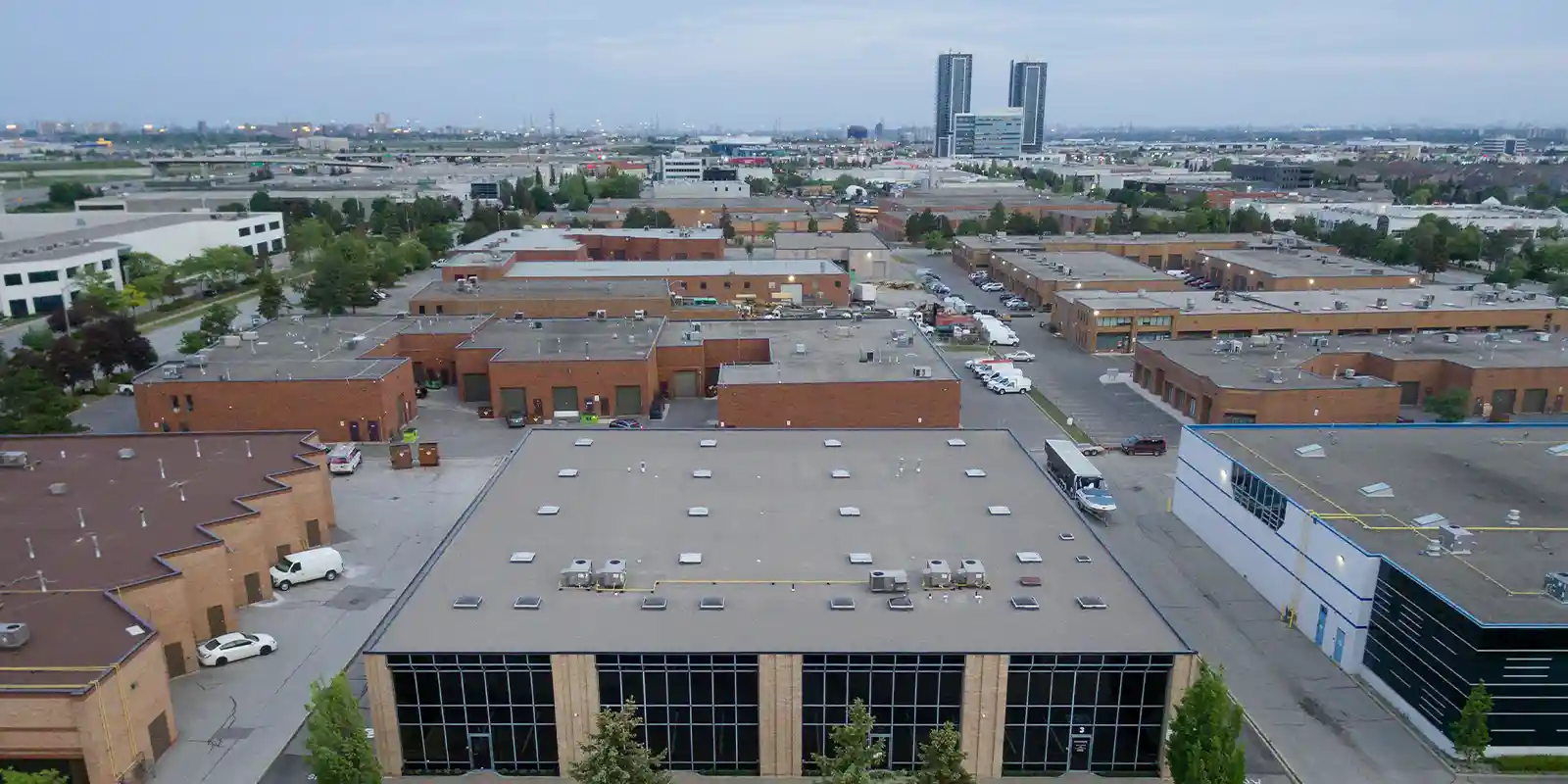
Toronto warehouses cover serious ground. A single industrial roof in Mississauga, Etobicoke, or Scarborough can run 100,000 square feet or more, with rooftop equipment, drains, and active tenant operations all under the same membrane.
In this post, we’ll cover what makes Toronto warehouses different than other industrial building types. We’ll also compare two roofing systems commonly used on warehouses, and the failure points worth watching.
Why Warehouse Flat Roofs Differ from Other Building Types
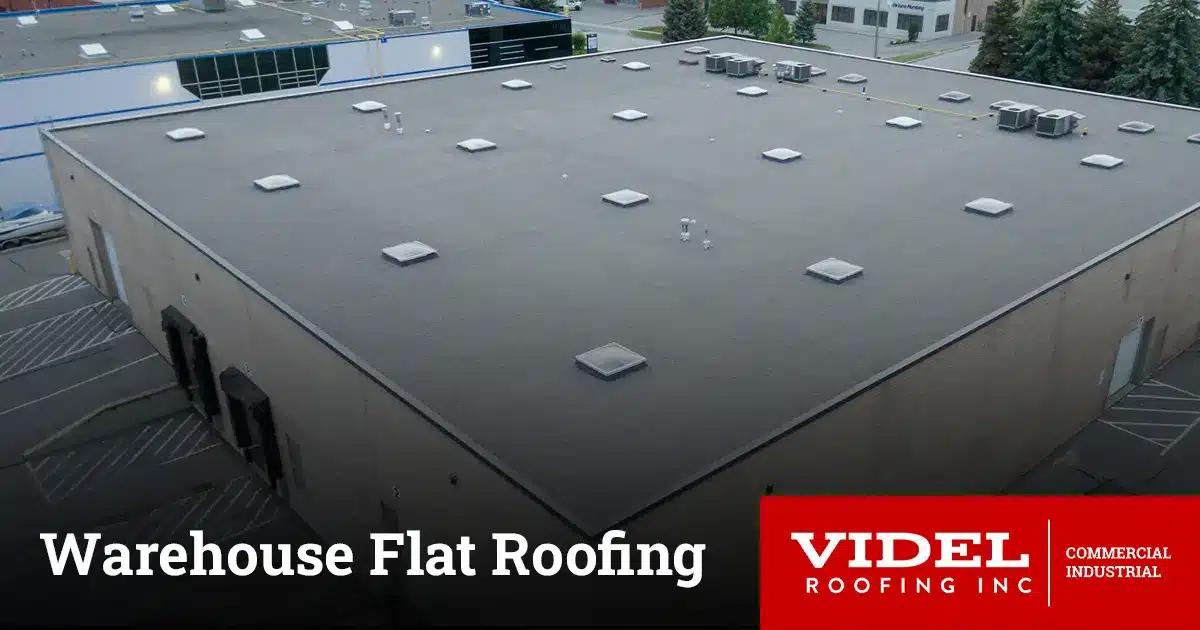
A warehouse roof faces different problems than a strip plaza roof or a small commercial property and its not just because of size. Strip plazas have shorter parapets, simpler drainage runs, and equipment loads that can be handled with off-the-shelf flashing details. A 6,000 square foot retail roof has maybe two or three RTUs and a few vents. A 150,000 square foot distribution warehouse has a dozen industrial HVAC units, exhaust fans, gas lines, and conduit runs all penetrating the same membrane.
Equipment density is the first reason warehouse roofs need different thinking. Industrial-scale RTUs and exhaust fans are heavy, vibrate constantly, and require reinforced curbing and custom flashing details to integrate into the membrane. Get any of those details wrong on installation and the curb becomes the first thing to leak.
Drainage is the second reason, and it’s a math problem. Moving water across hundreds of feet of deck to perimeter scuppers or internal drains requires properly engineered tapered insulation and slope. When that slope is wrong, water sits. Standing water weighs about 5.2 pounds per square foot per inch of depth, so a three-inch pond across 5,000 square feet adds roughly 78,000 pounds of dead load the deck wasn’t designed to carry indefinitely.
Inventory exposure is the third, and it’s where warehouse roof failures get expensive fast. A roof leak can drop water on millions of dollars of palletized electronics, ruin a freezer load of food product, or shut down an automated picking line until the membrane gets patched. Add in tenant claims, business interruption coverage triggers, and the logistics of moving inventory away from the leak zone, and the repair cost is the smallest line on the bill.
Need a Quote for Flat Roof Repairs or Replacement?
Start with a free Roof Condition Report.
Five Common Areas Where Warehouse Roofs Fail
- Drains and scuppers. Blocked or undersized drains let water sit on the roof for days. The longer water stays in contact with the membrane, the faster the membrane breaks down. Watch for slow drainage after rain, debris collecting around drain baskets, and any low spots holding water 48 hours after a storm.
- RTU and equipment curb flashings. Over time, the vibration from rooftop units break down sealant beads and backs out fasteners on the curb flashing around each unit. Most slow warehouse leaks trace back to a curb. Watch for lifted or rippled flashing metal, dried-out sealant at curb corners, and water staining on the deck around HVAC units.
- Parapet caps and counterflashing. Long warehouse parapets expand and contract with temperature, and the seams in parapet metal pull open over time. Once they do, wind-driven rain runs straight in behind the cap and down the wall. Watch for visible gaps in cap joints, rust streaks below the parapet, and interior water staining at the top of perimeter walls.
- Penetrations. Every vent, gas line, conduit run, and gooseneck stack is a hole in the roof with a flashing detail keeping water out. Watch for cracked or split rubber boots, hardened pitch-pan filler, and any penetration where you can see a gap between the flashing and the pipe.
- Insulation saturation. If water gets past the membrane, it soaks into the insulation layer first, where it spreads sideways and sits, sometimes for years. Wet insulation loses R-value, weighs the deck down, and rots the substrate from above. Watch for soft or spongy spots underfoot when walking the roof, visible dips or depressions in the membrane surface, and rising heating bills that don’t match the weather.
BUR vs. Modified Bitumen: Comparing Popular Warehouse Roofing Systems
Both Built-Up Roofing (BUR) and Modified Bitumen (SBS) are asphalt-based systems designed to survive Ontario’s brutal -30°C to +30°C temperature swings. They’re both great roofing systems but the choice depends on your warehouse’s structural capacity and how often people are walking on your roof.
Technical Breakdown
| Feature | Built-Up Roofing (BUR) | Modified Bitumen (SBS) |
| Layers | Typically 3 to 5 plies. | Typically 2 plies. |
| Material | Standard “Hard” Asphalt. | Rubber-Modified (Elastic) Asphalt. |
| Puncture Resistance | Extreme (Highest in industry). | High. |
| Weight | Heavy (High dead load). | Moderate/Light. |
| Best For | High-traffic roofs; long-term holds. | Warehouses with high thermal movement. |
Multi-Ply BUR for Warehouses
If your warehouse roof is essentially a second floor—meaning it’s covered in HVAC units, heavy mechanical equipment, or sees weekly foot traffic from service crews—BUR is the practical choice. For example, when a service tech drops a heavy compressor panel or drags a toolbox across the roof, a 4-ply BUR has enough “meat” to absorb that impact without hitting the deck.
It is the best option for owners who plan to hold the asset for 30+ years and want a roof that can be neglected for a season or two without catastrophic failure. If your building can handle the structural weight of the gravel and asphalt, the redundancy is hard to beat.
- Durability: If a technician drops a tool or a heavy branch hits a 4-ply BUR, it rarely penetrates the full assembly.
- Longevity: Many Toronto warehouses are hitting the 40-year mark on BUR systems because they are incredibly forgiving of minor neglect.
- The Trade-off: It is heavy. If your warehouse structure is already at its limit, adding a new gravel-surfaced BUR might be a weight concern compared to lighter modern specs.
Modified Bitumen Roofing for Warehouses
If you are managing a massive, clear-span warehouse where the steel deck is constantly “breathing” due to temperature swings, Modified Bitumen (SBS) is the smarter spec.
BS membranes are engineered with rubber polymers specifically to stretch. If your roof has fewer mechanical units but more surface area, Mod-Bit provides a lighter, more flexible skin that won’t crack during a February flash-freeze. It’s also the go-to if you’re operating a food-grade or high-density facility where the smoke and smell of a 400-degree asphalt kettle (required for BUR) would be a massive liability for your tenants.
- The Trade-off: You lose the “extreme redundancy” of 4 or 5 plies, usually relying on a robust 2-ply system.
- Flexibility: While standard BUR can get brittle in a flash-freeze, the SBS rubber allows the sheets to expand and contract without cracking.
- Streamlined Installation: It offers the benefits of asphalt without the logistical mess of a 400-degree kettle on the ground, which is often a requirement for tight industrial sites or food-grade facilities where smoke is an issue.
The decision for a Toronto warehouse usually comes down to abuse vs. movement. Both systems are heavily supported by Ontario manufacturers like IKO, BP, and Soprema, meaning you’re getting a localized chemistry designed for the Great Lakes climate regardless of the ply-count.
MAXIMIZE ROOF LIFE WITH A
Preventative Roof Maintenance Plan
Avoid surprise repairs and extend the time between costly replacements with expert maintenance tailored to your roof.
Reduce costly repairs
Prevent leaks & damage
Extend roof life
Maintenance That Actually Extends Roof Life
The single biggest lever on warehouse roof lifespan is whether the roof gets professionally inspected on a schedule, or only when something goes wrong. Reactive maintenance costs more, surfaces problems later, and produces shorter roof lives than proactive maintenance does.
The standard recommendation on a Toronto warehouse is two professional inspections per year:
- A spring inspection catches winter damage: ice damming at parapets, snow-load stress on drains, freeze-thaw splitting on cap sheets.
- A fall inspection prepares the roof for winter: clears drains, addresses summer UV damage, repairs seams before they get sealed under snow.
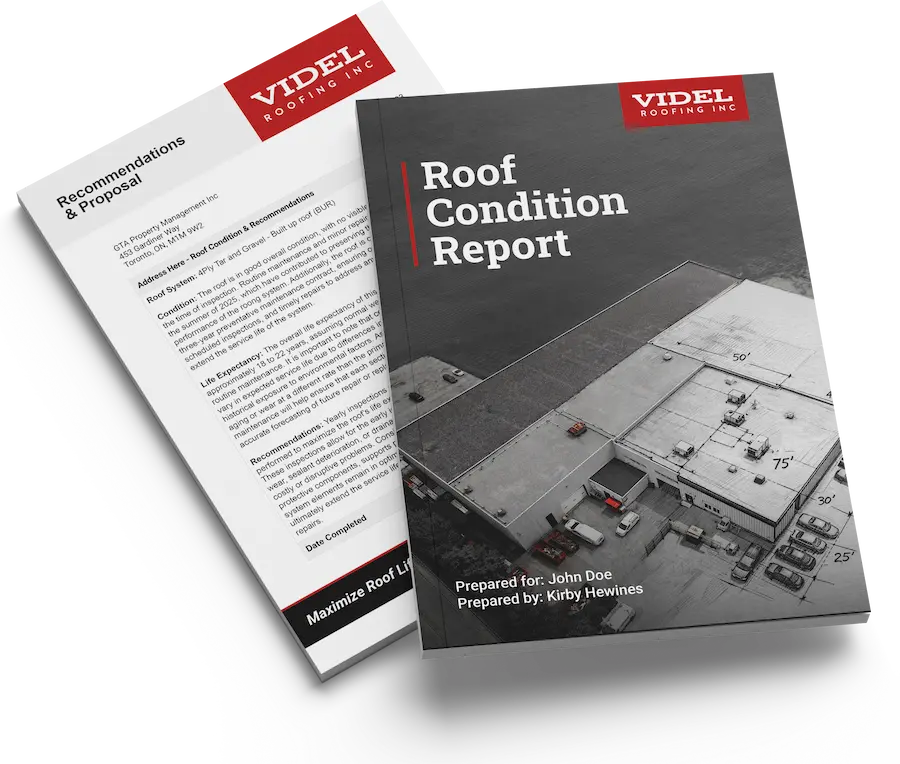
If your warehouse roof is approaching end-of-life, our 50+ point Roof Condition Report documents each item with photos and a recommendation.
Can I install a 2-ply SBS system directly over my old BUR roof?
Generally, no. While “recover” systems exist, they are rarely recommended for aging Toronto warehouses. Trapping moisture between the old BUR and a new SBS membrane leads to massive blistering and premature failure. A full “tear-off” is the only way to inspect the structural steel deck for rust and install a modern tapered insulation system to fix drainage.
Is BUR more expensive than Modified Bitumen?
In terms of raw materials, they are comparable. However, the labour and insurance costs for BUR are typically higher. Finding a crew in the GTA that still operates hot-asphalt kettles is becoming harder, and the fire insurance premiums for “hot work” on-site can drive the total project cost of a BUR system above a self-adhered or cold-applied SBS spec.
Will documented maintenance help with an insurance claim?
Documented inspection and repair records help establish the condition of the roof before a loss event, which supports the distinction between covered sudden damage and excluded wear or neglect. Coverage specifics and documentation requirements vary by carrier and policy, so property managers should confirm expectations directly with their insurer. The Insurance Bureau of Canada publishes general guidance on commercial property coverage.
How often should a warehouse roof be inspected?
Twice a year as a baseline, with a post-storm inspection after major wind, hail, or freezing rain events. Spring inspections catch winter damage. Fall inspections prepare the roof for winter loads. On warehouses with significant RTU loads or older systems, quarterly inspections are reasonable.
What does it cost to replace a flat roof on a Toronto warehouse?
Ontario commercial flat roof replacement costs typically range from $12 to $17 per square foot installed in 2025-2026, depending on the system specified, insulation strategy, and access. A 100,000 square foot warehouse roof replacement falls in the $1.2M to $1.7M range. Recover-over-existing strategies and insulation reuse can reduce that figure significantly when conditions allow.