
Key Takeaways
- A drone roof inspection covers an entire commercial flat roof in two hours or less, with no foot traffic on the membrane and no interior access required.
- A georeferenced overhead map measures square footage and pins every defect to its exact location, giving you documentation your insurer and capital planner can actually use.
- Drone work in Ontario requires a certified RPAS pilot, a registered aircraft, and the right liability insurance to fly over commercial property.
Commercial flat roofs in Ontario often only get looked at when something goes wrong. By the time a tenant calls about a stained ceiling tile, water has usually been tracking through the assembly for months. A drone roof inspection changes the economics of finding problems early, because the cost and disruption of looking are now low enough that there is no excuse to wait.
For property owners and managers responsible for buildings across Toronto and the GTA, the benefits of drone roof inspections makes managing a flat roof easier and more cost-effective.
What a drone roof inspection actually captures
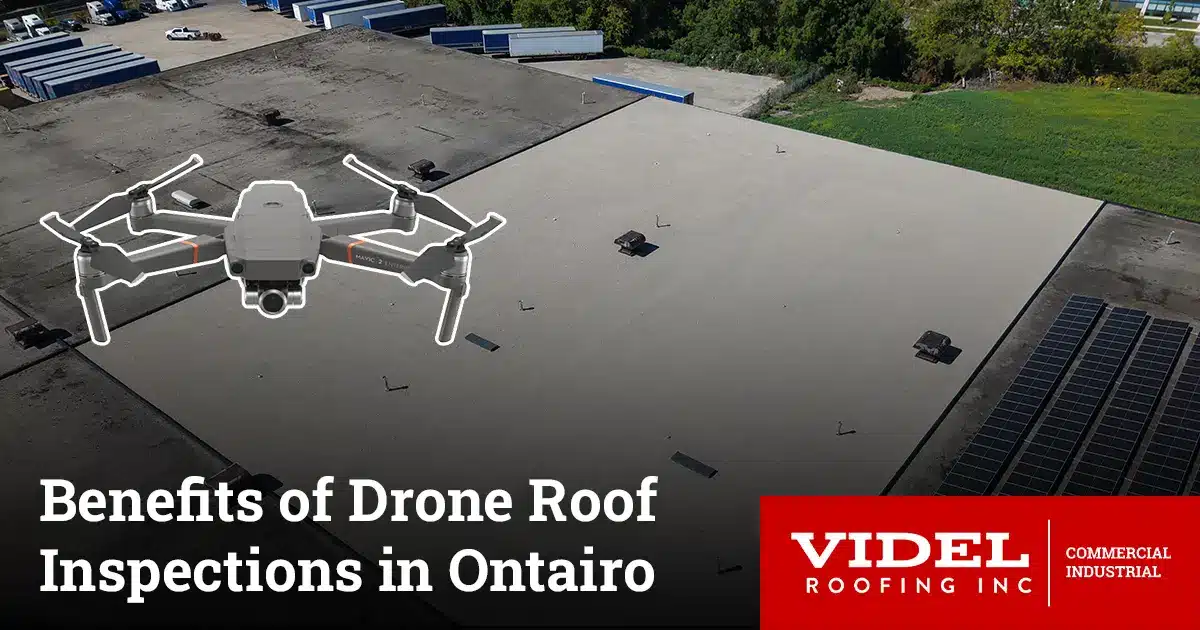
A proper commercial drone inspection is not just a few overhead photos. The deliverable is a complete dataset of the roof captured in a single flight, processed into formats that support repair decisions, capital planning, and insurance documentation.
On our drone roof inspections, we can provide:
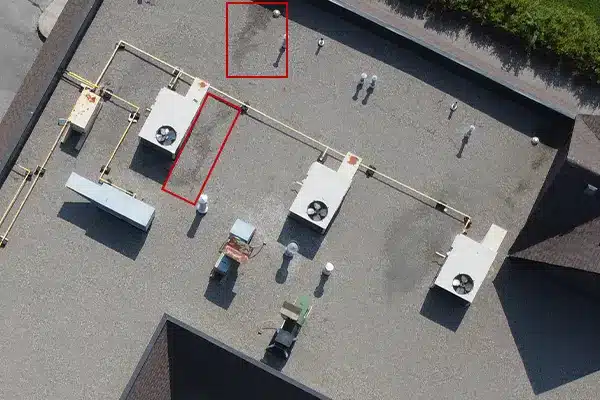
- A georeferenced overhead map stitched from hundreds of overlapping images, accurate enough to measure square footage and mark exact defect locations.
- 4K video of the entire roof, suitable for sharing with stakeholders, contractors, or insurance adjusters who need to see the full picture.
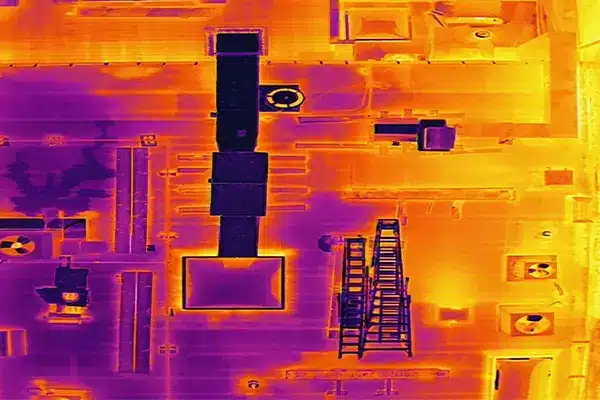
- Infrared thermal imaging that reveals trapped moisture, heat loss, and hidden membrane damage invisible to a standard camera.
- Crystal-clear photos of every square foot, including parapet caps, drain interiors, HVAC curbs, and the topside of every penetration.
- Every issue pinned to its exact location on the overhead map: ponding, blistering, seam separation, membrane damage, flashing failures.
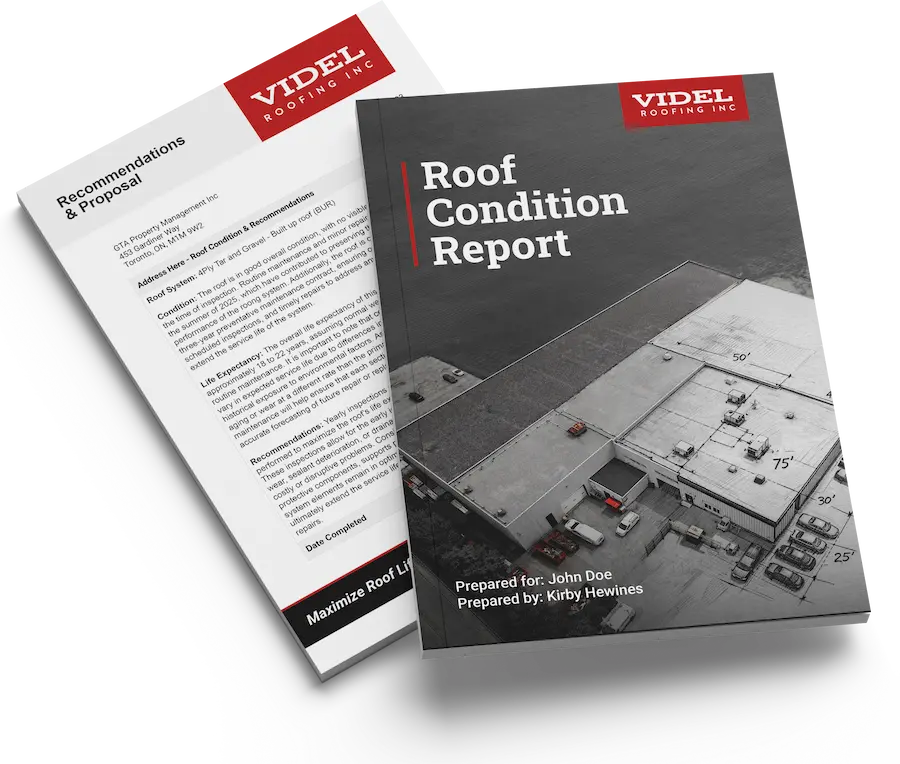
The whole package gets compiled into a written Roof Condition Report with defects tagged, photographed, and prioritized. Owners receive the file within five business days of the flight, and they keep every original photo and video file.
Why drone outperforms a traditional walk on a flat roof
A skilled roofer walking a roof can find most of what is wrong with it. The question is what they cannot find, what takes longer than it should, and what the walk itself costs the building.
Coverage you cannot get on foot
A walk inspection is necessarily a sample. The inspector documents what catches their eye and photographs the defects they choose to record. Two inspectors walking the same roof will produce different reports, because each one is making in-the-moment judgement calls about what matters.
Drone capture removes that variability.
Every square foot is photographed at the same resolution, including areas that are difficult or unsafe to walk: parapet caps, the inside of curbs, the topside of penetrations, and sections near roof edges where a fall arrest setup would be required. The overhead map is the same map every time, so a drone inspection done this year is directly comparable to one done next year.
Infrared imaging finds wet insulation a walk cannot
This is the single biggest technical advantage. Wet insulation does not announce itself on the surface until the membrane has failed, and by then the damage has already spread. Infrared imaging captures heat signatures across the whole roof in one pass. Saturated insulation holds heat differently than dry insulation, so it shows up on the thermal scan as a clearly defined warm or cool zone depending on conditions.
For a building owner deciding whether to repair, replace, or wait, knowing the actual extent of wet insulation changes the answer. Half the roof might be sound. A targeted repair on the wet section could buy years of additional service life and defer a full replacement. Without thermal imaging, that information is invisible.
No foot traffic on the membrane
Every time someone walks a roof for an inspection, an HVAC service call, or a satellite install, there is a chance of damage that does not show up until water finds it months later. Dropped screws and small fasteners get walked into the membrane and create slow punctures. We have collected a fair share of wrenches, screwdrivers, and stray hardware off Ontario rooftops over the years, all of it left behind by someone who thought they had tidied up. A drone flyover finds problems without adding any of that risk to the roof.
Speed without sacrificing detail
A thorough walk on a 50,000 sq ft commercial roof takes less than a few hours, especially with photography and note-taking. The same roof can be flown, photographed, and thermally scanned in under an hour. That speed matters most on multi-building portfolios, where a property manager responsible for ten buildings can have full inspection data on every roof in a single week instead of months.
How long does a commercial drone roof inspection take?
Most single-building inspections take two hours or less on site. The drone flies a programmed grid pattern over the entire roof, capturing visual and infrared imagery in a single flight. We provide georeferenced map, thermal scans, and defect documentation, within a few business days of the flight.
Do you need access to the inside of the building for a drone inspection?
Yes, often. The advantage is infrared thermal imaging. Wet insulation holds heat differently than dry insulation, so saturated zones show up clearly on the thermal scan even when the membrane surface looks fine. A walk inspection can confirm a leak that has already shown up indoors, but a thermal scan can map the full extent of trapped moisture across the assembly before a single tile drops.
Can a drone inspection actually find leaks that a walk inspection cannot?
Documented inspection and repair records help establish the condition of the roof before a loss event, which supports the distinction between covered sudden damage and excluded wear or neglect. Coverage specifics and documentation requirements vary by carrier and policy, so property managers should confirm expectations directly with their insurer. The Insurance Bureau of Canada publishes general guidance on commercial property coverage.
What happens if the weather is bad on the day of the inspection?
We reschedule at no extra cost. Drone flights require safe wind, visibility, and precipitation conditions, and we monitor the forecast in the days leading up to every scheduled inspection. If conditions deteriorate, we move the flight to the next workable window.
Is a drone inspection more expensive than a walk inspection?
Pricing depends on roof size, site complexity, and how many buildings are in scope, so a direct comparison depends on the job. What changes is what you get for the spend: every square foot photographed at the same resolution, infrared imaging, a measurable overhead map, and zero foot traffic on the membrane. For multi-building portfolios or pre-purchase due diligence, drone inspection is almost always more cost-effective per square foot than a comparable walk.
What to look for when hiring a contractor for drone roof inspection
Drone work over commercial property in Ontario is regulated. Three things matter, and any contractor you hire should be able to confirm all of them in writing.
Certified RPAS pilot
Transport Canada requires a Remotely Piloted Aircraft System (RPAS) pilot certificate to operate a drone for commercial purposes. For most commercial roof inspections in populated areas, an Advanced certificate is required. Ask for the certificate.
Registered aircraft
Every drone flown commercially must be registered with Transport Canada. The registration number should be marked on the aircraft. Your contractor should confirm the registration covers the specific drone being used on your job.
Insurance that covers aerial work
Standard contractor liability does not always extend to drone operations. The contractor should carry aviation liability insurance specifically covering RPAS work, and they should be able to name your property as an additional insured if your insurer requires it.
We carry $5M liability insurance across all our commercial work, including drone operations, and our pilots are RPAS-certified through Transport Canada.
A real deliverable, not just photos
A few drone photos in an email is not a drone inspection. The deliverable should include the georeferenced overhead map, the thermal scan, every original photo and video file, and a written Roof Condition Report with defects tagged and prioritized. If a contractor cannot describe what you will receive before the flight, hire someone else.
When drone inspection makes the most sense
Drone inspection works on every flat or low-slope commercial roof: single-ply (TPO, PVC, EPDM), modified bitumen, built-up roofs, and metal. The question is timing.
The cases where it pays for itself fastest:
- Active leak with no obvious source. Thermal imaging traces the moisture path through the assembly, often locating the entry point a walk inspection would take days to find.
- Capital planning for a portfolio. Consistent imaging across every building gives ownership a defensible basis for budgeting and prioritization.
- Pre-purchase or pre-renewal due diligence. A documented baseline before close protects the buyer from inheriting an undisclosed problem.
- Insurance claim documentation. Adjusters work from photographs and records. Drone inspection produces both at the resolution they need.
- Annual or biannual condition monitoring. A repeating inspection produces a year-over-year record that turns reactive maintenance into proactive planning.
For most commercial buildings, the right cadence is one drone inspection every twelve months, with a follow-up flight after any major weather event that could have caused damage.
We offer drone inspection across Ontario with a same-day quote, a two-hour flight window, and full deliverables within five business days. Learn more about our drone roof inspection service, then call (905) 397-1198 or contact us online to book a flight on your building.