
Key Takeaways
- A leak is almost never proof that a roof needs to be replaced. It’s a symptom, and symptoms can usually be treated.
- With a Preventive Roof Maintenance Plan (PRMP), the capital you don’t spend replacing a roof stays available for other projects that grow your property’s asset value.
- Our average PRMP client extends their roof’s life by 3 to 5 years, and some extend it by 15 years or more beyond the original expectation.
We’re keeping this article’s intro short because below is a scenario we see far too often:
- A leak shows up.
- The property manager calls three roofers for help.
- Two of them recommend a full replacement.
- Thirty days later, a six-figure cheque is being cut.
- In reality, the roof still had years of life left.
At Videl Roofing, we focus on preventing a premature roof replacement by maximizing roof life. Keep reading to learn how we do it along with the maintenance strategies we recommend to preserve your capital so it can be used for better things like tenant improvements, acquisitions, or other high-return projects.
Fact: A Leak Doesn’t Mean Your Roof Needs Replacing
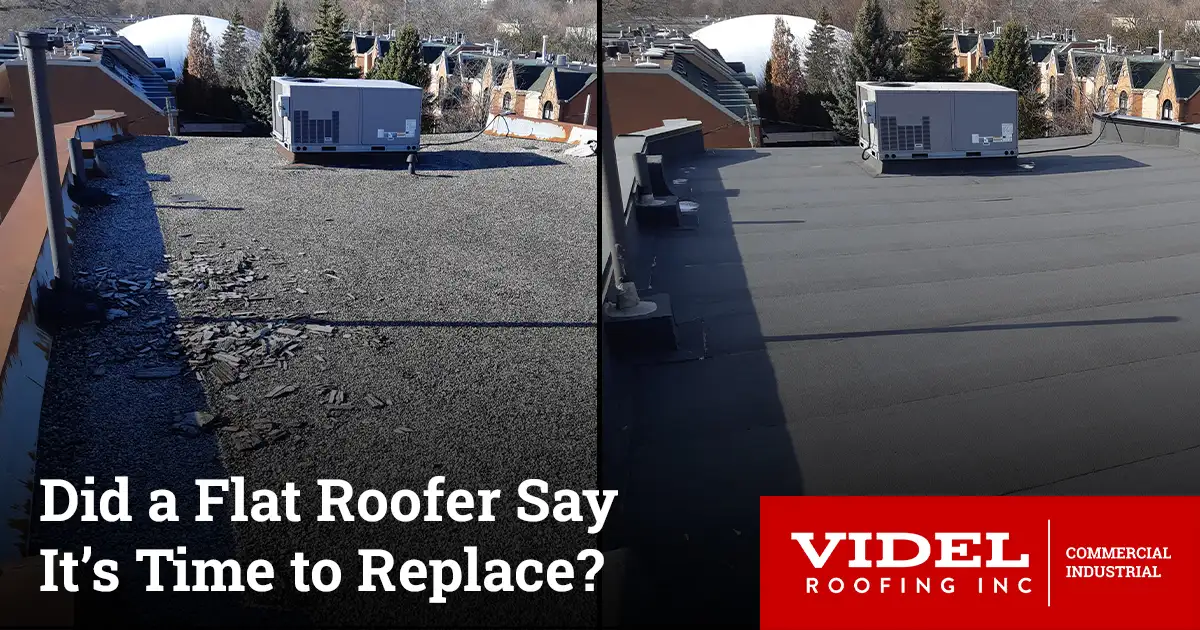
When water shows up inside the building, the first instinct is to assume the worst. A roof that’s leaking must be failing. A roof that’s failing must be replaced. Either assumption can cost you years of usable roof life and hundreds of thousands of dollars.
Leaks happen for lots of reasons such as a clogged drain that backs up water six inches deep in a few hours. Or a pitch pocket can dry out and crack around a penetration that was fine last year. Neither of these are roof failures, all you need might be a smart repair.
Here’s a few more causes of roof leaks that rarely require a full replacement:
- Clogged drains or scuppers, where debris holds water on the roof until it finds a weak spot
- Failed pitch pockets around conduit, pipes, or other penetrations, usually fixable in a single visit
- Cracked flashing at parapets, curbs, or roof edges where expansion and contraction has opened a seam
- Puncture damage from foot traffic, dropped tools, or HVAC service work
- Seam separation on EPDM or TPO roofs where a specific area needs re-welding or re-taping
Are you dealing with a leaky flat roof? The first step would be to schedule a proper inspection. That will help you see whether a repair can be made or your roof is due for a replacement.
Where does “80% of roofs are replaced prematurely” actually come from?
That number gets quoted on roofing websites across Canada and the US, including ours. It’s a shocking figure, so a fair question to ask is whether it’s based on real data or whether it’s a marketing statement that calcified into common knowledge.
We followed the trail and it led us to a US contractor called Fortis Roofing, who published a short piece on the origin of the claim. They found what everyone else finds: the statistic circulates widely, but no one can point to the original study. It’s quoted by associations, manufacturers, and contractors, and the source behind the source is hard to pin down.
So is it true?
We wanted to know for ourselves, especially on Ontario flat roofs, so we ran the numbers ourselves. What we found across 15 commercial and industrial properties in our 2025 field study was clear. Several property owners and building managers came to us specifically because another contractor had recommended a full replacement, and they wanted a second opinion.
In every one of those cases, we saw an opportunity where repairs and targeted maintenance could defer the replacement by years.
What a “Preventative” Maintenance Strategy Looks Like
Deferring a replacement isn’t the same as ignoring a roof. The owners who get 5, 10, or 15 extra years out of their roofs are those with a plan, and that plan has a structure.
Here’s what that structure looks like in practice:
- Twice a year, the roof is inspected on a documented schedule, typically spring and fall plus after any major weather event
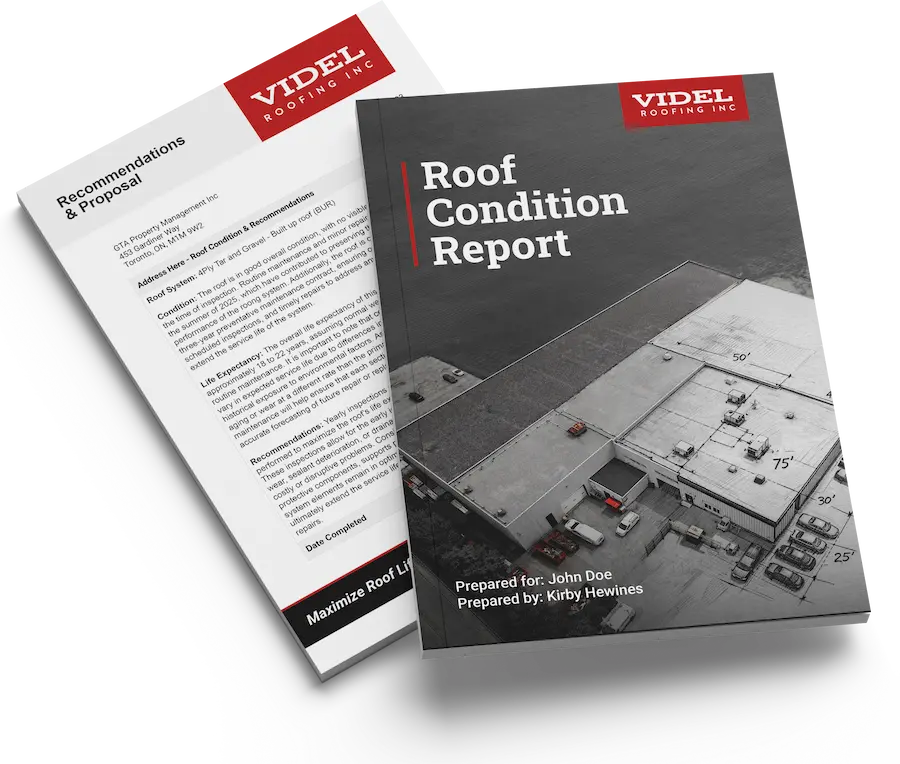
- Every inspection produces a written report with photographs, notes on what changed since the last visit, and recommendations ranked by urgency
- Small problems get fixed before they turn into leaks. A failing pitch pocket in May is a 30-minute repair. The same pitch pocket in November is a tenant complaint
- Capital is forecasted 3 to 5 years in advance, so the eventual replacement lands on your timeline, not the roof’s
- You have a contractor relationship where priority service is built in, so when something does come up between visits, it gets handled fast
That’s the framework behind our Preventative Roof Maintenance Plan (PRMP).
But, what’s the alternative?
Maintenance is one path. Replacement is another. But there’s also a third path which is running a roof to failure or intentionally pushing a roofing system past the point of repair, then replacing only when operations force the issue.
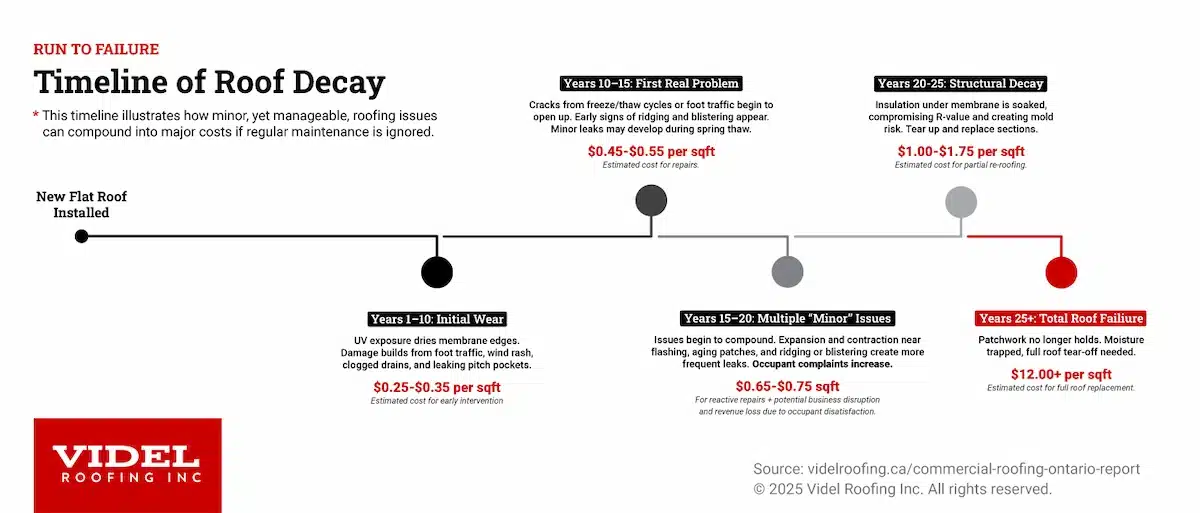
The chart above shows what run to failure looks like when it isn’t planned. Early-intervention costs in the $0.25 to $0.35 per square foot range compound over 25 years into full replacement costs of $12 or more per square foot. That’s the classic failure trajectory, and it’s how most “surprise” replacements actually happen.
But there are circumstances where a “run to failure” strategy, if you can call it that, is the right choice.
When run to failure actually makes sense:
- Your building is in a redevelopment zone and likely to be acquired or demolished within 1 to 3 years
- Your property is at the end of its hold period and being prepared for sale, where a cosmetic patch beats a six-figure capital event the next owner would absorb anyway
- Your roof is already past the point where maintenance will meaningfully extend its life, and you have a documented plan for the replacement when the time comes
We worked with a Mississauga property owner who was in exactly this scenario. Their building sat inside the Lakeview Village redevelopment footprint, a 177-acre master-planned community transforming Mississauga’s eastern waterfront into roughly 16,000 new homes. The owner’s building was in the target redevelopment area to be acquired and demolished within the next few years.
Even though the roof was showing typical signs of aging: cracked flashing, minor leaks, thermal movement near mechanical units. Other contractors were pushing a full replacement at over $415,000.
We looked at the same roof and saw a different solution. Not “does this roof need to be replaced?” but “what can we do to maximize this roof’s life?” What we did was targeted repairs and ongoing maintenance to ensure it would hold through the next 1 to 3 years, long enough for the redevelopment firm to buy out the building and schedule it for demolition.
How Long Can Roof Life Be Extended with Maintenance?
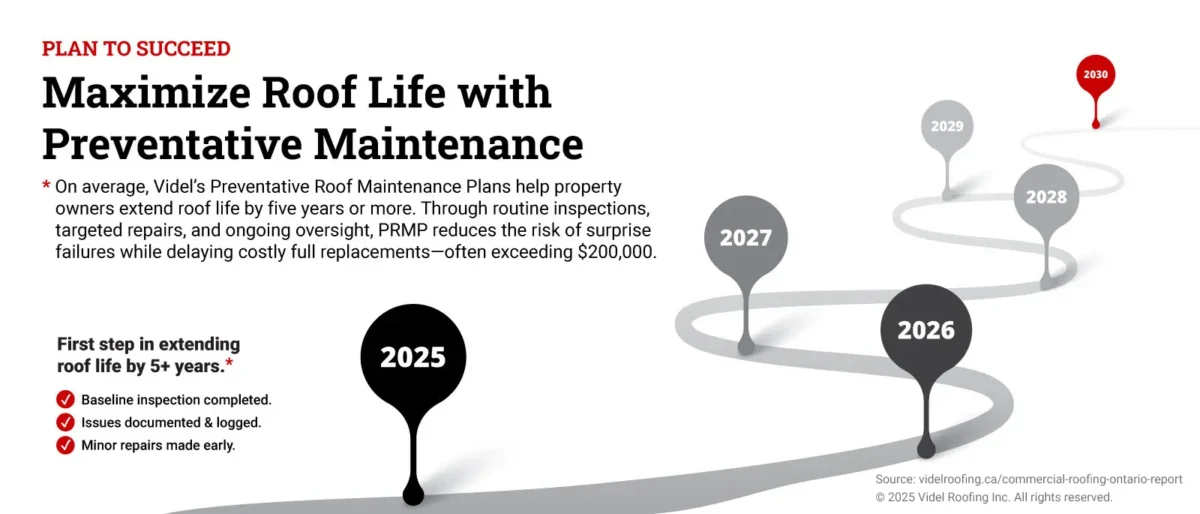
Our PRMP clients average 3 to 5 years of extra roof life, and the outliers go much further. We have clients whose roofs have been extended by 10 or 15 years past their original expected end-of-life, and they’re still going.
Three properties from our 2025 Ontario field data show the range:
- Property #1 in Wasaga Beach: a 21-year-old BUR roof on a 35,000 sq ft multi-tenant plaza. Quoted replacement: $420,000. After one year of PRMP, projected life extension of 3 to 5 years or more. Capital preserved for other priorities.
- Property #6 in St. Catharines: a 23-year-old BUR roof on a 15,000 sq ft industrial garage. Quoted replacement: $210,000. After two years of PRMP, projected life extension of 5 to 7 years or more.
- Property #13 in St. Catharines: a 25-year-old BUR roof on a 180,000 sq ft plaza. A full replacement would have cost $3 million or more. Instead, the owner adopted a sectional replacement strategy, spreading the cost over 10 to 15 years as individual sections reach end of life.
Across just those three properties, the combined deferred or avoided replacement cost is over $3.6 million. Which, the way we see it, allows for capital to remain available for more important projects that grow asset value.
The Problems of Replacing a Flat Roof Too Early
A replacement disrupts your building’s operations
For the one to six weeks the crew is on site, your tenants are living with noise, occasional odour from adhesives or torch-on work, restricted rooftop access, and crane or boom operations in the parking lot. On a multi-tenant property, that disruption can:
- Trigger tenant complaints or lease renegotiations
- Force HVAC maintenance scheduling around the project
- Limit rooftop access for cell carriers, building services, or solar systems
- Require temporary signage and site safety measures that weren’t budgeted
A replacement displaces capital from other work
Every dollar you spend replacing a roof prematurely is a dollar you aren’t spending on tenant improvements, energy upgrades, acquisitions, or debt paydown. In a portfolio context, forcing a roof replacement into the current budget year can:
- Delay tenant fit-outs that generate rent or retention
- Push back HVAC or lighting upgrades with faster paybacks
- Knock out flexibility on an acquisition or refinance window
- Reset depreciation schedules and the tax treatment of the expense
A replacement forecloses options
Once the new roof is on, that decision is locked in. This is why we built a tool to make that trade-off visible. Our Flat Roof ROI Calculator is a simple way to compare the cost of a premature replacement against the cost of extending your roof’s life through maintenance. Plug in your roof size and system type, and the tool shows you what a 3 to 5 year extension is actually worth in dollars.
Most owners who run the numbers see the same thing: the capital preserved by avoiding a premature roof replacement is significant, and it stays available for higher-return projects while the existing roof keeps doing its job.
Get a Quote for Flat Roof Repairs or Replacement
Claim your free Roof Condition Report today.
Can Your Roof’s Replacement Get Deferred?
Not every roof can be extended, and pretending otherwise is how owners end up with emergency repairs and water damage claims. A good contractor will tell you honestly whether your roof is a deferral candidate or whether replacement is genuinely the right next step.
Roofs that usually can be deferred:
- Four-ply BUR roofs with intact insulation, even at 25 or 30 years old
- Single-ply roofs (EPDM, TPO) with isolated leaks at identifiable repair points
- Roofs with drainage problems that can be fixed with tapered insulation retrofits or added drains
- Roofs with documented inspection history showing stable or slowly changing condition year over year
Roofs that usually can’t be deferred:
- Roofs with saturated or crushed insulation across a significant portion of the area
- Roofs with deck damage from corrosion, rot, or structural movement
- Roofs that don’t meet current code on R-value, fire rating, or load
- Roofs on buildings about to be renovated or repositioned, where replacement is part of a larger capital project
The only way to know which category your roof falls into is an on-site inspection with a written condition report.
Can You Trust a Roofing Contractor’s Recommendation?
Plenty of flat roof contractors are good at installing roofs. Fewer are willing to tell you when you don’t need one installed.
When a contractor walks your roof and comes back with a recommendation, the quality of the conversation matters more than the amount in the quote. Before you decide, you’ll want to hear:
- Why they’re recommending what they’re recommending, with photos that back it up
- What the alternatives are, including repair, partial replacement, or maintenance
- What the projected remaining life is under each scenario
- What they would do if this were their building
If you hear a single outcome pushed without options, or a replacement recommended before the roof has been walked. Or if the contractor can’t sit across from you and explain why maintenance won’t solve the problem, contact us and we’ll give you an honest Roof Condition Report.
How often should a commercial flat roof be inspected in Ontario?
Twice a year at minimum: once in spring to assess winter damage, and once in fall to prepare for the coming winter load. Post-storm walks should be added after significant weather events. This cadence reflects the freeze-thaw stresses specific to Ontario’s climate.
What does a commercial roof maintenance program cost?
Cost varies based on roof size, condition, and the scope of the plan. For most mid-size commercial and industrial properties in Ontario, annual maintenance is measured in cents per square foot rather than dollars, and is structured to be a fraction of what a single unplanned repair or accelerated replacement would cost.
Will documented maintenance help with an insurance claim?
Documented inspection and repair records help establish the condition of the roof before a loss event, which supports the distinction between covered sudden damage and excluded wear or neglect. Coverage specifics and documentation requirements vary by carrier and policy, so property managers should confirm expectations directly with their insurer. The Insurance Bureau of Canada publishes general guidance on commercial property coverage.
What is the difference between a roof inspection and a maintenance plan?
An inspection is a one-time documented assessment of current condition. A maintenance plan is an ongoing engagement that includes scheduled inspections, minor repairs performed on-site, and priority response to issues as they develop. The Preventative Roof Maintenance Plan page outlines what each tier includes.
Can I get a one-time roof assessment without a maintenance contract?
Yes. Videl’s free Roof Condition Report is a standalone deliverable requiring no contract. It documents current condition, identifies immediate concerns, and provides a three-to-five-year outlook suitable for budgeting, insurance documentation, or a second opinion.