REDUCE COSTS BY REUSING YOUR INSULATION
Replace Your Flat Roof Without Tearing Out Existing Insulation
Can your insulation be reused? In many cases, yes—and doing so can cut your re-roofing costs by up to two-thirds. Contact us today to see how much you can save by reusing your flat roof’s insulation.
Book your free roof assessment today!
Can Your Insulation Be Reused?
Here’s How Videl Roofing Finds Out
Initial Inspection
We check the roof from above and below, looking for leaks, staining, fastener patterns, and signs of moisture. This tells us whether the insulation might be reusable.
Test Cut (Core Sample)
We pull a 2-inch core to see exactly what’s under the membrane to see: insulation type, thickness, dryness, and whether any contamination is present.
Photo Documented Report
We document everything with photos and a clear report outlining what can be kept, what must be replaced, and where isolated repairs are needed.
Reusing Your Insulation Reduces Landfill Waste + Roof Replacement Costs
CASE STUDY
Core Sample Reveals a Better, More Affordable Re-Roof Job
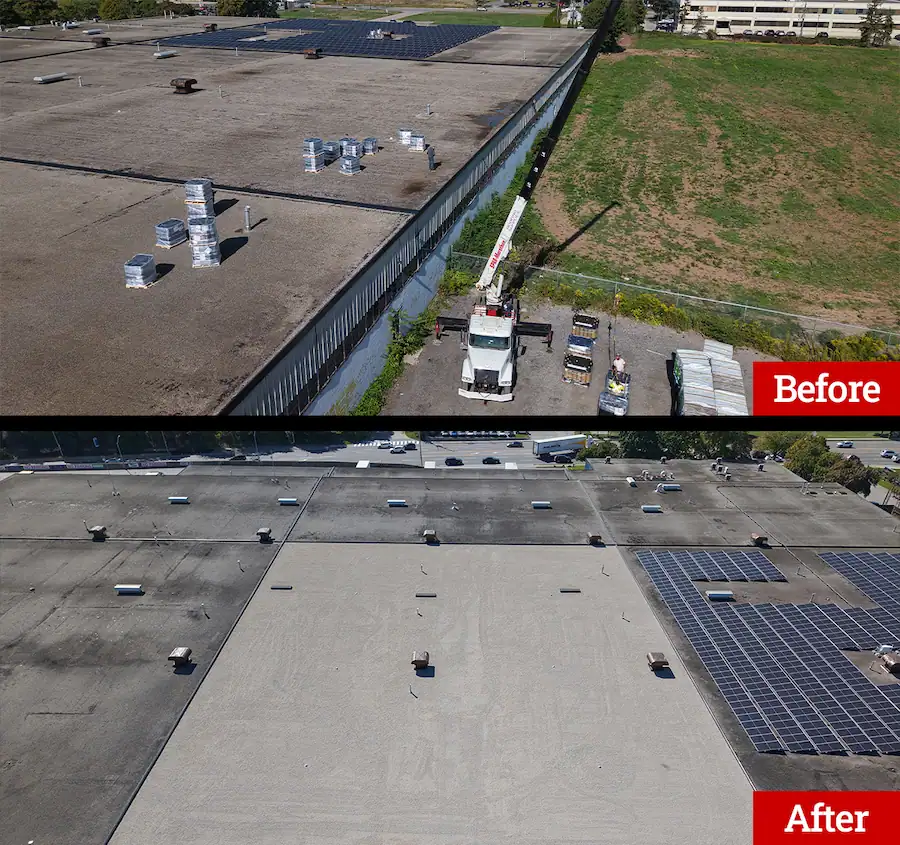
We were called to a commercial building in Burlington where a 2-inch core cut showed the existing insulation was dry, stable, and installed in uniform 4×4 sections. These conditions made the roof a perfect candidate for reuse.
Instead of a full tear-off, we removed only the membrane, replaced a few isolated contaminated pieces, and installed a complete modern roof system over top.
Key outcomes:
“Reusing Insulation Reduces Costs by 75%”
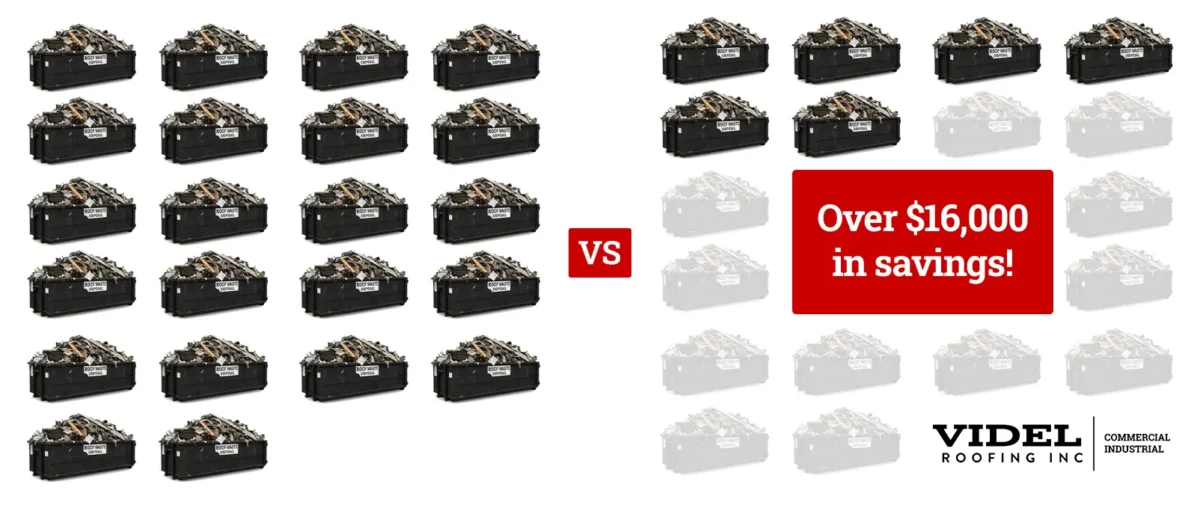
Every 40-yard bin costs around $1,000 to fill and haul away. When we reused the insulation on a building for a major Canadian grocer in Burlington, we reduced waste by roughly 16 bins and cut costs by more than $16,000.
NOT ALL INSULATION IS REUSABLE
Signs Your Insulation Cannot Be Reused
Before we commit to reusing your insulation, we check for the issues that make reuse unsafe or uneconomical. If any of the problems below appear during inspection or core sampling, removing and replacing the affected areas is the best option.
1. Moisture, staining, or dark spots
Indicates the insulation has absorbed water and lost its structural integrity.
2. Soft, spongy, or crumbling
Any area that gives way under pressure, flakes, or tears cannot be reused safely.
3. Mold, odor, or organic growth
Any area that gives way under pressure, flakes, or tears cannot be reused safely.
4. Burnt or chemically damaged
Any area that gives way under pressure, flakes, or tears cannot be reused safely.
Know What’s Under Your Roof
Before You Commit to a Re-Roof
More Ways We Can Protect Your Flat Roof
Whether you need repairs, a full replacement, or long-term maintenance, our team delivers solutions that keep your building dry, efficient, and operating without disruption.


Got a Flat Roof Problem?
FREQUENTLY ASKED QUESTIONS
Flat Roof Insulation
Q1. Can my existing insulation actually be reused during a re-roof?
Yes, but only if it passes inspection. We look for dry, structurally sound insulation that has not absorbed moisture or become contaminated. If the insulation is in good condition and mechanically fastened, it can usually remain in place.
To find out if your flat roof insulation can be reused, book a free assessment!
Q2. How much money can I save by reusing my insulation?
Reusing insulation can significantly reduce disposal, labor, and project time. On some commercial projects, keeping the insulation in place has cut total re-roofing costs by as much as two-thirds. A major part of the savings comes from avoiding dozens of 40-yard disposal bins and the labor required to remove thousands of screws and plates.
Q3. What happens if parts of the insulation are contaminated or damaged?
We only remove the sections that are compromised. Each 4×4 insulation piece is self-contained, so damaged areas can be cut out cleanly and replaced with new material. During the project, we document problem spots with photos and measurements so you know exactly what was removed, what was replaced, and why.
Q4. Will reusing insulation affect the lifespan or performance of my new roof?
No. If the insulation is dry, stable, and firmly fastened to the steel deck, it will continue to perform exactly as intended. Polyiso insulation in particular maintains its R-value for decades and often lasts longer than the roof membrane itself. Reusing it does not compromise the quality or longevity of your new roof system.
Q5. Does reusing insulation reduce disruption for my tenants or operations?
Yes. Removing insulation is extremely noisy and creates dust, debris, and paint flakes that fall into the interior space. By keeping the insulation in place, we avoid all of that. Your business or tenants can continue operating normally because there is no interior demolition and no need for extensive tarping or shutdowns.